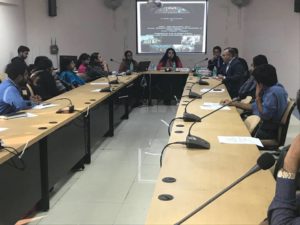
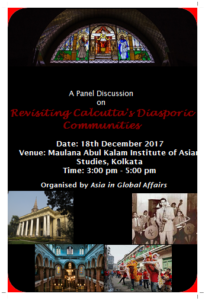
In the contemporary times of glocalization wherein the apparently paradoxical notions of globalization and localization exist concurrently, the world appears to contract as the local community assumes greater importance. In this milieu diasporas play a significant role as they are in essence about place rather than nation and that place is generally a city. Keeping in mind the notion of “city as home in diaspora” where the city in effect embodies a “distinct site of diasporic dwelling, belonging and attachment”, Asia in Global Affairs (AGA) in collaboration with the American Jewish Committee and the Maulana Abul Kalam Azad Institute of Asian Studies had convened a panel discussion on Revisiting Calcutta’s Diasporic Communities.
The objective of the discussion was to comprehend and elaborate upon the notion of “diaspora cities”, in the context of Calcutta. By way of a conversation on specific diasporic communities such as the Chinese, Jews, Armenians, Anglo-Indians, Afghans and Parsis who constituted and contributed distinctively and substantively to Calcutta’s social, cultural, economic and political mosaic, the forum sought to delve into the perceptible and enduring impact of the communities on the city. The purpose of the discussion was to underline the continuities.
The panel discussion began by way of introductory remarks from the representatives of the collaborating institutes. Sandip Sarkar who represented the Maulana Abul Kalam Azad Institute of Asian Studies spoke about the research traditions of the institute and its rich library; Arjun Hardass, the India representative of the American Jewish Committee introduced his organization and commented on diasporas studies in the Jewish context while Anita Sengupta, Director, Asia in Global Affairs observed that the ambit of diaspora studies has expanded over time to look beyond elements of memory, belonging and nostalgia to include a more nuanced analysis of the economic aspects of migration, networks of connectivity and the creation of diasporas.
Raka Banerjee from the Calcutta Research Group spoke on “Landscape of Memory: The Anglo-Indians and the Chinese of Calcutta”. Banerjee contended that the cityscape of Calcutta represented a unique mix of the old and the new. While the “iconic landmarks and neighbourhoods” comprise the city’s landscape they also constitute the very core of its cultural life. Nevertheless, Banerjee observed that flanked by the categories of ‘residents’ and ‘tourists’ there are also those who recognize the city as their ‘home’ though they are settled elsewhere. The paper began with the premise that Calcutta was/is a ‘diaspora city’ to comprehend the experiences and to trace the evolution of the two important diasporic communities of Calcutta that is, the Anglo-Indians and the Chinese. Banerjee observes that the Anglo Indians constitute a minority group which traces its origin to the 16th century when the Europeans particularly the British (East India Company) first came to India and settled in parts of it. They felt culturally closer to the West than to India. As such after 1947 and the Partition, they migrated abroad in three major waves. The Chinese arrived in Kolkata in the late 18th century and today are mainly confined to the Chinatown in Kolkata where about 2,000 of them reside .Hakka Chinese of Kolkata tend to be endogamous but at the same time have integrated into Kolkata society by learning the Bengali language. A wave of migration from India to outside triggered after the 19th century due to fears regarding not being granted Indian citizenship. Banerjee concluded with the reflection that Calcutta is, peculiarly, both the “city of settlement as well as departure”. In the context of the Chinese and the Anglo-Indian communities, the unclear relation with the Indian nation-state is in contrast to their connection with Calcutta as “home”. Thus while both the communities consider Calcutta as “home” however do not essentially consider India as the “homeland”, thus extending the notion of Calcutta as a “diaspora city”. In the words of the author, “The temporality and spatiality of the city consisting of its monuments, memorials, street names, buildings and associated cultural rituals create for both communities a ‘landscape of memory’”. To put it differently, the diaspora community’s character is as much fashioned by the cityscape, as the city’s personality has been molded by its diverse diaspora.
Somdatta Chakraborty also from the Calcutta Research Group, presented a paper on “The city and her people: Afghans and Parsis and their trajectories of existence in Calcutta, present and past”. Chakraborty began by characterizing Calcutta as a “confluence city” rather than a diaspora city keeping in mind its distinctive, cosmopolitan fabric encompassing diverse ethnic communities who came to the city either to visit, trade or settle down. Chakraborty traced the origins of the Afghans in Calcutta and then moves on to narrate the bond between Rabindranath Tagore and the community which has been entrenched in the form of his short story, entitled, Kabuliwala. Though popularly referred to as the “Kabuliwallahs” most members of the Afghan diaspora in Calcutta have by and large not set foot in Kabul in their entire lifetime. A 5000 strong community, the Afghans of Calcutta are predominantly money lenders, who have tried to retain and preserve their distinctive culture, celebrating their religious and cultural festivals in their distinctive style. Chakraborty then elaborates upon Calcutta’s Parsi community who were originally from Bombay and have played a significant role in the nation building process. The Parsi community in Calcutta dates back to the 18th century. Like the Afghans the Parsis also share a Bengali connect through the works of Tagore. Chakraborty concludes with the observation that though landmarks such as the Parsi fire temples serve as a historical signpost, the scarcity of job opportunities led the Parsis to migrate abroad, yet the miniscule Parsi community in Kolkata is not entirely dormant as they try to keep their cultural identity and historical legacy alive by way of exhibitions and similar cultural activities.
Anurabha Patra, a journalist by profession who has covered the Armenians in Calcutta and elsewhere spoke about the Armenians in Calcutta. Patra observed that the Armenians are predominantly a trading community who usually don’t settle down permanently but instead earn and move out. Patra went on to comment on the age old economic and cultural connect of the Armenians with India and that their presence has enriched India in several ways. A handful of around 150 still remain. Patra commented that the British and Armenians worked together until India’s independence, after which the Armenians continued to stay in Kolkata due to their heavy investment in the real estate business. The best known Armenian institution in India is the Armenian College and Philanthropic Academy, better known as the Armenian College, in Kolkata, funded by endowments and donations. There are presently around 125 children studying there from the Republic of Armenia, Iran and Iraq and the local Armenian population. Kolkata has been a Cultural Centre for the Armenians. Professionally speaking the Armenian community has rendered invaluable service in the field of medicine and associated charitable endeavours. Patra concluded by stating that the first modern Armenian history was written in the city and its historical and religious monuments continue to be preserved in the city and its fringes. Kolkata has played an important role in Armenian nationalism and is also the origin of the classical and modern Armenian language.
Navras Aafreedi from Presidency University teaches two unique courses, one which deals with Holocaust Studies and the other with minority communities of foreign origin in India. Responding to a statement made by the moderator of the session that core issue in studying the diasporic communities in Kolkata lies in the words of Edward Said, by replacing “the absence by a presence”, Aafreedi commented that as far as the minorities and micro-minorities are concerned, in order to replace their absence by presence it is necessary to give them their due in the form of recognition, by studying these minority groups and making them a part of the regular curriculum. In course of his presentation Aafreedi remarked that the Anglo-Indian community for instance is not one of foreign origin but a “hybrid community”. Aafreedi observed that that in contemporary times when minorities feel that they are under constant siege, it is imperative to initiate minority studies. However, he rued the fact that it has been observed that while conducting minority studies, great consideration is given to their numerical strength. Communities which are insignificant in number fail to get any recognition in academia. Thus while disciplines like Islamic Studies have been given their due recognition, academic disciplines such as Jewish Studies do not feature in Indian Universities due to the state of international and domestic politics which has created an antagonism against Israel. Aafreedi argued that Jewish studies is a much more extensive area of academics than Israeli Studies and should be given its due. Aafreedi went on to elaborate upon the various Jewish groups in India and their contribution towards the economy, art and culture.
The panel discussion was chaired by Priya Singh, Associate Director, Asia in Global Affairs. She pointed out that the emphasis should be on “people” rather than landmarks in the study of the diasporic communities in Kolkata with the concomitant need to substitute the “absence with presence”. The diasporic communities of Calcutta that so beautifully enriched its diverse cultural mosaic were in themselves a heterogeneous category with multiple linkages with each other adding to the city’s plural character.