FROM AWAKENING TO ASHES: THE SACRED GHATS OF VARANASI AND THEIR ETERNAL LEGACY
Posted on : July 7, 2025Author : Lahari Bandyopadhyay
Varanasi is one of the oldest cities in the world located in the state of Uttar Pradesh. The city was first named as Kashi. According to Hindu mythology, Lord Shiva created this city to live amidst humans and according to historians, the civilization in Varanasi was started by Aryans during the Ganges Valley civilization even before 2000 BC. By the end of 2nd century BC, Varanasi was one of the thriving and wealthy regions of the country. In 5thcentury BC, Lord Buddha gave his first sermon, just 10 km away from Varanasi, in Sarnath and introduced the new religion, Buddhism. Adi Shankaracharya made Shiva worship an official Varanasi sect in the 8th century. The city is well-known for its temples, including the Kashi Vishwanath Temple, Annapurna Temple, Kal Bhairav, Sankat Mochan etc. In Varanasi, Tulsidas composed his epic in the Awadhi language, the Ramcharitmanas, which is a reworking of the Sanskrit Ramayana by the Bhakti movement. Kabir and Ravidas were among the other prominent members of the Bhakti movement who were born here. In 635 AD, Hsuan Tsang, a Chinese traveller, visited Kashi. Rajput aristocrats working for Akbar, the Mughal emperor, funded the construction of Hindu temples in the city in the 16th century using an architectural style common to the entire empire.The city has also been a cultural and educational hub in Northern India with the Banaras gharana form of Hindustani classical music being developed there. The city was linked to Ustad Bismillah Khan and MunsiPremchand in the 20th century. In 1791, Benares Sanskrit College, India’s oldest Sanskrit college, was established. Central Hindu College was established by Annie Besant in 1898, and in 1916, Banaras Hindu University was founded by her and Madan Mohan Malviya together. In reaction to Mahatma Gandhi’s non-cooperation movement, Kashi Vidyapith was founded in 1921. As part of the traditional etymology, the city is located on the north shores of the Ganges, bounded by two tributaries, “Varuna” and “Assi”, thus forming the name “Varanasi”. The name “Kashi” has been referred in Mahabharata from Sanskrit verbal root “kaś”which means”to shine”, making Varanasi known as “City of Light”.
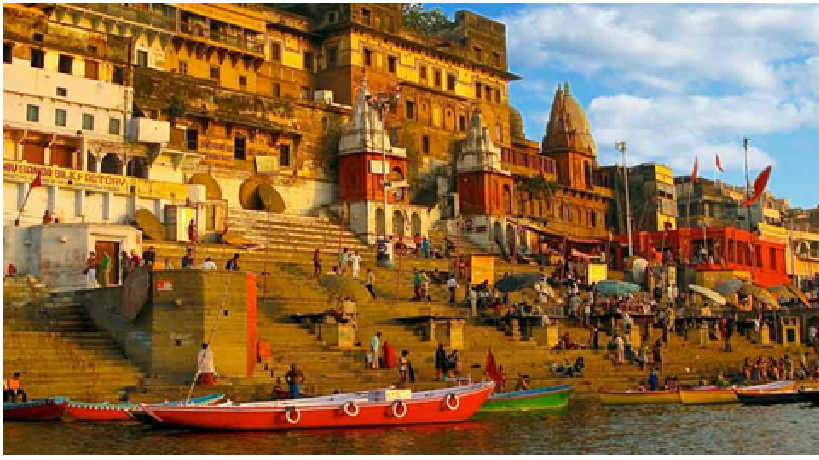
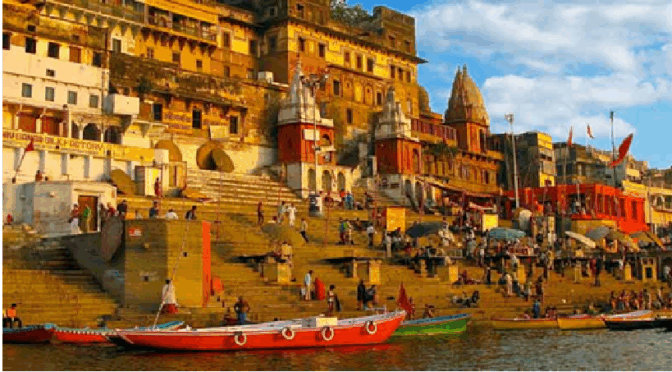
The city is well-known across the world for its numerous ghats, which are stairs that descend the steep riverbank to the water and are used by pilgrims for rituals. There are 84 ghats in the city. The Marathas reconstructed the majority of Varanasi’s ghats in the 18th century. Maharajas of Benares, Marathas, Shindes (Scindias), Holkars, Bhonsles, and Peshwes (Peshwas) are the current patrons of the ghats. While some ghats have private histories and uses, many are connected to legends or folklore. According to the puranic sources, there are five key ghats on the riverfront which are important because of their association with a defining feature of the holy city of Kashi: Assi Ghat, Dashashwamedh Ghat, Manikarnika Ghat, Panchaganga Ghatand Adi Keshav Ghat.
- Assi Ghatis one of the largest ghats in Varanasi. The name is derived from the river Assi, that marks the traditional southern boundary of the city. AsisangameshwarTemple at the ghat finds mention in the Kashi Khand of Skandmahapuran, where Assi is described as “Saimbeda Tirtha,” meaning that the person who bathes in this holy river receives the punya of all other notable thirthas. Assi Ghat is described, in some of the Puranas, as the place where the goddess Durga defeated two asuras, Shumba-Nishumba and threw her sword in the river. The ghat hosts Subah-e-Banaras, a cultural and spiritual event, every morning.
- Dashashwamedh Ghat is the most popular of all the ghats and is located close to the Kashi Vishwanath Temple. The ghat is connected to two Hindu legends. One says that Brahma made it to welcome Shiva. In another one, Brahma offered 10 Ashwamedha (horses from ashwamedh yagna) sacrifices here, and hence the name Dash-Ashwamedh. The present ghat was built in the year 1748 by PeshwaBalaji Baji Rao. A few decades later, in 1774, Ahilyabai Holkar, the Queen of Indore, rebuilt the ghat. Ganga aarti is performed at this ghat every evening in dedication to Shiva, the goddess Ganga, Surya, Agni, as well as the whole universe and is attained by thousands of tourists every day.
- Manikarnika Ghat is one of the two main cremation sites besides the Harishchandra ghat. It is one of the oldest ghats in Varanasi as mentioned in a Gupta inscription of 5th century CE. There are two legends which are associated with the Manikarnika Ghat.According to one, after Daksha yagna and Sati’s self-immolation, Shiva took Sati’s burning body to the Himalaya. On seeing the ceaseless anger and sorrow of Shiva, Vishnu sent his chakra and the body was split into 51 pieces, which then dropped on the “Shaktipeeth” of the earth. Manikarnika Ghat is where Sati’s ear jewellery fell. The second mythology states that Parvati concealed her earrings here in order to prevent Shiva from navigating the globe. On the banks of the Ganges, she told him, she had misplaced the earrings. According to this tradition, whenever a body is cremated at the Manikarnika Ghat, Shiva asks the spirit if it has seen Parvati’s earrings or not. Hinduism views death as the beginning of a new life filled with sufferings brought on by one’s karma. It is believed that when a person is cremated here, their soul achieves moksha and breaks the cycle of rebirth.
- Panchaganga Ghat is a famous ghat that is named after the five holy rivers that are said to confluence at this spot: Ganga, Saraswati, Dhupapapa, Yamuna, and Kirana. The others are believed to have vanished or changed into ethereal forms, leaving only the Ganga visible today. It is believed to have been constructed during the Mahabharata era by Sage Bhrigu. Because of the magnificent golden temple of Vishnu located at the Ghat, it was formerly known as Bindumadhav Ghat. In 1673, Aurangzeb demolished the temple and it was transformed into the Alamgir Mosque. The current temple has been restored on the mosque’s right side.
- Adi Keshava Ghat is now known as Raj Ghat. The Mauryan and Gahadavala inscriptions mark Rajghat as one of the most sacred spots in Varanasi. It was the busiest ghat till 12th century CE. It was also famous for pinddaan and asthi-visarjan
Besides these, some of the other major ghats are Tulsi ghat, Jain ghat, Harishchandra ghat, Darbhanga ghat, Ahilyabai ghat, Lalita ghat, Chet Singh ghatetc, all of which have major mythological and historical significance.
The ghats are a witness of the Dev Deepawali, the festival of Kartik Purnima, which takes place in the month of November. Mythologically, the gods are believed to descend on Earth to bathe in the Ganges on this day. The steps of all the ghats on the riverfront of the Ganga are lit with more than a million earthen lamps. Magnificent laser and fire cracker shows are a new attraction since the past few years.
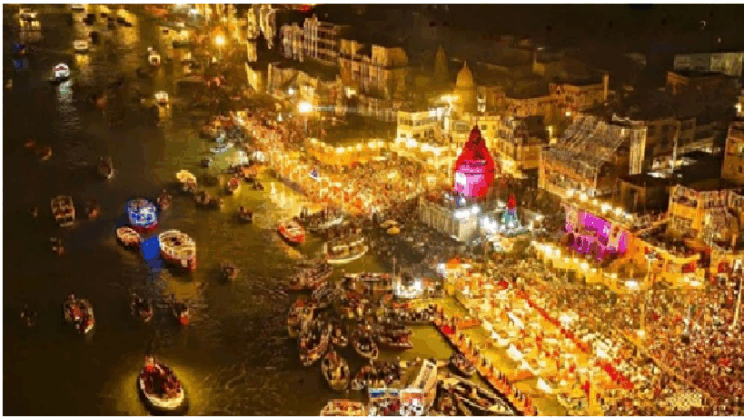
Dev Deepavali celebration, 2022, https://www.youtube.com/watch?v=xNtOBESJ14A
Varanasi and its ghats have been a favourite hub for several film industries in many languages, for instance, Aparajito (1956), Hotel Salvation (2016), Raanjhanaa (2013), Mohalla Assi (2018), Chokher Bali (2003), Masaan (2015), The Last Colour (2019), and too many other movies gets drawn to its raw, unfiltered beauty, the quiet melancholy and the vibrant frames. Therefore, when Mark Twain writes “Older than history, older than tradition, older even than legend” it echoes none other than the timelessness of Varanasi — a city that has not only survived but thrived across millennia, with her ghats whispering hymns that are older than empires and where death itself bows, not in fear, but in reverence.
References:
- Ghats in Varanasi. Wikipedia. https://en.wikipedia.org/wiki/Ghats_in_Varanasi
- Culture of Varanasi. Travelogy India. https://www.travelogyindia.com/varanasi/culture-of-varanasi.html
- Assi Ghat. Wikipedia. https://en.wikipedia.org/wiki/Assi_Ghat
- Pandey, V. (2025). Varanasi: A tapestry of time, belief, and coexistence. Explore Banaras. https://www.explorebanaras.in/2025/05/20/varanasi-a-tapestry-of-time-belief-and-coexistence/
- Rastogi, S. (2018). Rajghat – older than Banaras? Varanasi Guru. https://www.varanasiguru.com/rajghat/
- Wikipedia. https://en.wikipedia.org/wiki/Varanasi
- Ghats in Varanasi. Wikiwand. https://www.wikiwand.com/en/articles/Ghats_in_Varanasi
- Rastogi, S. (2023). Panchganga Ghat – confluence of 5 rivers. Varanasi Guru. https://www.varanasiguru.com/panchganga-ghat/
Lahari Bandyopadhyay
Intern, Asia in Global Affairs
The views and opinions expressed in this book review are those of the author and do not necessarily reflect the official policy or position of Asia in Global Affairs. The review is intended for academic and informational purposes only. It is not an endorsement of any particular viewpoint, nor is it intended to malign any individual, group, organization, company, or government