The Paradoxes of the Great Indian Middle-Class
Posted on : June 14, 2025Author : Allen David Simon
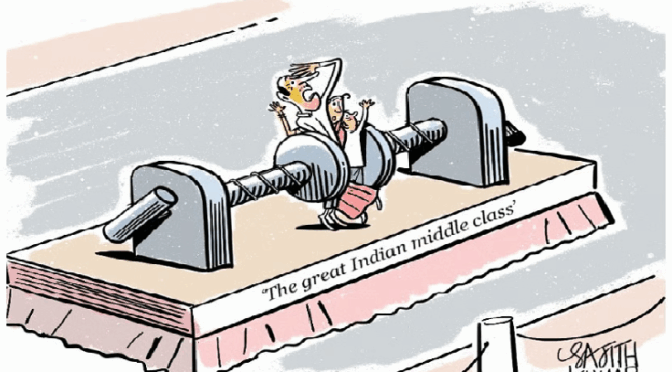
Image courtesy of Kumar, S. (2025, January 27). DH Toon: The middle class conundrum. Deccan Herald. https://www.deccanherald.com/opinion/cartoon/dh-toon-the-middle-class-conundrum-3374098
The “notoriously difficult” to define or demarcate Indian middleclass maintains its social distinction through social and cultural attributes rather than proprietary over the means of production. The middle-class elites emerged to play a “strategic role” in conceptualization of the democratic framework and modernizing efforts in post-colonial India.
The Middle-Classes
Forming the crux of the civil society, the middle-classes are a heterogenous social group of three clear strata. A continuity between the capitalist class and the middle classes – the “petite bourgeois” of small-business that form the “local capital” in the informal economy. The “dominant faction” of english-educated, professionals and intellectuals who occupy recognized positions of authority in various fields. Lastly, the “mass faction” of white-collared, salaried workers who are active consumers of middle-class intellectual ideologies. The Nehruvian command economy provided venue for the expansion of the middle-class niche while frustrating ambitions of other social groups. Thus the “intermediate class” consolidated its chokehold over the Indian economy through diverse “particularistic tactics” of lobbying the political circuits to their favor.
It has been the pre-eminent faction that determines the general direction of Indian politics – articulating the hegemony (Sallach, 1974) of the ruling bloc of Indian society and acting as a liaison to upset the “mutual incomprehensiveness” between the elites and the masses. The middle-class receives active support from the bourgeois in brandishing the Gandhian mode of class conciliation (Weber, 2001) to suppress opposition to perpetuate class-hierarchy. Moreover, the ‘ambivalent’ attitude of the middle-class towards popular processes is reflected in its efforts to curtail democracy from attempts to empower the lower-classes. Yet, its failure to create a common political language or develop common beliefs has done little to deter middle-class primacy. (Harris, 2010, pg.144-147)
The New Middle-Class
While the ‘old’ middle-class was too was a site of political and economic debate, there has been a lack of consensus over qualifying variables for the middle class. The middle class by itself is an ‘aspirational’ category, having a positive socio-cultural and parallel economic considerations. The middle class, since the Aristotelian days been considered the democratic class as well as an ethical category. The Indian middle-class is viewed as the class valuing education and hard work for mobility, seeking security in the formal (generally public) sector, self-made and saving creating, socially responsible class, value and family-oriented, the new middle class has a distinct character.
The new middle-class is composed of those sections of society who were able to benefit for the post-1990 liberalization of the Indian economy. They are decisively urban, confined to metropolitan centers, and gaining from the boom in the private sector from western outsourced technical jobs, Multinational Corporations (specifically in the IT, biotechnology, pharmaceuticals, etc.) and the startup ecosystem. Economic opportunities have upliftment has resulted in higher standard of living. There has been no shift between the social makeup between the old and the new, it is a generational shift, not a class shift or a cultural one. The new middle-class is not a monolith, but a more composite class in terms of religion, caste, ethnicity, and linguistics with social and geographic mobility. (Harris, 2010, pg.149-151)
The new middle-class embraces a global (over)consumerist pattern, with a distinct break from the savings culture of the ‘old’ middle-class into a more atomistic lifestyle. The shift in the social standard for disposable income, from savings to overspending. Yet the uncertainties of the labor market create a new pattern of hassle culture, smoke room decisions, competition, moonlighting, a constant FOMO that pushes for upskilling (especially education in AI, marketing, management, etc.) or a nightlife (else face social exclusion).
The Middle-Class Spiel
Journalist John Harris in his ‘Class and Politics’ in The Companion to Politics in India, edited by Niraja Gopal Jayal and Pratap Bhanu (2010) proceeds to highlight the emergence of the neo-middle class as a product of the ‘new-politics’ – a distinctive combination of economic liberalism and social illiberalism. While economic liberalization 1991 catapulted middle-class significance in capital development, the second-democratic upsurge necessitated re-alignment with Hindu nationalism to defend class interests from popular aspirations. Middle-class through civil society bodies reinforce middle-class superiority, despite its apparent withdrawal from electoral politics. Another distinct departure of the ‘old,’ which had been an agnostic in politics, the new middle-class has steadily moved towards a more appreciation for the new-right. Class has moved far from the simplistic notion of fundamental opposition between capital and labor: the globalized free-market has forwarded class based on neighborhood rather than occupation or income. The hegemonic design of the closed cosmopolitan-urban centers of opportunity cater to the capitalist and middle-classes over the excluded “informal proletariat.”
The Politics of the Middle-Class
In Amit Ray’s “The Enigma of the ‘Indian Model’ of Development” (2015), he noted on the lop-sided economic growth, with rapid expansion of high-end knowledge-intensive/service sector, parallel to the neglect of low-end labor-intensiveindustry, resulting in the inequality to the extreme:“a prescription for political volatility” and an unsustainable development model. Leena Fernandez in “Restructuring the New Middle Class in Liberalizing India” in the Comparative Studies of South Asia, Africa and the Middle East, Volume 20 (2000) may have an answer to provide.She critiques the emergence of new middle class to be a “discursive image,” created by the direct interests of the state in two ways.
As the globalized culture has brought about the ascendence of the cosmopolitan culture, this lifestyle has become the aspiration. The state finds this ‘aspiration dream’ to coincide with the ‘New India,’ provide a justification for the liberalization of the 1990s, convincing the public that mobility was earned solely through merit. This conscience is created through the media and advertisement agency illustrating the proof of an emergent economy, and those who fail to prosper, are mismatches for the labor market, and not a failure of opportunity. Further, the state uses this aspirant class to pitch as the consumer market, drawing the foreign investments and entrepreneurial innovation to cater to this class.
The Indian middle-class – the old and new – is beset by paradoxes of being: both educated-intellectuals and “conducive to autocracy,” inclusive of all cultural identities but exclusive to a social status, opinionated yet apathetic. Despite the absence of a majority middle-class constituency in the Indian society, it occupies hegemonic function in the Indian polity: in which the middle-class is both the product and the producer of the Gramscian hegemony of the Indian society.
References
- Glassman, R. M. (1997). The new middle class as an Aristotelian base for democracy. In The new middle class and democracy in global perspective, 105-123. Palgrave Macmillan. https://doi.org/10.1057/9780230371880_5
- Fernandes, L. (2000). Restructuring the new middle class in liberalizing India. Comparative Studies of South Asia, Africa and the Middle East, 20(1-2), 88–112. https://doi.org/10.1215/1089201X-20-1-2-88
- Harris, J. (2010). Class and politics. In N. G. Jayal & P. B. Mehta (Eds.), The Oxford companion to politics in India, 139-153. Oxford University Press.
- Ray, A. S. (2016). The enigma of the “Indian model” of development. In Rethinking development strategies after the financial crisis (pp. 31–40). https://doi.org/10.18356/d822fc14-en
- Krishnan, S., & Hatekar, N. (2017). Rise of the new middle class in India and its changing structure. Economic and Political Weekly, 52(22), 40–48.https://www.epw.in/journal/2017/22/special-articles/rise-new-middle-class-india-and-its-changing-structure.html
- Sallach, D. L. (1974). Class Domination and Ideological Hegemony. The Sociological Quarterly, 15(1), 38–50. http://www.jstor.org/stable/4105619
- Weber, T. (2001). Gandhian philosophy, conflict resolution theory and practical approaches to negotiation. Journal of Peace Research, 38(4), 493–513. https://doi.org/10.1177/0022343301038004006
Allen David Simon
Intern, Asia in Global Affairs
The views and opinions expressed in this book review are those of the author and do not necessarily reflect the official policy or position of Asia in Global Affairs. The review is intended for academic and informational purposes only. It is not an endorsement of any particular viewpoint, nor is it intended to malign any individual, group, organization, company, or government