Book Review Gender: In World Perspective
Posted on : March 9, 2026Author : Shilpi Singh
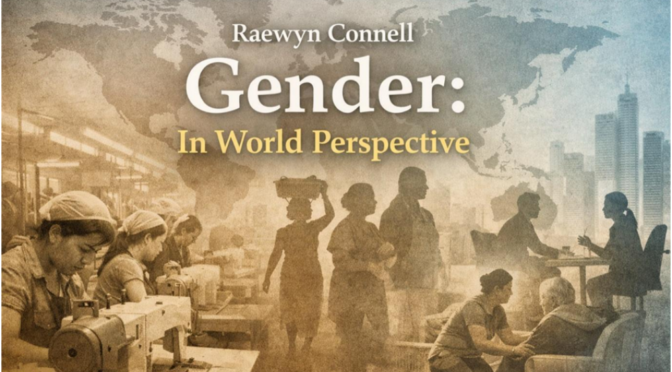
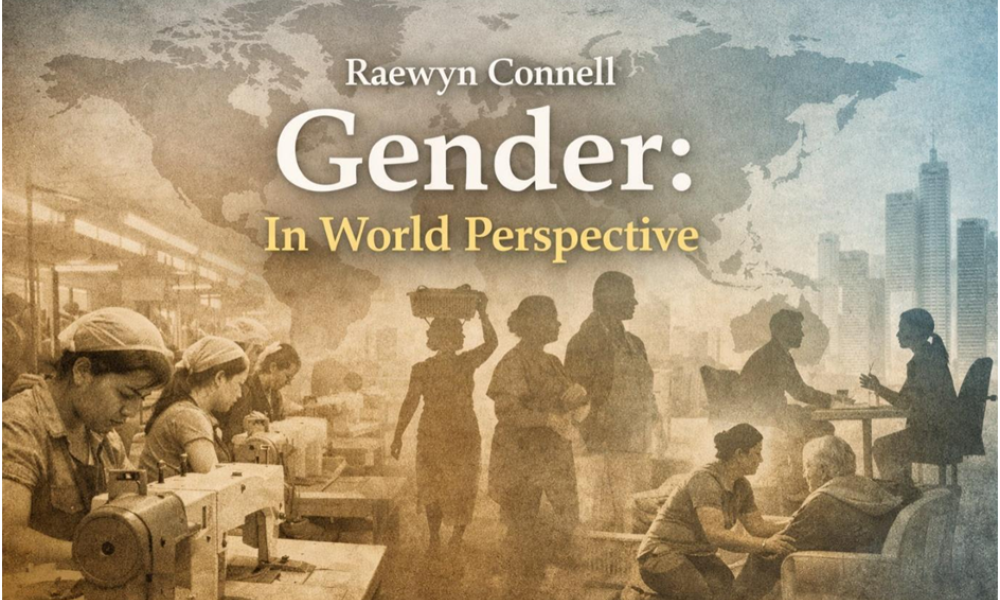
Raewyn Connell
Gender: In World Perspective. Second Edition.
Cambridge: Polity Press, 2009.
Raewyn Connell’s Gender: In World Perspective examines gender relations within historical, colonial, and global economic contexts. The book situates gender inequality within broader systems of power, labour, and institutional structures across societies. By analysing gender arrangements at both global and local levels, Connell highlights how gender hierarchies are produced, sustained, and sometimes challenged in contemporary social systems.
Connell, throughout the text, evaluates gender by exploring many instances of gender patterns in colonial system and the globalized world economy. These are not just random facts, but are a part of ‘gender order’ of the society. She describes gender order as the overall gender arrangement; within this we also need to take notice of gender inequalities revealed across domains, over time. Gender disparity or inequality is described as a non-uniform, subjective, contextual, time variant phenomenon, since reasoning in each domain or sector of society varies. Its direct implication on gender disparity is that gradual change in one sector can spread to other sectors (and in a more optimistic view, lead to change in world gender order). The sustenance of such ‘discriminating’ gender order is owing to advantage that men as a group receive from maintaining it, which Connell termed as the ‘patriarchal dividend’. Patriarchal dividend takes the form of money income, authority, respect, service, safety, housing, access to institutional power, emotional support, and control over one’s own life. It may be accessed by women also, those who have wealthy spouse.
This can be instantiated by creation of international sex trade destinations in Thailand, Philippines by local elites, arms trafficking with manufacturing units set up in the metropole, local elites as an accomplice for exploitation of women labour.
In the grass root level of gender relations, there is a belief of ‘power’ of father over wives and daughter. This corresponds to the ‘breadwinner/ housewife’ narrative that spread during the period of colonialism. The subjugation of indigenous people by imperial powers lead to a change in customs, culture of people, this effect was also present other way around but weaker. The men from metropole, colonizing forces created ‘fused race/gender hierarchy’. Even in the post-colonial era, there is a deeply misogynist, patriarchal and homophobic regime. The results ranged from internal war in central and western Africa to recognition of hegemonic masculinity in India. Connell emphasises on the need of democratic agenda to oppose this inherited regime in the Global South.
The key neoliberal policies of deregulation of markets, reduction in taxes and government services allowed transnational corporations and global markets exploit the weak industrial position of many women workers due to their motive of search for cheap labour. There is a strong presence of gender division of labour, and glass ceiling for the minority men and women that prevents them from acquiring top managerial position. Additionally, the products are gendered, and gender symbolism is a by-product which in turn, creates gender differentiation. Connell states, “Corporations are gendered institutions, with a gendered history”. In modern world also instances of gender division exist, though there is an overall movement of women towards financial freedom. The representation in trade unions’ leadership as well as membership has been predominantly men. From ‘women labour force participation rate’ standpoint, the Global South has high variation, with many parts of South Asia having 1/4th of the rate of men, Arab states having ½ of the same and parts of West Africa having an unusually high rates of labour force participation rate of women.
Women have been brought into the labour force, but not equally into the political leadership. The need and interest of women are represented in peripheral agencies. Women who are able to enter the politics often face credibility issue. Connell highlights the hypocrisy of ‘gender neutral’ policies, which are evidently not favourable for women. For example, provision of retirement pension to those who have had continuous employment, which is majorly males and not females, who have done a higher degree of unpaid domestic labour. There has never been a woman head of government in modern Russia, China, France, Brazil, Japan, Egypt, Nigeria, South Africa or Mexico, only one each in the history of Germany, Britain, India and Indonesia. Connell suggests providing high valuation to Sociology.
From effectiveness standpoint, the countries which were historically defined as the ‘imperial centres’ and currently are the financial centres of the global economy, the feminist movements have been able to achieve some significant legal and constitutional victories. However, the representation in top positions of power hierarchy is highly skewed towards men. The constitution of cabinet ministers by females in Asia remain critically low, for instance 6 per cent in China, 0 per cent in Saudi Arabia.
In modern liberal state, described men and women as citizens, completely alike. On the contrary, the sexual code describes men and women as ‘opposites’; women are supposed to be nurturing, kind, submission to men vis a vis man who are the bread earner, and rather restricted on an important dimension of gender, emotional relations. A stark differentiation has been created between the domains of men and women; economic sphere and domestic sphere respectively.
Gender discrimination, according to author, is not something accidental feature of gender-neutral bureaucracy. In fact, bureaucracy has an inherent tendency to lean towards selection criteria, formal procedures that favour men. In fact, this is evident in the sense that men do actually have larger power share in majority of large-scale organisations. This paves the way for ‘gender inequality’.
A point of further discussion is the two phenomena defined by Connell which could possibly lead the society to either of the ends of gender relation: gender disparity or gender equality. Firstly, ‘intersectionality’ and interweaving describe how overlapping identities, such as gender, race, and class compound disadvantage and how institutions reinforce these inequalities, respectively. Secondly, she states the possible departure of gender regime from the gender order of society. These could coordinate in a synergistic way.
Additionally, ‘gender dichotomy’ is still a dominant hypothesis. Sex role theory and sex difference research constantly collapse into biological dichotomy, which disregards the many intersex categories which account for a non-trivial figure of 1.7% of all births. Gender arrangements can’t be viewed as something set within the distinct boundaries set by biological differences. This might be a deliberate attempt of institutions like gendered state to resist changes for protection of their own surplus or ideological reproduction in a continuum of reinforcing the norms through social, cultural practices.
Shilpi Singh
Intern
Asia in Global Affairs
Disclaimer
The views and arguments expressed in this review are those of the author and do not necessarily reflect the positions or institutional views of Asia in Global Affairs.

Leave a Reply