Governing Through Freedom and Discipline Rethinking the Neoliberal State
Posted on : March 9, 2026Author : Muskan
A Review Essay
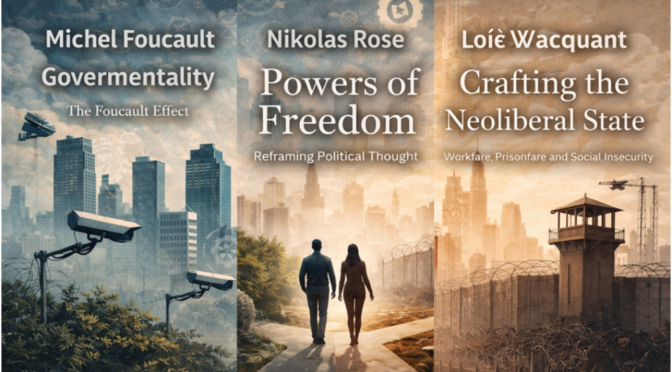
This review essay examines three influential contributions to debates on modern governance and neoliberal state formation: Michel Foucault’s concept of governmentality, Nikolas Rose’s analysis of advanced liberal rule in Powers of Freedom, and Loïc Wacquant’s account of workfare and prisonfare in the neoliberal state. Although these works emerge from different intellectual traditions, they address a common question: how contemporary societies are governed through a combination of freedom, discipline, and institutional restructuring.
Discussions of neoliberalism often move between two opposing claims. On one side, we hear that the state has retreated, leaving individuals to fend for themselves in deregulated markets. On the other, we encounter accounts of expanding surveillance, policing, and incarceration. These narratives appear contradictory. Yet when read together, the work of Michel Foucault, Nikolas Rose, and Loïc Wacquant suggests that they describe different aspects of the same transformation. Contemporary governance does not simply shrink or expand. It reorganises itself in ways that rely simultaneously on freedom and discipline.
Foucault’s formulation of governmentality offers a starting point for thinking about this shift. He asks us to move beyond viewing power solely in terms of laws, prohibitions, or sovereign commands. Modern rule, he argues, increasingly operates through the shaping of conduct. Rather than compelling obedience through visible force, it structures the field of possible action. Populations become objects of management through statistics, economic reasoning, and administrative expertise. Governing means arranging conditions under which individuals guide themselves.
This insight unsettles the assumption that liberalism is defined by minimal interference. Liberal rule does not withdraw from society. It governs differently. Markets, security, and circulation become central concerns. Power becomes productive, working through norms and calculations that organise behaviour without always appearing coercive. Yet Foucault’s analysis remains largely conceptual. It sketches a transformation in political rationality but leaves open the question of how these ideas take institutional form in late twentieth century reforms.
Nikolas Rose’s work helps fill this gap. Writing about advanced liberal democracies, he describes how governing increasingly takes place through responsibilisation. Citizens are encouraged to see themselves as autonomous, self-managing actors. Welfare, employment, health, and education are reframed around personal initiative and self-regulation. Rather than being treated primarily as recipients of state provision, individuals are addressed as active participants who must manage their own risks and improve their own capacities.
What is striking in Rose’s account is the centrality of expertise. Psychological knowledge, managerial audits, performance indicators, and market mechanisms become tools for shaping behaviour. The state does not disappear. Instead, it coordinates from a distance, relying on dispersed authorities and indirect techniques. Freedom becomes the medium of rule. Individuals are free to choose, yet those choices are structured by expectations of responsibility, productivity, and adaptability.
However, when we turn to Loïc Wacquant’s analysis of workfare and prisonfare, the picture becomes more complex. If contemporary governance works primarily through self-regulation, how do we account for the dramatic growth of punitive institutions? Wacquant argues that neoliberalism does not produce a weak state. It produces a reengineered one. As welfare protections are reduced and made conditional, penal institutions expand. Social assistance becomes tied to strict work requirements, while incarceration rates rise, particularly among marginalised populations.
From this perspective, coercion has not vanished. It has been reorganised. The same political rationality that emphasises individual responsibility also justifies sanctioning those who fail to meet its demands. Workfare disciplines the unemployed through monitoring and conditionality. Prisonfare contains those rendered surplus within a restructured labour market. The state becomes permissive in relation to capital while remaining intrusive in relation to the poor.
Reading these thinkers together reveals that responsibilisation and penal expansion are not opposing logics. They are intertwined. The expectation that individuals govern themselves creates a threshold of failure. Those who cannot conform to the ideal of the self-sufficient, entrepreneurial subject are subject to intensified regulation. Freedom is offered unevenly. It is extended as opportunity to some and withdrawn through discipline from others.
At the same time, each framework has its limits. Foucault’s concept of governmentality is powerful but abstract. Rose captures the subtlety of governing through freedom, yet his analysis can underplay material inequalities that shape people’s capacity to self-govern. Wacquant grounds his account in institutional and class dynamics but pays less attention to how norms of responsibility are internalised in everyday life. Bringing them into conversation does not dissolve these tensions. It clarifies them.
What emerges is a view of the neoliberal state as differentiated rather than uniform. It does not operate through a single technique of rule. It combines market oriented reform, moral appeals to responsibility, and punitive management of insecurity. Governance is not simply about reducing state intervention. It is about reallocating it.
This synthesis also raises broader concerns. When responsibility is individualised, structural inequalities risk being recast as personal shortcomings. When punishment expands alongside market reform, social insecurity is treated as a problem of discipline rather than redistribution. The language of empowerment can coexist with systems that narrow the range of viable choices for many.
Understanding contemporary governance therefore requires attention to both freedom and force. The neoliberal state cultivates self-regulating subjects, but it also draws boundaries around those deemed incapable of self-management. The interplay between these strategies reveals a form of power that is neither purely liberal nor overtly authoritarian, but something more complex. It is in tracing that complexity that the combined insights of Foucault, Rose, and Wacquant remain most valuable.
References
Foucault, Michel. 1978. “Governmentality.” In The Foucault Effect: Studies in Governmentality, edited by Graham Burchell, Colin Gordon, and Peter Miller. Chicago: University of Chicago Press, 1991.
Rose, Nikolas. 1999. Powers of Freedom: Reframing Political Thought. Cambridge: Cambridge University Press.
Wacquant, Loïc. 2010. “Crafting the Neoliberal State: Workfare, Prisonfare and Social Insecurity.” Sociological Forum 25(2): 197–220.
Muskan
Intern
Asia in Global Affairs
Disclaimer
The views and arguments expressed in this article are those of the author and do not necessarily reflect the positions or institutional views of Asia in Global Affairs.

Leave a Reply