Homebound: Aspirational Citizenship and the Politics of Waiting
Posted on : March 15, 2026Author : Swastika Kar
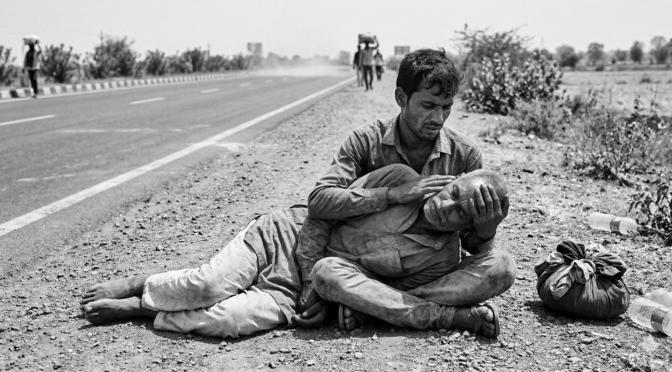
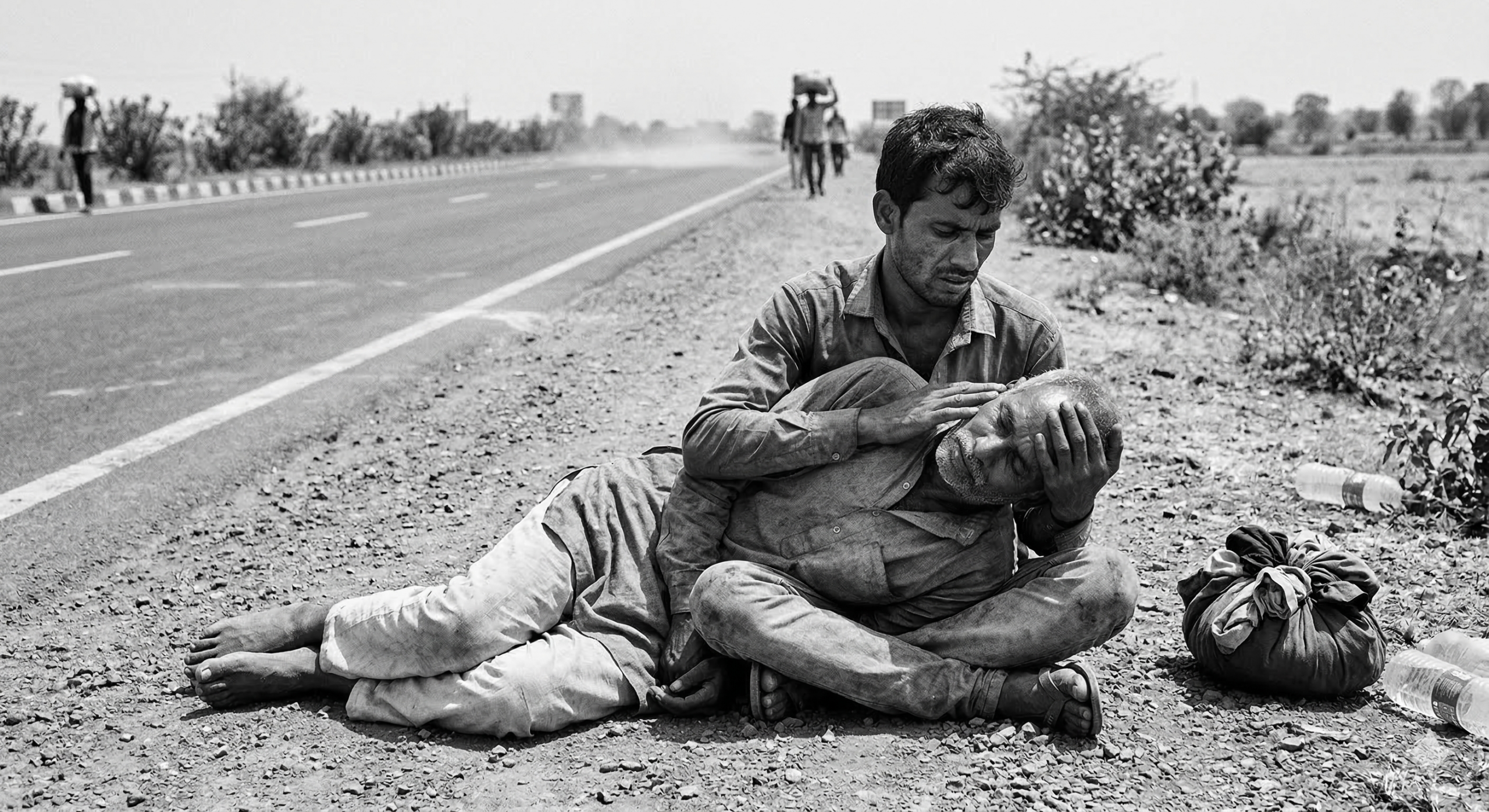
In May 2020, as the pandemic tightened its grip on India, a poignant newspaper photograph surfaced of a wiry Saiyub holding an unconscious Amrit in his lap on a scorched highway in Madhya Pradesh. Fate indeed has its own destiny. It was not just a melancholic photograph of abiding friendship, it carried Amrit home; it was also a subtle commentary on a media ecosystem that chose to portray Muslims as super spreaders. Journalist Basharat Peer traced the tale of these two friends to their village in eastern Uttar Pradesh for The New York Times. Five years later, in “Homebound,” writer-director Neeraj Ghaywan takes away the exactitude of the Op-ed essay and makes it a deeply immersive and emotionally resonant cinematic experience, that is both specific to the pandemic and universal in its tone and tenor. While it is a film on the surface about a quiet tale of friendship between two young men and their struggles with the uncertainty of early adulthood, it is also a deeply political commentary on unemployment, masculine aspiration, and upward mobility in modern India. The film does not rely on dramatic spectacle or overt political rhetoric; instead, it unfolds as a subtle but piercing commentary on what it means to seek dignity in a system where opportunity is unevenly distributed and hope itself becomes precarious.
Set between the stagnation of small-town life and the imagined promise of urban transformation, Homebound follows its protagonists as they prepare for state employment examinations. Their pursuit of government jobs is not incidental but it represents stability, legitimacy, and recognition. In a country marked by volatile labor markets and shrinking secure employment, the state becomes a symbolic guarantor of belonging. To secure such a job is not merely to earn a salary; it is to acquire social legitimacy, familial pride, and a place within the moral order of society.
The film’s most striking paradox lies in its portrayal of aspiration as both empowering and suffocating. The young men are not portrayed as rebels resisting the system; rather, they desperately seek inclusion within it. Their daily routine of studying late nights, practicing mock interviews, sharing tiny living spaces, shows the immense hardworkthat goes into maintaining hope. Waiting here becomes a central theme.From waiting for exam results, or interview calls, to waiting for life to actually “start”, shows their determination and patience. This politicisationof waiting is particularly resonant in the context of India’s youth unemployment crisis, where millions remain suspended between education and employment, qualification and recognition.
Ghaywan’s restrained cinematic style escalates a “a holding pattern”. The camera moves in long, static frames, letting silence and stillness convey what dialogue often does not. The subdued tones and linear spaces reflect emotional containment. Even moments of laughter or camaraderie are tinged with anxiety, as though joy must be limited. The visual language mirrors the psychological condition of insecurity: nothing is guaranteed, and every aspiration is shadowed by the possibility of failure.
Masculinity works as a silent yet commanding force throughout the film. The protagonists carry the weight of expectation, not only personal ambition but familial responsibility. Economic success becomes a virtue of moral worth. Their worth as sons, friends, and future husbands is implicitly measured against their employability and economic status. In this context, Homebound subtly critiques a gender hierarchy in which men must perform stability and competence even when the structures necessary for such performance are absent. Failure is not merely financial; it is existential.
However the friendship between Shoaib and Chandan is at the heart of the film, offering a fragile counterpoint to this pressure. Their bond is intimate yet restrained, affectionate yet competitive. Moments of solidarity exist side by side with silent comparisons likewho will pass the exam first? Who will be able to do it sooner? Neoliberal insecurity penetrates through their most personal bond, changing shared dreams into silent rivalry. The film does notdramatise this tension with conflict or violence; instead, it lets it simmer beneath ordinary exchanges, revealing how economic structures reshape emotional worlds.
Moreover, the state itself is neither villainised nor glorified. It appears primarily through procedures like application forms, interviews, and bureaucratic corridors. It is informal, distant, yet omnipresent. The protagonists’ faith in state employment reflects a broader longing for what political theorist T.H. Marshall termed “social citizenship”,the idea that full membership in society requires access to economic security and social rights. Yet the film complicates this promise. Citizenship here feels conditional, based upon exam scores and institutional approval. Inclusion is meritocratic in theory, exclusionary in practice.
The title itself is layered with ambiguity. “Homebound” suggests being tied to one’s roots like social status, class, locality and inherited barriers.However it also evokes a journey directed towards home and stability. The protagonists are stuck between these meanings. They try to escape from the limitations of their background, yet the path to mobility repeatedly loops back to waiting rooms and rented spaces that feel indistinguishable from the lives they hoped to leave behind. The film subtly asks whether mobility in neoliberal India is a tangible reality or a deferred promise.
What differentiates Homebound from traditional narratives of success is its refusal to deliver catharsis. There is transformation without applause that neatly resolves tension. The film lingers in uncertainty. This refusal is politically significant. It challenges the dominant conventionalidea that hard work inevitably yields reward. By foregrounding ambiguity, Ghaywan resists the myth of guaranteed upward mobility and exposes the structural fragility underlying aspirational narratives.
It is more than a personal story, providing a lens into broader socio-economic dynamics shaping youth in South Asia. Urbanisation, competitive examination cultures, decreasing public sector employment, and the moral centrality of economic success converge within the personal space of two young men. The film reminds us that macroeconomic transformations are experienced not as statistics but as sleepless nights, strained friendships, and quiet self-doubt.
Ultimately, Homebound is a study of longing, longing for dignity, security, and recognition. It captures a generation left stuck between promise and disappointment, ambition and barriers. Through its understated storytelling and political subtlety, the film invites viewers to reflect on the cost of aspiration in unequal societies.
In a nation that celebrates growth and opportunity, Homebound leaves us with an uncomfortableand unsettling question: when mobility becomes the measure of worth, what happens to those who are left waiting?
References:
Ajun Kumar,2025,‘Homebound’ movie review: Neeraj Ghaywan applies balm on the cracked heels of a world pulling apart, The Hindu
Shubhra Gupta, 2025, Homebound movie review: Ishaan Khatter, Vishal Jethwa film unflinchingly brings up troubling home truths, The Indian Express
Sucharita Tyagi,2025, Homebound Movie Review — Sucharita At Cannes 2025,Medium
Uday Bhatia,2025, ‘Homebound’ review: Two friends and a country full of obstacles, The Mint
Homebound
Directed by Neeraj Ghaywan
Co-authored by Neeraj Ghaywan and Sumit Roy
Hindi 2025
Swastika Kar
Intern, Asia and Global Affairs
The views and opinions expressed in this review are those of the author and do not necessarily reflect the official policy or position of Asia in Global Affairs. The review is intended for academic and informational purposes only. It is not an endorsement of any particular viewpoint, nor is it intended to malign any individual, group, organization, company, or government



Leave a Reply