Negotiating Gender in Turbulent Times: A Comparative Review of Persepolis, Wicked Girl, and Mustang
Posted on : February 28, 2026Author : Nabina Kansa Banik
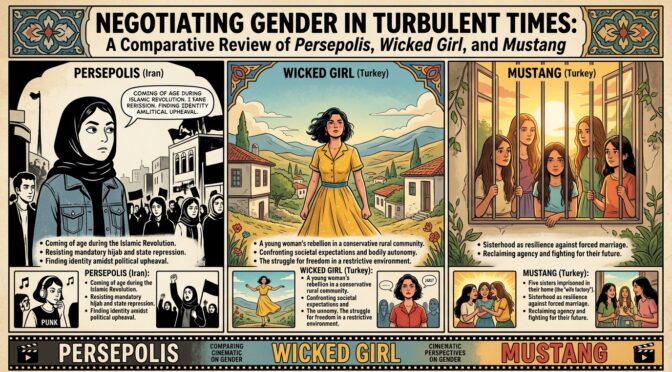
In the diverse cinematic landscape of West Asia, films often serve as mirrors reflecting the intricate interplay of gender roles, societal norms, and political upheavals. This review focuses on three compelling works: Persepolis (2007), an animated autobiographical film directed by Marjane Satrapi and Vincent Paronnaud, depicting a young girl’s coming-of-age amid the Iranian Revolution; Wicked Girl (2017), a Turkish/French animated short with hand drawn frames by Ayçe Kartal, exploring the traumatic aftermath of child sexual abuse; and Mustang (2015), a live-action drama directed by Deniz Gamze Ergüven, portraying five sisters’ resistance against patriarchal constraints in rural Turkey. These films, drawn from Iran and Turkey, illuminate shared gender concerns across the region, including the subjugation of women and girls during periods of social and political transition. By examining how young female protagonists navigate power structures, economic dependencies, and cultural expectations, this comparative analysis highlights the resilience and quiet rebellions that challenge entrenched inequalities, without delving into artistic techniques.
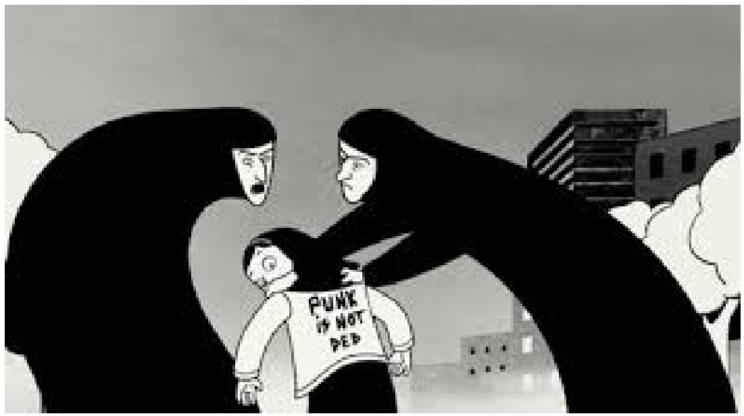 Persepolis chronicles Marjane Satrapi’s childhood and adolescence in Tehran during the 1979 Islamic Revolution and the subsequent Iran-Iraq War. The narrative underscores the drastic shift in gender dynamics as the revolution imposes strict Islamic codes, transforming a relatively westernized society into one where women’s freedoms are curtailed. Pre-revolution, Iranian women enjoyed visible agency, with access to education and public life, as seen in Marjane’s family where her mother actively participates in protests and decision-making. Though this was largely restricted to urban middle class women and is now contested by conservative forces. However, the post-revolutionary regime enforces veiling, gender segregation in schools, and prohibitions on women’s attire, symbolizing broader control over female bodies and autonomy. Economically, the war exacerbates hardships, with rationing and black markets affecting households, where women often bear the brunt of managing scarcity while men are conscripted. Politically, the film reveals how the revolution, initially promising equality, devolves into a theocratic state that polices women’s morality through “morality guardians,” threatening violence for non-compliance. Marjane’s personal negotiations with power manifest in subtle acts of defiance, such as listening to forbidden Western music or loosening her veil, representing micro-level resistance against macro-political oppression. This reflects the tension between individual identity and state-imposed gender roles, where young women must reconcile their aspirations with societal demands

In contrast, Wicked Girl offers a harrowing glimpse into the psychological and social ramifications of child sexual abuse in a conservative Turkish village. Based on true events, the eight-minute animated short follows an eight-year-old girl, S., recounting her trauma from a hospital bed. The film exposes how patriarchal structures enable abuse, particularly in rural settings where family honour and stigma silence victims. Economically, the story hints at vulnerabilities in lower-income communities, where children like S. are sent to live with relatives, exposing them to exploitation without adequate protection. Politically and socially, Turkey’s context of underreported child abuse exacerbated by cultural taboos and inadequate legal responses—frames the narrative. Kartal’s research reveals that many young victims develop schizophrenia as a coping mechanism, dissociating from memories of violation. S.’s dissociated recollections, blending innocent childhood scenes with horrific intrusions, illustrate how gender power imbalances manifest in the most intimate violations. The title “Wicked Girl” critiques the victim-blaming prevalent in some societies, where abused girls are stigmatized rather than supported, perpetuating cycles of silence and trauma. Through S.’s voice, the film underscores the long-term societal cost: forgotten victims left to navigate mental health crises alone, highlighting the need for systemic change in addressing gender-based violence.

Mustang, set in contemporary rural Turkey, extends these themes through the lens of five orphaned sisters confined by their conservative guardians after a perceived indiscretion playing with boys on a beach. The film critiques the patriarchal control over female sexuality and autonomy in a society where women’s roles are rigidly defined by marriage and domesticity. Economically, the sisters’ family relies on traditional arrangements, where girls are commodified through arranged marriages to secure alliances, reflecting broader rural dependencies on kinship networks amid limited opportunities for women. Politically, it echoes Turkey’s slide toward conservatism under influences like the AKP government, which has been criticized for reinforcing gender inequalities, including rising child marriages and honour-based restrictions. The sisters’ home becomes a “wife factory,” where they are taught household skills instead of attending school, symbolizing the denial of education as a tool of control. Their negotiations with power are collective and bold: sneaking out to attend a soccer match or resisting forced unions, acts that challenge familial and societal authority. The youngest, Lale, embodies emerging feminist consciousness, plotting escapes that underscore the intergenerational transmission of oppression, often enforced by women themselves under patriarchal norms.
Comparatively, these films reveal overlapping gender concerns in West Asia during times of flux. All portray young girls as focal points of societal control, where revolutions or conservative shifts amplify restrictions on female agency. In Persepolis, the Iranian Revolution’s ideological fervour mirrors Mustang‘s rural patriarchy, both imposing dress codes and limiting mobility to preserve “honour.” Wicked Girl adds a layer of intimate violence, showing how such systems enable abuse, akin to the virginity tests and forced marriages in Mustang. Economically, the films depict women’s disproportionate burdens: wartime scarcity in Iran, rural poverty in Turkey fostering dependency. Politically, they critique state or cultural mechanisms that prioritize male authority, from Iran’s theocracy to Turkey’s blending of religion and tradition. Yet, resilience shines through negotiations—Marjane’s cultural rebellions, S.’s imaginative dissociation, and the sisters’ solidarity—highlighting how women forge paths amid constraints.
These narratives underscore that gender roles in West Asia are not monolithic but shaped by intersecting social, economic, and political forces. They call for recognizing women’s everyday resistances as catalysts for change, urging policies that address abuse, education, and equality. In a region grappling with ongoing transitions, such stories remind us that true progress lies in amplifying these voices.
Persepolis (French: Persepolis), 2007
Directed by Marjane Satrapi, Vincent Paronnaud
Writer – Marjane Satrapi (based on her autobiographical graphic novel; screenplay co-written with Vincent Paronnaud).
Stars – Chiara Mastroianni (voice of Marjane), Catherine Deneuve (voice of Marjane’s mother), Danielle Darrieux (voice of Marjane’s grandmother), Simon Abkarian (voice of Marjane’s father).
Origin: France (co-produced with the United States; animation produced in France).
Style: Animated, 2D black-and-white (adult-oriented biographical drama with hand-drawn animation).
Wicked Girl (Turkish: KötüKız), 2017
Directed by Ayçe Kartal, Ayel Kamal
Writer – Ayçe Kartal (written, designed, and animated).
Stars – Zeynep Naz Daldal (Voice).
Origin: Turkey (co-produced with France).
Style: Animated, 2D (hand-drawn with over 13,000 frames created digitally on a Wacom tablet; short film format).
Mustang, 2015
Directed by Deniz Gamze Ergüven
Writer – Deniz Gamze Ergüven (original screenplay) with Alice Winocour
Stars – Güneş Nezihe Şensoy (Lale), Doğa Zeynep Doğuşlu (Sonay), Elit İşcan (Selma), Tuğba Sunguroğlu (Nur), İlayda Akdoğan (Ece), Nihal Koldaş (Grandmother), Ayberk Pekcan (Uncle Erol).
Origin: France/Germany/Turkey/Qatar (co-production).
Style: Live-action drama (coming-of-age story with elements of realism and fairy-tale aesthetics; focuses on collective female resistance in a patriarchal rural setting).
References
- Handyside, Fiona. “The Politics of Hair: Girls, Secularism and (Not) the Veil in Mustang and Other Recent French Films.” Paragraph 42, no. 3 (2019): 351–368. https://www.euppublishing.com/doi/10.3366/para.2019.0311.
- Akçalı, Elif, et al. “Mustang: Translating Willful Youth.” In Mustang (book chapter or related analysis), 2022. Available via ResearchGate or Academia.edu.
- Kosmidou, Eleftheria Rania. “The Unbearable Lightness of Persepolis: Cultural Memory and the Melancholy of History.” Filmicon: Journal of Greek Film Studies, Issue 3 (October 2015). http://filmiconjournal.com/journal/article/2015/3/3.
- Warren, Kate. “Persepolis: Animation, Representation and the Power of the Personal Story.”
- Satrapi, Marjane. Persepolis. Translated by Anjali Singh. New York: Pantheon Books, 2003.
- Ergüven, Deniz Gamze, dir. Mustang. 2015; France/Germany/Turkey/Qatar: CG Cinéma / Ad Vitam.
- Kartal, Ayçe, dir. Wicked Girl (KötüKız). 2017; France/Turkey: Les Valseurs / ARTE.
- Additional scholarly piece: “Feminist Orientalism and National Identity in Satrapi’s Persepolis.” Journal of International Women’s Studies (2020). https://vc.bridgew.edu/cgi/viewcontent.cgi?article=2212&context=jiws.
Nabina Kansa Banik
Intern, Asia in Global Affairs

Leave a Reply