Asymmetric Sovereignty in the International Order: The Global South in the World System
Posted on : April 26, 2025Author : Allen David Simon
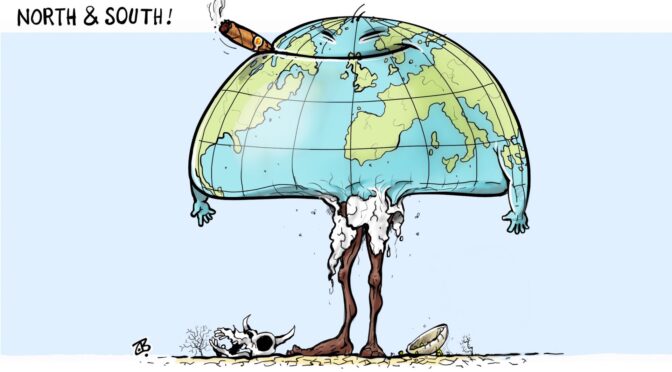
Admitting the evolutionary state and its shifting roles Clapham finds evidence to what he calls “relative sovereignty” (1998: pg. 143) – sovereignty as a localized and particularistic notion and expression in “validly different forms” (Wilson, 1934: pg. 410). The dynamic nature of international order and state sovereignty itself thus ensures differentiated circumstances in both claims and the practice of sovereignty. The construct of sovereignty is no mere livre de circonstance but a staple to state theories presenting long and diverse traditions in conceptualization, and yet has been perplexed by the failure to recognize its bigamous nature, that is, its two-fold classification: (1) a system of state claims (upon both the internal hierarchy and external anarchy), and (2) a state exercise.
However, states are not equally capable of exercising their sovereignty, nor defend its limitless-ness in real-politique. Thus, the sovereignty of the global south must be located as a claim and a practice in the international order, with both being circumstantial, rather than universal. While the orthodox view would thus hold that “a polity cannot be a little less sovereign” – incompliant with any deviations from Westphalian sovereignty, one must accept the relational and unit-centric attributes of sovereignty (Lake, 2003).
In practice, sovereignty is determined by the national power reposited from time to time in the state machinery as expressed and executed vis-a-vis the political leadership through both domestic and international policy. While the international order as represented by the United Nations Organization General Assembly, the principle of equal sovereignty is nominal, yet essential for the conduct of seemingly fair business amongst states and transborder interaction on at-least legal equality in the international system, the ‘apparent’ equality amongst states is superficial. As globalization has put forth contenders, in differing aspects, to the exercise of absolute sovereignty – a pluralist contention of power actors, the classical buttress on state-centric international studies does little to acknowledge the presence of and the exercise of power over human behavior, habits, actions, thought and orientation, as well as future course of events by non-state players in the global arena.
Although not all interesting actors within the international system are sovereign, sovereignty need not juxtapose the invariable inequality and segments of human life simply outside of and included into the authoritative domains of non-state others, be it the Bretten Woods institutions that have come to characterize the global system and its jurisprudence, or the multi-national corporations (MNCs) that expose neo-colonialism of the third-world. Thus, justifications to the alternate unequal status of nation-states in hypothesis in the exercise of global power politics can be found in the Dependency theories of peripheral underdevelopment fueling the development of the core states, out of structural and historic inequality amongst states as a product of differences in power and global market flows.
Immanuel Wallerstein’s World Systems Theory provides a model of dependence among nation-states in the arena of international relations, its careful scenery of clash between the affluent and impoverished, developed and underdeveloped, modernity and primitive can be traced out as the proviso for abject disparity amongst states in the world economy. While the colonial bondages of old have been shed, the neo-colonial experience of latent exploitation and control has been all expansive and all pervasive – designating a system of all global inequality and disbalances amongst nation-states.
Thus, institutional hierarchies have only been replaced with indirect instruments of foreign intervention – the liberal-rights regime by the UN Human Rights Commission, economic standards by the triad of the World Bank, International Monetary Fund (IMF) and World Trade Organization (WTO), foreign aid, debt traps, imbalance in the flow of information, cosmopolitanism as westernization, international legislation upheld by the International Court of Justice, etc. Therefore, even as the United Nations Organization General Assembly appears to provide evidence to a fact of equal sovereignty, the underlying bias in favor of major occidental nations is ever present and pretentious. Never, in true intent and earnest essence would equality sovereignty stull congregate entities of less or more sovereign power and stronger or weaker claims. This discrepancy between the preaching and practice cannot hide the class divisions among states.
If the United Nations Organization is held to be the highest common platform for all states, therein lies an inherent and apparent system of privileges in its coercive organ, the UN Security Council: the distinction of the Big Five permanent members from the tenure limited ad hod constituents give greater weight to the priorities of stronger states than weaker states. While it can still be argued that contribution to peacekeeping provides them additional weight in form of veto rights. Thus, “whether sovereignty is unlimited or qualified has often depended upon the answer to the question, whose sovereignty was actually involved, its own or that of the other party?” is determines the agility in the world arena (Garner, 1925: pg. 22-23). USA runs free from signing international covenants, China refutes the decisions of the International Court of Justice – beyond technicalities of IR practices, intricacies of power politics and intrigues of international relations. Although, sovereignty has been a fiercely defended aspect for Global south states due to their large post-colonial experiences – with state insecurities over public control (fears of insurgency, regionalism, ethnic conflict) creating a heightened sense of a security state. The Global South has been meted the shorter end of the stick, with greater dependence on triad institutions for financial aid and thereby greater control of dominant powers over decision making in such states.
‘Sovereigntism in the International System: From Change to Split’(2016) by Alles & Badie lays down the sequence of sovereigntism of states corresponding to the multilateralism paradigms – from the Westphalian Moment (territorialism), to the nation-state (self-determination and democratization), colonial rule (civilizational inequality and bigamy between non-western secular nationalists and identity entrepreneurs), the bi-polar context (restored and defence of sovereignty), and finally the post-bipolar era (challenges to sovereignty). The further proposed typology of sovereigntism in the post-bipolar order includes:
- Neo-sovereigntism: Claiming the implementation of sovereign equality and protesting the rigidity of the international architecture.
- Archeo-Sovereigntism: Radically opposing the transnational dynamics of globalization and picturing them as a threat.
- Conservative Sovereigntism: seeking to preserve the international architecture by redefining sovereignty on normative grounds.
| Contemporary Types
of Sovereigntism |
Conception of
Sovereignty |
Claim | Protest | Approach Towards
Globalization |
| Neo-sovereigntism | Self-affirmation | Equality | Hierarchy | Pragmatic |
| Archeo-sovereigntism
|
Specificity | Identity | Globalization | Antagonist |
| Conservative
Sovereigntism |
Normative | Hierarchy | Emergence of
challengers |
Selective |
Table 1: Three coexisting types of sovereigntism in the post-bipolar context, a system of claims and counterclaims.
Source 1: (Alles & Badie, 2016, pg. 18)
As sovereigntism, as a system of state claims, is evolutionary – adaptive to the ‘transformative logic’ of context and situation (Alles & Badie, 2016, pg. 6), one can deduce that the relative position of states in the community of nation-states determines its choice of vocalizing sovereigntism. The global south may largely be located as claimants to Neo-sovereigntism: harping on the principle of sovereign equality and protesting hierarchical structures of the global system, e.g., the veto powers of the permanent members of the UN Security Council. As most global south nations are post-colonial states, sovereignty is also self-asserted. But, here too, one must recognize that states show a more dynamic approach to sovereignty, rather than one which is uniform. Moreover, asymmetry persists even among the Global South states, and not always is the Global South speak with a united voice. An example can be found in the matters of climate responsibility. While Global South states (like India) typically encourage claims of sovereign equality, climate governance shows the more agile response – with most Global South states demanding a greater responsibility of the developed North as historic beneficiaries of the post-industrial environmental degradation rather than the universal responsibility of states in climate action, calling for financial aid to South states to tackle global warming (Gupta, 2024).
Thus, contemporary sovereignty in the global structure lies between normative equality and legal uniformity; a ‘graded institutionalized hierarchy’ (Alles & Badie, 2016: pg. 5). This breeds what called out by critics as ‘political fiction’, a ‘social construct’, and ‘organized hypocrisy’ (Alles & Badie, 2016, pg. 6) , despite its historic and systematic weight as the cornerstone to both national and international articulation and interactions – the assumption of powers to make do. Thus, the principle of ‘equal sovereignty’ that the global order pretends to stand on is superficial -neither ‘equal’ nor ‘sovereign’ in its base connotations. Thus, the sovereignty of the Global South suffers from layers of inequality that stems from a colonial legacy of exploitation, neo-colonial challenges by TNC actors, and dependency on Global North-led institutions for development – resulting in Norther control over the cultural, political and economic processes of the Global South and its limits on sovereignty thereof.
Image courtesy of Hajjaj, E. [@EmadHajjaj]. (2017, March 28). [Cartoon image] [Tweet]. X. https://x.com/EmadHajjaj/status/846674592060096512
References
- Alles, D., & Badie, B. (2016). Sovereigntism in the international system: From change to split. European Review of International Studies, 3(2), 5–19. https://doi.org/10.3224/eris.v3i2.02Ake, C. (1981). A political economy of Africa. Longman.
- Chomsky, N. (2003). Hegemony or survival: America’s quest for global dominance. Metropolitan Books.
- Clapham, C. (1998). Degrees of Statehood. Review of International Studies, 24(2), 143–157. http://www.jstor.org/stable/20097515
- Escobar, A. (1995). Encountering development: The making and unmaking of the Third World. Princeton University Press. https://doi.org/10.1515/9781400839926De Gruyter Brill
- Garner, J. W. (1925). Limitations on National Sovereignty in International Relations. The American Political Science Review, 19(1), 1–24. https://doi.org/10.2307/2938889
- Gupta, A. (2024, May 18). Global South and its push for an equitable climate policy. Raisina House. https://raisinahouse.org/climate-change/f/global-south-and-its-push-for-an-equitable-climate-policy
- Krasner, S. D. (1999). Sovereignty: Organized hypocrisy. Princeton University Press. https://doi.org/10.1515/9781400823260SCIRP+1De Gruyter Brill+1
- Lake, D. A. (2003). The New Sovereignty in International Relations. International Studies Review, 5(3), 303–323. http://www.jstor.org/stable/3186572
- Nkrumah, K. (1965). Neo-colonialism: The last stage of imperialism. International Publishers. https://www.marxists.org/ebooks/nkrumah/nkrumah-neocolonialism.pdfMarxists Internet Archive
- Rodrik, D. (2011). The globalization paradox: Democracy and the future of the world economy. W. W. Norton. https://doi.org/10.1355/ae28-3kSCIRP
- Sachs, J. D. (2005). The end of poverty: Economic possibilities for our time. Penguin Press.
- Smith, L. T. (1999). Decolonizing methodologies: Research and indigenous peoples. Zed Books. https://nycstandswithstandingrock.files.wordpress.com/2016/10/linda-tuhiwai-smith-decolonizing-methodologies-research-and-indigenous-peoples.pdfResearchGate+2nycstandswithstandingrock.files.wordpress.com+2Bloomsbury Publishing+2
- Williams, D., & Young, T. (1994). Governance, the World Bank and liberal theory. Political Studies, 42(1), 84–100. https://doi.org/10.1111/j.1467-9248.1994.tb01675.x
- Wilson, F. G. (1934). A Relativistic View of Sovereignty. Political Science Quarterly, 49(3), 386–410. https://doi.org/10.2307/2143219
Allen David Simon
Intern, Asia in Global Affairs
The views and opinions expressed in this book review are those of the author and do not necessarily reflect the official policy or position of Asia in Global Affairs. The review is intended for academic and informational purposes only. It is not an endorsement of any particular viewpoint, nor is it intended to malign any individual, group, organization, company, or government




Leave a Reply