Hunger as critique: The famine reportage of Chittaprosad
Posted on : July 31, 2025Author : Rik Bhattacharya
The closing years of British Raj in India would be marked by several ruptures, critical moments that would, in the years to come, define the contours of the new nation-state. One such critical conjecture would be that of the Bengal famine of 1943. Within half a decade of this catastrophic event, the region would be rocked again by communal riots in 1946 and violent fissures due to Partition in 1947. Even today, jibes of ‘bhookha Bangali’ (the hungry Bengali) continue to haunt the community, 8 decades down the line.
The Bengal famine of 1943 killed and displaced millions. It was notorious for being “manmade,” triggered by wartime profiteering, black marketing, and an imperial war policy that used the eastern colonial frontiers as war fronts, but without any socioeconomic protection. Following Sen (1981), the famine was caused by a shortage of food grains and dearth of exchange entitlements in the vulnerable sections of Bengali society. The experience of hunger during the famine proved to be a critical rupture- the colonial government proved woefully inadequate in tackling the famine in its infancy, in part caused by official reluctance to recognise it as a famine until October 1943. This reluctance to recognise the famine in its initial stages, and thus shirk the obligation to provide relief, was mirrored in official apathy to record the famine.
Chittaprosad Bhattacharya’s (1915-78) oeuvre has been distinctly iconised by his stark black-and-white imagery recording the famine, so much so that his reputation has been singled out as a ‘famine artist’, even more than his contemporaries who engaged in similar tasks. His famine sketches carve out what Sunderason calls a ‘physiognomy of hunger’ (2011:84). This essay shall briefly delve into his sketches documenting the Bengal famine, to explore how this ‘aesthetics of hunger’ could be understood as a critique, both of imperial policies as well as indigenous compradorship.
Chittaprosad was born in 1915 in Naihati, but moved to Chittagong, in the eastern borders of undivided Bengal bordering Burma, in the 1930s. Chittaprosad became a card-holding member of the Communist Party of India (CPI) in 1943 when he moved from Chittagong to the Party office in Calcutta and later in the year to the Party headquarters in Bombay. He became the most prominent artist-reporter of the CPI, featuring regularly in the Party’s newspapers JanajuddhaPeople’s War and People’s Age . At the Party’s behest, Chittaprosad began his tours of the famine- affected regions around late 1943, the earliest referencebeing in November 1943. He toured extensively through 1943–4 in the Contai subdivision of Midnapore district. He produced a substantial body of sketches- desolate landscapes, death and pestilence, uprooted villagers, relief kitchens, orphanages and hospitals. These sketches, as well shall see, were marked by a looming sense of deformed corporeality, hunger overriding and occupying the pictorial space.
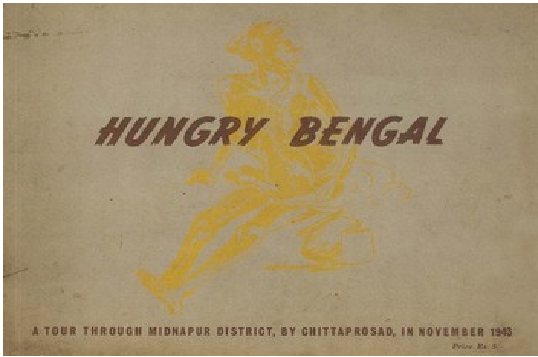
In 1944, 22 sketches from Chittaprosad’s tour in the Midnapore district were published along with the journal entries he kept during his journey. The book would be entitled Hungry Bengal: A Tour through the Midnapore Districtby Chittaprosad in November 1943. Chittaprosad’s journey traces back the routes of hunger and destitution from the city streets through the sub-divisional towns and into the famine-hit villages in the Contai interiors. These sketches were also interfused with quotes by the famine affected, or with notes written by the artist, often on the subject’s conditions. Hungry Bengal could be argued to be the first in the genre of visual reportage by an artist-reporter in India (Sunderason 2011: 81). The British government is said to have burnt 5,000 copies after its publication in 1944, as claimed by the artist’s sister (Sunderason 2021: 33). The crucial question here arises- why did the colonial government, which had itself set out to record the famine in late 1943, albeit via other means, deem it necessary to purge this book?
The answer probably lies in the fact that the visual reportage of Chittaprosad, both in the pages of People’s War and in Hungry Bengal, forged a critical aesthetic of hunger that lay bare both the failure of the governmental machinery, as well as the complicity of the indigenous compradors, in firstly causing and secondly, exacerbating the famine. This was achieved through two means- the stark black-and-white ink sketches where hunger, emaciation, poverty, deprivation, etc were the main trope and the captions which did not generalise, but gave first-hand accounts of the subjects. His subjects weren’t an undifferentiated mass of victimhood, but had identities of their own. For example, in one of the sketches from June 1944, the artist describes his subject:
‘’This is hungry, disease-ridden, and virtually naked Rabi Raut, a kisan boy of Kadamdanga village, Balagor, Hooghly district. He has 3 younger brothers and a sister, all bed-ridden through protozoal infection, scabies, and cough.” (Quoted in Guin 2022)
However, victimhood is not the sole trope which lays bare the realities of the famine. Chittaprosad also critiques the colonial government, which forces the villagers to go back towards their rural homes from the urban spaces of Calcutta under the threat of force. The imperial might, which has failed to provide substantial relief to the famine afflicted, is now pushing the same people towards hunger and destitution, possibly death. Similarly, while millions die of hunger, the gods change hands, “their poor votaries and going to the abode of the faithful- the fat bellied Hindu merchant” (Chittaprosad: 1944)- a trenchant critique of black marketing and hoarding. Or, as he so evocatively puts it in his account in People’s War in August 1944, the comprador politicians continue to pile riches in their homes, in an insult to the hundreds of destitutes in their surroundings, the latter bearing the twin effects of official negligence and indigenous corruption (Chittaprosad 1944).
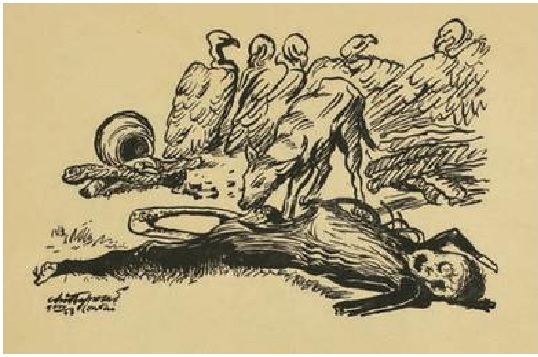
Thus, the famine reportage of Chittaprosad evokes an affective response from its viewers; going beyond mere pathos or victimhood, it articulates a visual critique by foregrounding hunger and emaciation as a trope. The pictorial reportage by the artist has created a niche for itself- creating a critical repertoire of hunger that still resonates across space and time, a visual reportage that is as evocative and pertinent as that which led to its ban 8 decades previously.
References:
- Sunderason, S (2021). A melancholic archive in Forms of the Left in Postcolonial South Asia, (33-64). Bloomsbury Publishing.
- , A. (2022, August 10). The Bengal famine of 1943: Chittaprosad Bhattacharya and political art. Indigenous. https://indigenousweb.com/blog/chittaprosad-bhattacharya-political-art/
- Sen, A. (1982). Poverty and Famines: An Essay on Entitlement and Deprivation. Oxford University Press.
- Sunderason, S (2011). As ‘Agitator and Organiser’: Chittaprosad and art for the Communist Party of India, 1941-8. Object, No. 13: 76-96.
- Sunderason, S. (2020). Partisan aesthetics: Modern art and India’s long decolonization. Stanford University Press.
Rik Bhattacharya
Intern, Asia in Global Affairs
The views and opinions expressed in this book review are those of the author and do not necessarily reflect the official policy or position of Asia in Global Affairs. The review is intended for academic and informational purposes only. It is not an endorsement of any particular viewpoint, nor is it intended to malign any individual, group, organization, company, or government



Leave a Reply