Radical possibilities of Third World solidarities: The genesis of the Tricontinental movement
Posted on : May 24, 2025Author : Rik Bhattacharya
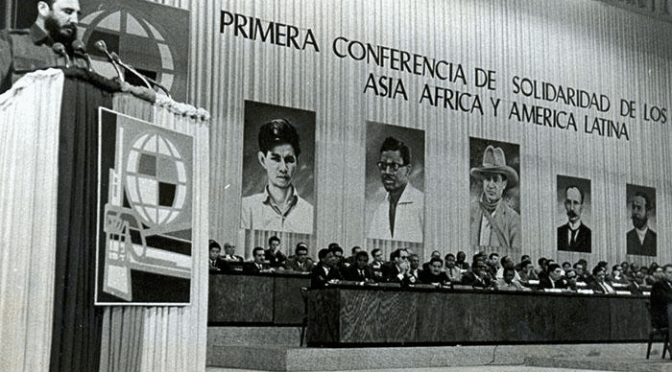
Delegates attending the Havana Conference, 1966. Source: Granma International.
It is perhaps more melancholic than ironic that postcolonial and decolonial scholarship often assumed that to speak of possibilities of Third World positionalities that toed the line of neither of the power blocs during the Cold War would find its genesis and subsequent championing in the Non-Aligned Movement (NAM) that originated in the famous Bandung conference in 1955. Consequently, what is often marginalised in this dominant narrative are attempts of building alternative imaginations of Third World solidarities in the long 20th century. However, such taxonomies of ‘Third World’ and more recently, ‘Global South’ have been vigorously contested, with some even suggesting that the current temporal realities have far rendered such categories outdated. Though it is not my intention to delve into the rich nuances of this inexhaustible debate, I nevertheless will premise my usage of the term ‘Third World’ as a loose descriptive category that encompasses all former colonies in Africa, Asia and South America that have, or still, negotiate with the repercussions of former colonial exploitation and continued neo-imperial extraction. My argument in this essay, which will briefly trace the ideological programme of the Tricontinental movement during its formative period, will be that the latter imagined radical new possibilities of consolidating Third World solidarities in the 20th century and created an alternative praxis and discourse to the dominant narrative of the NAM.
The first Tricontinental conference was held in January 1966 at Havana, Cuba, the locational significance of which, as the former ground zero of American neo-imperialism in the Caribbean under the Batista regime, was not lost on the organisers. This conference emerged from and was a successor (and yet a detractor in crucial ways) of two tendencies- the NAM, which included not only radical regimes but also those with a more conciliatory attitude towards imperialism; anti-colonial wars of national liberation which had a more radical edge to them and which had been gathered together in 1957 in the Afro-Asian People’s Solidarity Organisation (AAPSO) (Barcia, 2009: 210-11). The momentum generated by the success of the Cuban revolution seven years earlier would spur on the decolonisation process to include Latin America[i] within its ambit. However, this was not solely limited to a geographical expansion of the decolonisation diplomatic circles, i.e. the expansion of AAPSO into the Organisation of Solidarity with the Peoples of Asia, Africa and Latin America (OSPAAAL)- the 1966 conference would constitute a radical political reimagination of possibilities of Third World solidarities, cohering around a concrete ideological programme that emerged out of the demands for self-determination among the Third World countries, closely attentive to the needs of the Global South in a rapidly mutating and fragile scenario of the postcolonial moment.
With respect to the Bandung conference, the Havana conference would also constitute a reimagining on two lines. At the obvious first level, while Bandung would host the leaders of twenty-nine formerly colonised, newly independent nations of Asia and Africa, the latter would be attended by delegates from 82 countries- which did not just include governmental heads of independent states, but also representatives of armed revolutionary movements from both European colonies and independent states, ranging from the Rebel Armed Forces of Guatemala (FAR) to the Palestinian Liberation Organization (PLO) (Parrott, 2022: 1-2). But at the more significant ideological level, the Havana conference departed from the self-conscious neutrality of Bandung: the rapid mutations of the post- World War 2 global order revealed that it had become insufficient for Afro-Asian heads of state to collaborate diplomatically to denounce nuclear war and explore new forms of economic cooperation, as earlier proposed- a decade of mostly pro-Western coups and manufactured domestic stability had revealed the fragility of postcolonial governance as well as the ever-growing threat of America-led interventionism (Parrott, 2022: 2). New directions were the need of the hour- to mount a revolutionary challenge to the West- dominated international system, effectively marking the Havana conference as “an event of outstanding importance to the Free World” ( quoted in Portella, 2024: 161).
What then constituted the ideological programme of the Tricontinental to warrant its status as a pivotal moment in the rapidly gaining anticolonial struggle? The Tricontinental explicitly laid down its goals- to define a vision of Third World solidarity that could combat the threats of imperialism, colonialism, and neocolonialism, to address the inequalities of the then world order resting on a radical vision of self-determination that could develop an alternative social and political philosophy that could “expand out from the South and embrace the world and its possibilities” (Tricontinental Institute of Social Research: 2018). Thus, the delegates at the conference advocated anti-colonial socialism to achieve this goal, and championed whatever means were necessary, including but not limited to armed struggle, socialist revolution and the creation of cultural and economic institutions to resist foreign domination (Parrott, 2024: 1). In other words, there were four major tenets of tricontinental anti-colonial thought and praxis: anti-imperialism; internationalism; support for armed liberation struggles especially in the pursuit of self-determination; substantive equality through socialism, adapted to the specific conditions of the Third World (Portella, 2024: 166). Such tenets were expressed through intentions to replicate Vietnam’s resistance to US imperialism (famously including Che Guevara’s message of creating a second or third Vietnam), calls for racial equality, for example by calling for a dismantling of the racial discrimination in apartheid South Africa as a tool of imperialism (Mahler, 2022: 65-66), the dissemination of its messages of socialism through the development of an iconography of revolutionary radicalism in its widely distributed journal Tricontinental and ultimately to develop OPSAAL as a launchpad to develop the necessary infrastructure for mutual understanding and solidarity amongst the anti-colonial movements in the three continents.

This image served as the OSPAAAL logo. OSPAAAL, Artist Unknown, 1968. Sourced from: Wikimedia Commons.
Thus, the genesis of the Tricontinental movement at the 1966 Havana conference represented a pivotal moment of what Vijay Prashad calls a “Third World Project” pursued by the “Darker Nations” (Prahsad, 2008: xv-xviii), which imagined and generated radical new possibilities of alternate discourses of internationalism emerging out of the fraught Global South, and yet rapidly expanding into new directions in the crevices of the Global North (for example, the Black Panther movement). However, despite the recently burgeoning scholarship in this field, it is indeed disheartening that such alternative praxis of Third World solidarities rooted in radical socialism have in larger scholarship been marginalised as ‘failures’ in the wake of the dissolution of the USSR and perceived ‘capitalist triumphs’. Yet, it is my contention that the strategies, ideologies, and international solidarities that the Havana gathering birthed, and the consequent influence it had in the postcolonial states, continue to hold deep meanings in the neoliberal status quo, both as means of addressing it and developing modes of resistance to it, ensuring the continued relevance of the legacy of the Tricontinental movement.
[i] I use the term consciously to denote the formerly colonised areas of South America in a geo-geographical sense, without intending to connote Eurocentrism or overdeterministic homogenisation of the diverse cultures of that area.
Rik Bhattacharya
Intern, Asia in Global Affairs
The views and opinions expressed in this book review are those of the author and do not necessarily reflect the official policy or position of Asia in Global Affairs. The review is intended for academic and informational purposes only. It is not an endorsement of any particular viewpoint, nor is it intended to malign any individual, group, organization, company, or government




Leave a Reply