The Third Pole in Crisis Glacial Retreat in the Hindu Kush-Himalaya and the Geopolitics of Water
Posted on : April 1, 2026Author : Nabina Kansa Banik
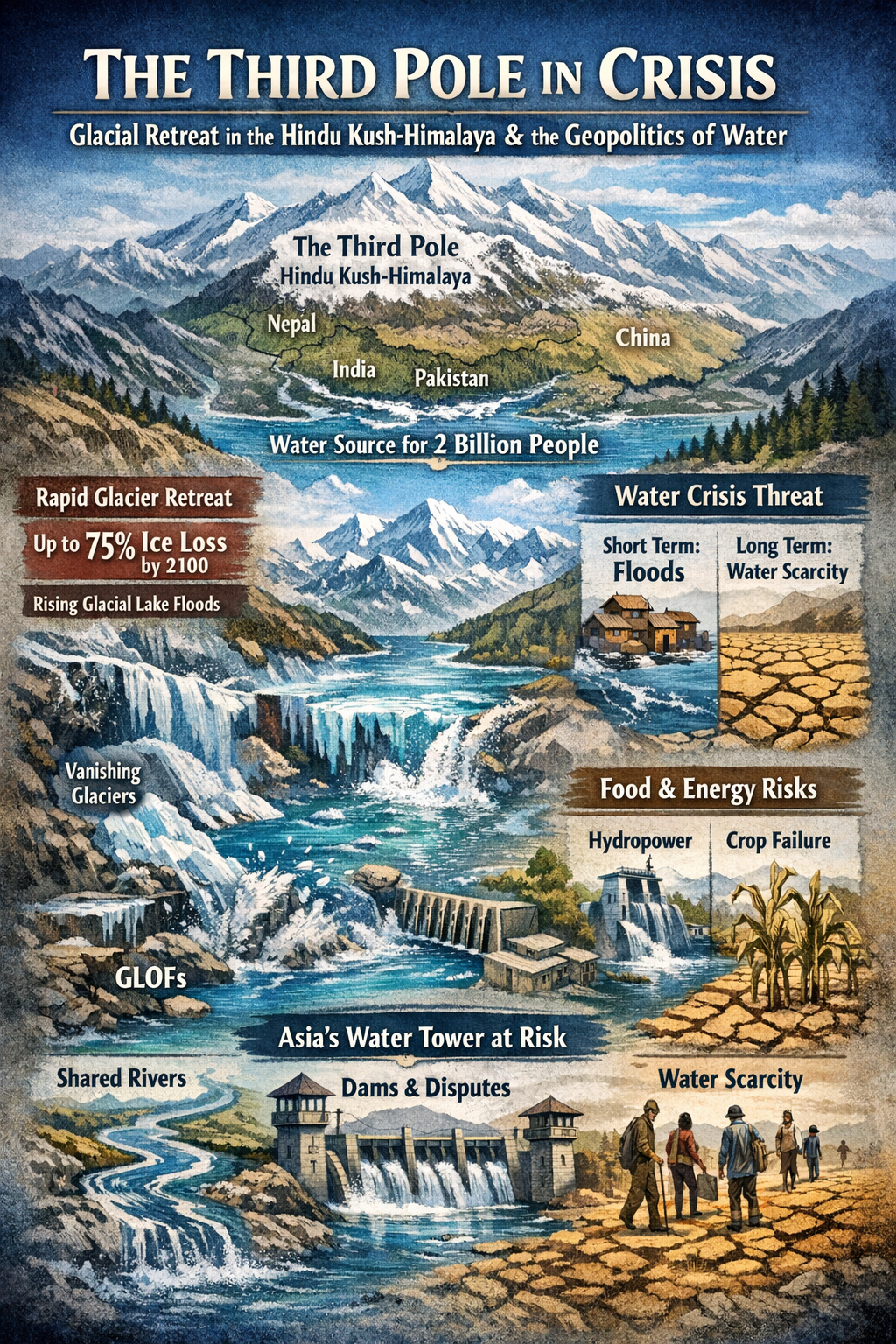
The glaciers of the Hindu Kush-Himalaya (HKH) — the Third Pole — are melting at rates unprecedented in recorded history. Warming across this arc of mountains stretching from Afghanistan to Myanmar has proceeded at roughly 0.3°C per decade since the 1950s, nearly double the global average. The IPCC and ICIMOD project a loss of 30–50 per cent of glacier volume by mid-century under moderate emissions scenarios, rising to over 70 per cent by 2100 under high-emission pathways. The rivers that originate here — the Indus, Ganges, Brahmaputra, Mekong, Yangtze and others — sustain the agriculture, energy systems and livelihoods of more than two billion people across fourteen countries. The crisis is not prospective. It is already unfolding, and its most consequential dimensions are geopolitical.
Water Nationalism and Transboundary Tensions
The HKH presents conditions uniquely conducive to hydro-political tension: multiple states sharing transboundary river systems, pronounced upstream-downstream power asymmetries, pre-existing territorial disputes, and a near-total absence of comprehensive multilateral water-sharing frameworks. As glacial retreat reduces long-term water availability, competition over a shrinking resource risks converting latent rivalry into open conflict.
The India-China dyad over the Brahmaputra is the most consequential flashpoint. China controls the river’s headwaters on the Tibetan Plateau as the YarlungTsangpo, and is pressing ahead with a mega-dam near the Great Bend — potentially the world’s largest hydropower project. India receives the river in Assam, where it sustains tens of millions in agriculture and biodiversity. There is no comprehensive water-sharing treaty between the two states, only a limited flood data-sharing arrangement. That institutional vacuum sits alongside an unresolved border dispute that turned deadly in the 2020 Galwan confrontation. As glacial melt alters Brahmaputra hydrology — intensifying seasonal floods in the near term, reducing dry-season baseflows over decades — the absence of a joint management framework becomes increasingly dangerous.
Further west, the Indus Waters Treaty (IWT) of 1960 — long cited as a rare success of hydro-diplomacy between adversaries — is showing its age. The Treaty was designed around stable historical flow data. Climate change has rendered those baselines unreliable: the Indus basin is approximately 40–50 per cent glacier-dependent for its summer flows, and Pakistan’s agricultural heartland faces existential water stress as that ice contracts. India has simultaneously sought modifications to the IWT to permit greater storage infrastructure, a demand Pakistan resists on the grounds of downstream flow security. The Treaty has survived wars and crises for six decades, but it was not built to accommodate the kind of hydrological volatility now in prospect.
In Southeast Asia, China’s eleven large dams on the upper Mekong — combined with the ongoing retreat of Tibetan glaciers — have generated profound anxiety among lower Mekong states. Cambodia and Vietnam’s Mekong Delta, already stressed by sediment trapping behind upstream dams, face the additional prospect of reduced dry-season baseflows as the cryosphere contracts. The political architecture for managing these tensions — the Mekong River Commission — excludes China as a full member, limiting its effectiveness precisely where upstream power is most concentrated.
Institutional Responses: Progress and Governance Gaps
The International Centre for Integrated Mountain Development (ICIMOD), with its eight HKH member states, is the principal multilateral institution for Himalayan research and knowledge-sharing. Its 2019 Hindu Kush Himalaya Assessment — synthesising over 350 researchers — remains the definitive baseline on glacier status and downstream vulnerability. ICIMOD facilitates glacial lake outburst flood (GLOF) early-warning systems and community adaptation projects, and is trusted as a neutral technical platform even by governments in political tension with one another. But its mandate is advisory, its resources are thin relative to the challenge, and it cannot substitute for the political will required to forge binding water agreements.
Most HKH states have produced National Adaptation Plans under the UNFCCC framework that acknowledge glacier-related water risk. India’s National Action Plan on Climate Change includes dedicated Himalayan ecosystem and water security missions. Pakistan has mountain-specific adaptation programmes in Gilgit-Baltistan; Nepal and Bhutan have invested in GLOF early-warning with international support. Yet these responses remain nationally siloed, under-funded, and disconnected from each other. Rivers, of course, do not respect political borders. The central institutional failure of the HKH is the absence of any transboundary water governance architecture analogous — even imperfectly — to the Nile Basin Initiative or the Mekong River Commission.
This governance deficit is not merely bureaucratic. It reflects the deeper problem of water nationalism: the tendency of riparian states to treat shared rivers as sovereign assets rather than common resources requiring joint stewardship. In the HKH context, that nationalism is entangled with nuclear rivalries, unresolved territorial disputes, and asymmetric development pressures. The window for building cooperative frameworks is narrowing — and the glaciers do not wait on diplomacy.
What Is to Be Done?
Several interventions are both technically achievable and politically urgent. First, a phased HKH transboundary water framework — beginning with mandatory data-sharing and GLOF risk cooperation, expanding over time to flow-allocation protocols — is more realistic than an immediate comprehensive treaty, but would begin to build the institutional habits that deeper cooperation requires. The ICIMOD platform provides a ready-made neutral venue.
Second, ICIMOD’s authority and resourcing need to be substantially upgraded — ideally to a status analogous to the IPCC, with a dedicated financing window under the Green Climate Fund and a formal reporting mandate to member governments and the UN. A proposed Himalayan Cryosphere Science-Policy Platform could fulfil this function. Third, joint GLOF early-warning systems across borders are technically feasible now, would save lives, protect infrastructure, and — crucially — build the trust that more ambitious governance requires. The Sendai Framework for Disaster Risk Reduction provides political cover for exactly this kind of collaboration.
Finally, black carbon reduction deserves far more attention in regional climate diplomacy than it currently receives. Emissions from brick kilns, agricultural burning and diesel transport across the Indo-Gangetic Plain may account for 10–20 per cent of observed glacier retreat beyond what temperature rise alone explains. Coordinated regional action on industrial emissions and clean fuel standards would deliver direct cryosphere benefits alongside public health co-benefits — a rare case of a policy lever that is both consequential and tractable.
The science is unambiguous. The vulnerabilities are documented. What the Third Pole crisis awaits is political will — the willingness of India, China, Pakistan and their HKH neighbours to treat a shared environmental emergency as a foundation for shared governance, rather than a staging ground for zero-sum rivalry. The window remains open, but it is narrowing as the glaciers themselves narrow.
References
- IPCC. Climate Change 2022: Impacts, Adaptation, and Vulnerability — Contribution of Working Group II to the Sixth Assessment Report. Cambridge: Cambridge University Press, 2022.
- Wester, Philippus, Arabinda Mishra, Aditi Mukherji, and Arun Bhakta Shrestha, eds. The Hindu Kush Himalaya Assessment: Mountains, Climate Change, Sustainability and People. Cham: Springer, 2019.
- ICIMOD. Water, Ice, Society, and Ecosystems in the Hindu Kush Himalaya. Kathmandu: ICIMOD, 2023.
- Chellaney, Brahma. Water: Asia’s New Battleground. Washington DC: Georgetown University Press, 2011.
- Ojha, Hemant, et al. ‘Governing a Shared Himalayan Cryosphere: The Case for an Intergovernmental Science-Policy Platform.’ Environmental Science & Policy 120 (2021): 36–45.
Nabina Kansa Banik
Intern, Asia in Global Affairs
The views and opinions expressed in this article are those of the author and do not necessarily reflect the official policy or position of Asia in Global Affairs. The review is intended for academic and informational purposes only. It is not an endorsement of any particular viewpoint, nor is it intended to malign any individual, group, organization, company, or government