Technology and Culture: The Indian Experience

Posted on : August 7, 2023
Author : Antardeepan Roy Chowdhury

Technology has long been seen as an exogenous process which humanity itself creates but it simultaneously guided by it. From the wooden plough which improved agriculture to the steam engine in 18th century England. Science has been seen as the leading source of technological growth however technology cannot prosper without the proper sociological and economic environment. This phenomenon seen in the beginning of the Age of Enlightenment, England and France both of which had enormous colonial empires and adopted the same enlightenment ideals however the Industrial Revolution took place in England rather than in France, an event whose impacts were felt around the world soon changing it altogether. The reason for this unusual event has been the institutions present in England which allowed people who made scientific breakthroughs and contribution to societies to gain social status and wealth even sometimes being granted knighthood an prominent example is Isaac Newton on the other hand France at the time was one most absolutist monarchies in Europe since the reign of Louis XIV also known as the ‘Sun King’, had institutions which blocked the peasants or the serfs from moving upward in their social status whatever their contribution towards the state, a system which would be brought down during the French Revolution and then carried forward by Napoleon, this social mobility made both adoption and creation of technology a more facile, hence was born the Industrial Revolution. Technology has also been guiding hand of economic growth in nations, in some ways the technology might even be a part of Adam Smith’s Invisible Hand, which he had described as, “Individuals serve the collective interest precisely because they are guided by self-interest”. Economists like Solow and Frankel who belonged to the neoclassical school of economics gave the idea, technology being one of the crucibles on which a nation economic development is achieved.  This economic doctrine was adopted by both blocs which had emerged after the end of the Second World War, although the political doctrines influenced these economic theories.

However modern economists, have indicated that technology itself is much more complex a factor than it was initially thought, shown by Ricardo Hausman and Dani Rodrik. Culture which is a very subjective factor plays a big role in the use and adoption of technology, this has one of the critics against the neoclassical theories of growth even technology and geography also play a critical a relation explored by Paul Krugman. Even though the internet has made knowledge easier to access and globalism had led to breakdown of barriers between nations easier transfer of technology, however the adoption of technologies has varied from nation to nation. While in some places technologies which produced great failed in a different nation. An example of this event was seen in Japan which had begun its modernization after the Meji Restoration. The Japanese experience in the steel industry was similar, in 1874, the Meji government overrode local engineers to build a factor with technology adopted from England but the factory was closed down shortly after this because of scare availability of charcoal and low-quality coke.


In wake of the Battle of Plassey, Cornwallis instituted the Permanent Settlement after the, this fixed the revenue in newly conquered Bengal but left the common peasants to untold oppression by the Zamindars who were now mostly rich business men with sole intention of increasing their gain replacing the old Zamindars who had knowledge of the land and its limitations. This new form of feudal system which worked in Cornwallis’s own land back in England was a disaster in India, leading to horrific famines were millions perished, this forced import of technology was a catastrophe. One of the best studied events in economic history concerns, the cotton textile industry which was a crucial industry in 19th century and Lancashire cotton mills were the world leader, and remained so well into the 20th century, one such firms, Platt sold foreign buyers a full technological package, complete with equipment, training to operate the machines and even managerial staff. This gave firms around the world access to “same” technology as the Lancashire firms. In case of India, a firm named Clark and Woolcott bought this package from Platt to set up a firm in India, however the factories set up in India had a fraction of both the profitability and productivity. This showed the emergence of new Industries is a diverse affair which depends on both mutual adaption of machines and local conditions which includes a multitude of factors such as culture, climate, resources available. After India’s tryst with destiny, the Planning commission was set up India formally became a republic in 1951, it came up with the system of Five-Year Plans a less stringent form compared to the Soviet Union. The First Five Year Plan included a myriad of objectives but focused on the domain of agriculture since 70% of India’s population were dependent on however even then India would face chronic famines. This famine situation will be finally eliminated after Green Revolution, this new technology is also a curious case of adoption of technology, since the green revolution worked significantly better in West India in states like Punjab, Haryana and UP, which increased their yields many folds however the green revolution had little impact in rice belt of Eastern India. This lopsided situation saw the greater commercialization of agriculture in West India leading to higher incomes but little to no effect in the east. India witnessed a good amount of growth during this period but it stagnated as India was unable to find to the comparative advantage in Industries however a seed planted by the late Prime Minister Rajiv Gandhi, had far reaching consequences was the import of computer technology, this would later bloom into the syncretism which was achieved when India became a giant of the IT industry. India which wasn’t able to follow the traditional steps of stages of economic growth, jumped into the tertiary sectors like IT, Tourism, etc. However, India is not a particularly technologically advanced nation, but has generated firms which have gone on become leaders in the Informational Technology industry like Infosys and Wipro. India’s rise in this field has been a perfect combination of both technology transfer and local conditions which can and should be replicated in the future. A policy born out of this was the Special Economic Zones (SEZ) which have been particularly active and has produced moderate results. India has the youth population largest in the world which is an enormous resource which attracts industries. Education in this way is also a boost for syncretism which allows for the creation of skilled labor which is crucial for the lopsided growth India finds itself in. Third world nations across both Asia and Africa have struggled in adoption of technologies since many of these technologies are incompatible with the local culture. Hence technology and culture go hand in hand, a curious relation which will be crucial for nations, as today the world is more multicultural and linked than ever before allowing for a greater flow of technology which if accomplished properly will lead poverty eradication and economic development.

References

Hausmann, R., & Rodrik , D. (2003). Economic Development as Self-Discovery. Journal of Development Economics, 603-633.

Krugman, P. (1996). Increasing Returns and Economic Geography. Economic Geography, 259-292.

Lowe, N. (1997). Mastering Mordern World History (3rd Edition ed.). Chennai: Macmillan Publishers, ISBN: 978-0333-93218-6

Rao, V. V. (1952). India’s First Five-Year Plan-A Descriptive Analysis. Pacific Affairs, 3-23.

Screpanti, E., & Zamagni, S. (2005). An Outline of the History of Economic Thought (2nd ed.). New Delhi: Oxford University Press,ISBN:978-0-19-927913-5

Solow, R. M. (1956). A Contribution to the Theory of Economic Growth. The Quarterly Journal of Economics, 65-94.


Antardeepan Roy Chowdhury

Intern, Asia Global Affairs.


The originality of the content and the opinions expressed within the content are solely the author’s and do not reflect the opinions and beliefs of the website.
/ Technology and Culture: The Indian Experience

WORLD AND LAND OF THE RISING SUN : JAPAN ON RELEASING FUKUSHIMA’S RADIOACTIVE WASTE

Posted on : August 1, 2023
Author : Purnima Prasad

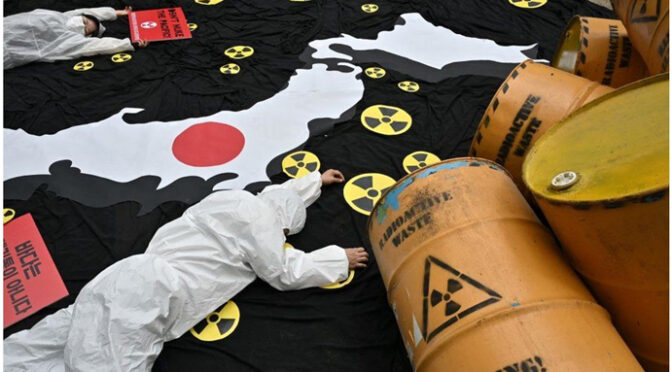
Japan will soon begin dumping radioactive water into the ocean after the United Nations Nuclear Regulatory Agency approved a controversial plan to go into effect 12 years after the Fukushima meltdown. Plans to release the treated wastewater have been in the works for years, and in 2019 the environment secretary said there was “no other choice” as space to contain pollutants was running out. The devastating earthquake and tsunami of 2011 damaged the power and cooling systems of the Fukushima nuclear power plant, overheated the reactor core, and contaminated the water inside the plant with highly radioactive materials. Since then, new water has been pumped in to cool the fuel residue in the reactor. At the same time, groundwater and rainwater percolate, creating even more radioactive wastewater, which must now be stored and treated. The state-owned Tokyo Electric Power Company (TEPCO) has built over 1,000 giant tanks, currently holding 1.32 million tons of wastewater. That’s enough to fill over 500 Olympic swimming pools. But the space runs out quickly. The company said building more tanks was not an option and that it needed to make room for the plant to be safely decommissioned. This process includes decontamination of the facility, demolition of the structure and complete decommissioning. Despite, this decision of Japan is met with heavy criticism from both outside and inside.

China is urging Japan to reach agreements with regional countries and international organizations before releasing water. The Chinese government also accused Tokyo of violating its “international moral and legal obligations” and warned that it “will have to face all the consequences” if it goes ahead with the plan. The two countries now have an awkward relationship, with tensions escalating due to Japan’s recent military buildup and China’s provocative moves around Taiwan. Japan consulted with neighbouring countries and invited a team of South Korean experts to visit the Fukushima nuclear power plant in May. But it is unclear to what extent it will get approval from neighbouring countries before proceeding. South Korea, which, unlike China, is interested in strengthening ties with Japan, pushed its concerns by saying it “respects” the IAEA’s findings. But the approach has angered South Koreans, with a recent poll showing 80% of the public worried about water release. “The government is implementing strict policies to avoid littering into the sea…But now the government has not said a word (to Japan) about sewage flowing into the sea,” said Park Hee-jun, a South Korean fisherman. said. BBC Korean. “Some officials are arguing that if they don’t want to confuse consumers further, they should be silent. I think that’s nonsense.” Thousands took part in protests in Seoul demanding government action as some shoppers stocked up on salt and other essentials out of fear of food supply disruptions.

In response, South Korea’s parliament last week passed a resolution opposing the water discharge plan, but it’s unclear how that will affect Japan’s decision. Authorities have also introduced “strict inspections” of seafood and maintain a ban on imports of Japanese seafood from the area around the Fukushima nuclear plant.
To ease public fears, Prime Minister Han Duk-soo said he intended to demonstrate that the water from Fukushima was safe to drink, but officials said last week that only a small portion of the runoff was in South Korean waters. Elsewhere in the region, several island states have also expressed concern, with the regional group Pacific Islands Forum calling the plan another “massive nuclear pollution disaster.”

Despite the enormous global scientific and political interest in the status of Fukushima treated water, local fishermen and Fukushima coastal communities, living in the shadow of the nuclear power plant and daily accept the effects of the release as they still face banof their products in other market and the release of radioactive water will only bring further financial burden. Despite the concerns of key stakeholders living on it, the rationale limited the visibility of the aftermath of the Fukushima accident in scientific-political discourse. Even if TEPCO and the government minimized the environmental impact through careful management of the process, some international experts believe that, Indirect socio-economic impacts of treated water discharge on fisher communities are likely to be felt. Year-round in the long run. Proposals from the community of researchers and institutions working on science-policy linkages on reclaimed water in Fukushima should be based on a deep understanding of the local community context and address the concerns of local stakeholders.

To ease up the chaos, the researchers and scientists have a positive stance in this situation-

Professor Robin Grimes, Professor of Energy Materials, Imperial College London, said that the concentration of the radionuclide tritium remaining in the wastewater is very low and well below the level of environmental concern. Tritium status is important. In this case the tritium is part of a water molecule (tritiated water) but not bound to a more complex compound. These low levels of tritium are greatly diluted by release, as there is no established mechanism for bioaccumulation of tritiated water. It would be interesting to see if there is a detectable increase in tritium within the discharge region compared to the natural tritium produced by the cosmic ray process. Admittedly, it is very difficult to compare the environmental impacts of different radionuclides, but concentrations of tritium would be much lower than levels of naturally occurring radionuclides.Smith points out that the release of tritiated water is part of normal nuclear power plant operation. He said 400 to 2,000 terabecquerels of tritium are released into the ocean each year from the Heysham nuclear power plant and the Sellafield nuclear fuel fabrication plant in the UK. It’s a very weak beta-emitter, so overall it’s not very radiotoxic.

Lastly, it is sure to say that despite all the arguments and counter-arguments,the geo-politics of the region depends and revolves heavily on the ecological causes and effect it will have in future forthis region, not just mere for the ‘Land of the Rising Sun’.


References

Expert reaction to IAEA safety review and report on Japan’s plans to release treated water into the sea. (2023, JULY 4, ). Retrieved from Science media centre: https://www.sciencemediacentre.org/expert-reaction-to-iaea-safety-review-and-report-on-japans-plans-to-release-treated-water-into-the-sea/

IAEA Releases First Report on Safety of Planned Water Discharge from Fukushima Daiichi Site. (2022, April 29). Retrieved from IAEA: https://www.iaea.org/newscenter/pressreleases/iaea-releases-first-report-on-safety-of-planned-water-discharge-from-fukushima-daiichi-site

Jessie Yeung, M. M. ( 2023, July wednesday 5). Japan will soon release Fukushima radioactive water into the ocean. How worried should we be? Retrieved from cnn: https://edition.cnn.com/2023/07/04/asia/japan-fukushima-wastewater-explainer-intl-hnk/index.html

Mabon, L. (2022, October 28). Bring voices from the coast into the Fukushima treated water debate. Retrieved from PNAS: https://www.pnas.org/doi/10.1073/pnas.2205431119

Wong, T. (2023, july Wednesday ,4). Fukushima: Anxiety and anger over Japan’s nuclear waste water plan. Retrieved from BBC News: https://www.bbc.com/news/world-asia-66106162


Purnima Prasad

Intern, Asia in Global Affairs


The originality of the content and the opinions expressed within the content are solely the author’s and do not reflect the opinions and beliefs of the website.
 

/ WORLD AND LAND OF THE RISING SUN : JAPAN ON RELEASING FUKUSHIMA’S RADIOACTIVE WASTE

THE TAIWAN ORDEAL AND THE THREAT OF THE DRAGON

Posted on : April 20, 2023
Author : RAUNAK BHATTACHARJEE

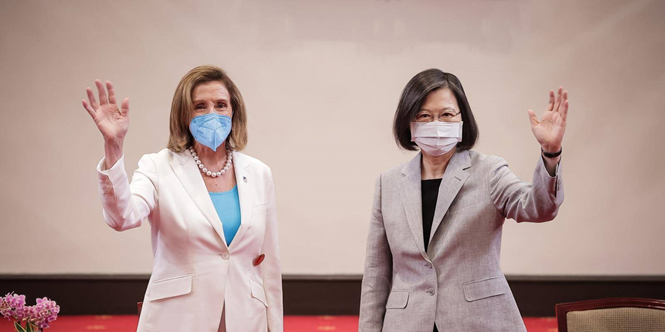
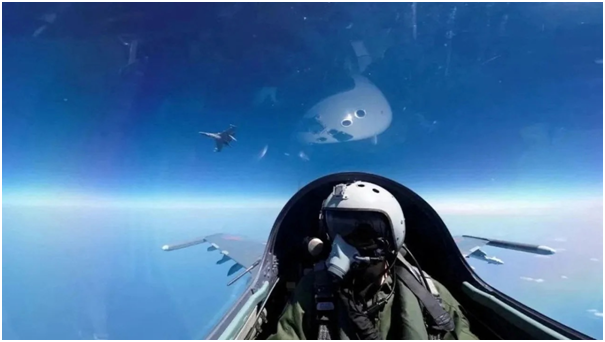
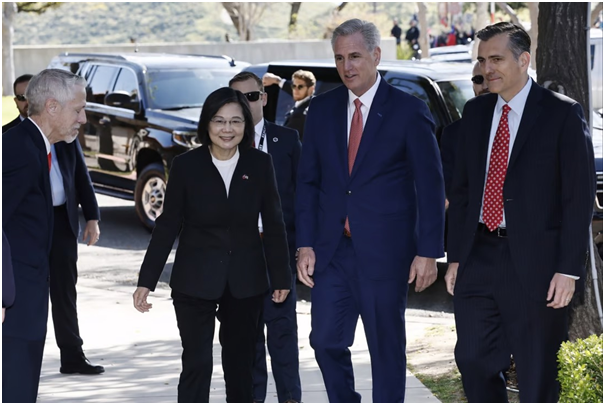
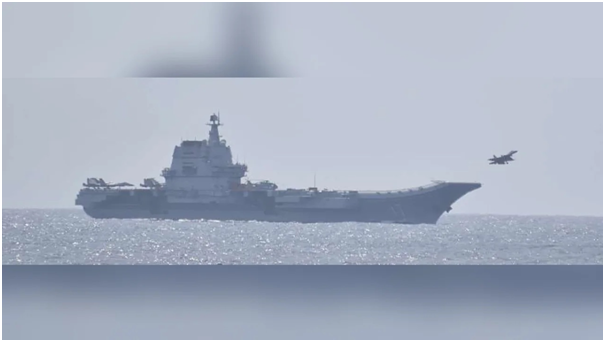
Operation Joint Sword officially comes to an end, as of 10th April, 2023. It was a 2-day exercise regime conducted by the Chinese PLA’s Eastern Theatre Command that keeps an eye on the Taiwan Strait, and also plays a pivotal role in the South China Sea region; this show of strength is meant to be a part of the Chinese Carrot and Sticks Strategy, that it employs in handling the immediate neighbourhood. These latest series of exercises and naval as well as aerial build-up around Taiwan, encroaching upon its airspace and territorial waters, undermining its sovereignty, constitute a knee-jerk response to the Taiwanese President Tsai Ing-Wen meeting up with US House of Representatives Speaker, Kevin McCarthy. This is reminiscent of the Chinese action following the then House of Representatives’ Speaker, Nancy Pelosi’s visit to Taiwan in 2022.

The ‘One China Policy’ is not exactly an unbeknownst Chinese policy stance, however, what it seriously clashes with, is the United States’ ‘Strategic Ambiguity’. The Nixon-Kissinger opening to China strongly augmented China’s image in the international arena. Michael Pillsbury, the noted diplomat and China watcher, in his work, ‘The Hundred-Year Marathon China’s Secret Strategy to Replace America as the Global Superpower’ clearly states how Nixon and successive regimes of Carter, Reagan and Clinton have pandered to the ‘One China Policy’, however, maintaining ties with Taiwan, arming it and augmenting its position. The pro-Taiwan stances, in this regard, have been taken the US Congress, with the Office of the President of the United States maintaining a principled silence on Taiwan, until extenuating circumstances erupt.

The present exercise, Joint Sword, involved massive PLAN (People’s Liberation Army Navy) and PLAAF (People’s Liberation Army Air Force) forays into Taiwanese territorial waters and airspace, with the most advanced weaponry at hand, making a full display of strength. On the diplomatic front, the ‘Wolf Warrior’ diplomats of China, part of ‘China’s Civilian Army’, as Peter Martin addresses them, discredited both US and Taiwan for maintaining communications. On the other hand, the failure of the West in handling the Russo-Ukrainian crisis is also something they harked back to, as part of the exhibition of Chinese Smart Power.

The term ‘Smart Power’ is in fact, very ambiguous in nature, and is contested. Wilson III (2008) defines it as the ‘capacity of an actor to combine elements of hard power and soft power in ways that are mutually reinforcing such that the actor’s purposes are advanced effectively and efficiently’. To put it in other words, the teleological facet of smart power involves the proficient usage of resources albeit in an economical manner, focussing on an efficacious outcome. The particular areas of importance include: the ‘target’, the specific point spatially or demographically, wherein the power needs to be exercised; ‘self-knowledge’ pertaining to the setting up of goals and also, having epistemological and ontological understanding of the self; ‘broader regional and global context’ pertaining to the location and contextuality of the action; ‘tools’ vis-à-vis the application of resources aimed at teleological execution. This was something that he referred to, vis-à-vis, US Foreign Policy, but China is a very strong adherent of this particular dictum.


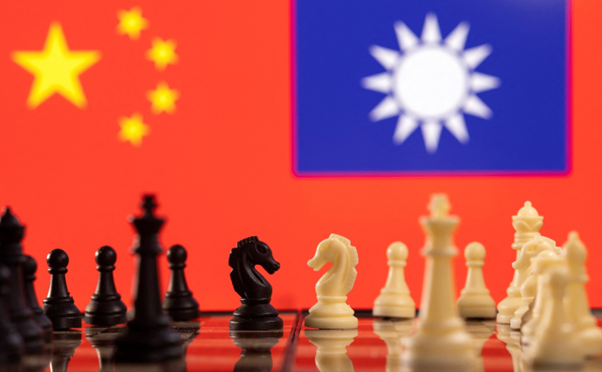
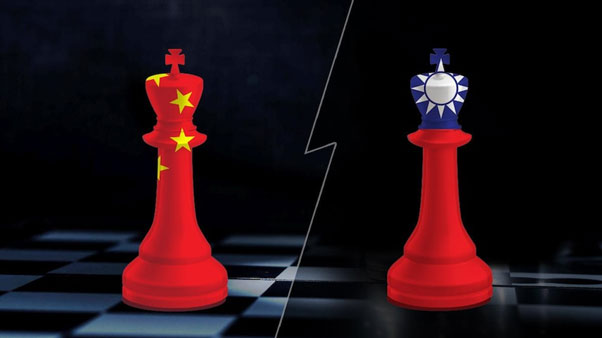
Pillsbury has talked in length about China’s Marathon Strategy in his magnum opus, that involves a multi-pronged process of deception, inconspicuous surveillance, a certain discretion when it involves manoeuvrability, and hedging bets on the certain recklessness of the hegemon. However, China has, at this juncture, shown its deep understanding of Kautilya’s Shadgunya theory that involves the six principal tenets of Foreign Policy: sandhi (peace); vigraha (war); asana (neutrality/ to wait and observe, before acting); yana (involving coercive diplomacy and mobilization for war); samshraya (forming alliances); dvaidhibhava (diplomatic duplicity/ ‘dual policy’).  Adhering to yana exhibits Chinese carrot and sticks policy, and to the Warring States philosophy that the ying pai (hawks) executive tend to prefer, goes on to show that President Xi Jinping is not mincing his words or vacillating his position. In fact, he is not even counting the cauldrons. He is biding his time, provoking to a certain extent, but overall, he is playing a Long Game of wei qi.


Raunak Bhattacharjee is an Adjunct Researcher at Asia in Global Affairs, Kolkata, India.He is an Honours Graduate in Political Science from Presidency University, Kolkata, West Bengal, India. His interests lay in International Relations, Area Studies and Maritime Naval Security Studies with particular emphasis upon the Indian Ocean Region, and he is a neo-realist.

/ THE TAIWAN ORDEAL AND THE THREAT OF THE DRAGON

DEEPENING THE GORDIAN KNOT: RUSSIAN SUSPENSION OF ‘NEW START TREATY’

Posted on : March 13, 2023
Author : RAUNAK BHATTACHARJEE

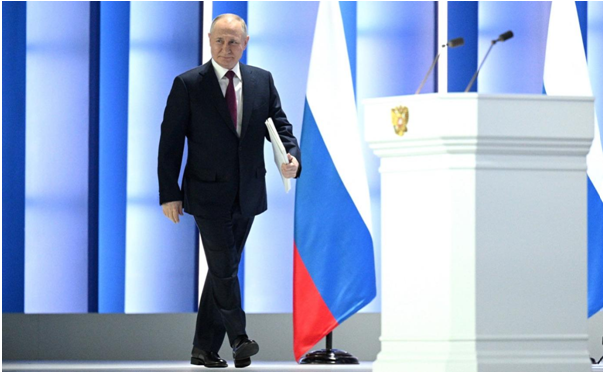
Source: http://en.kremlin.ru/events/president/news/70565/photos/70394


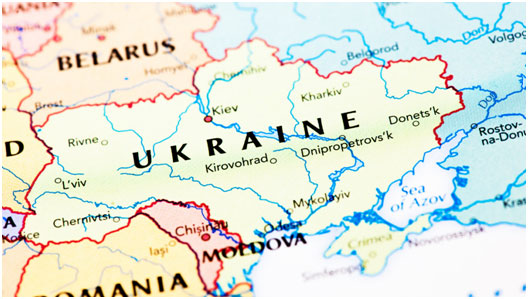
“The Russian belligerence against Ukraine has been morphing into a stalemate”, these are the exact words used by the Western media houses in general, under the undue influence of the Five Eyes Club, to present their discourse vis-à-vis the Russo-Ukrainian Conflict. The economic war, being waged by the United States and its allies, particular, the United Kingdom, against the Russian Federation, has further pushed the latter to the Chinese camp, who at the commencement of the crisis, did voice out their vote of dissent against the presence of the North Atlantic Treaty Organization (NATO), but over time, has obviously kept herself under check; a classic Chinese ploy picked from the Stratagems of the Warring States, the Chinese equivalent to Kautilya’s Arthashastra (‘Compendium on Statecraft’) and Machiavelli’s Il Principe (‘The Prince’), that provides the wisdom, ‘wai ru, nei fa’ (‘mask of munificence veiling the bestiality of the self’).


It is under such precarious and pernicious circumstances, one should take cognizance of the fact that a year has passed, with the clouds of conflict still intact, and neither Vladimir Putin nor Volodymyr Zelensky are backing down from their aggressive stances, thereby aggrandizing the conflict, and with the delivery of Western weapons to Ukraine, the Russian Federation finds itself in a Gordian knot, out of which it cannot really find a way out, but with time, gets itself more inextricably engrossed. Bearing these ontological facets in mind, President Putin has kept his right foot forward and suspended the new START, that was signed in 2011 by his predecessor, Dmitri Medvedev and then-US President Barack Obama.


The START is an acronym for Strategic Arms Reduction Treaty, that actually stands for ‘The Treaty between the United States of America and the Russian Federation on Measures for the Further Reduction and Limitation of Strategic Offensive Arms’, a policy relic of the erstwhile Cold War-era Containment strategy, as envisioned by George F Kennan, adhered to, by the United States vis-à-vis the USSR, augmented by détente and deterrence. This is indeed an unforeseen step from Putin’s modus operandi, and is not at all reflective of Soviet diplomatic strategy, something that was not done even at the height of the Soviet’s Afghan misadventure of the 1980s. This brings out in the open, multiple and multifarious vicissitudes in the mode of warfare, with the Russian arsenal being put to use, on a scale that has not been witnessed in the passing year.


Kyiv’s assertive position with President Zelensky at the helm, in his camouflage dress greens, meeting with Western leaders, lobbying for weapons and garnering support, have been augmented by US President Joseph Biden’s Ukraine visit and subsequent stopovers at the capitals of NATO member states like Poland, that had earlier been under the Soviet led Warsaw Pact and fell directly under the USSR’s area of influence, have not been missed by Moscow. The revocation of the New START that was set to expire by February 4, 2026 is indeed a solid statement that the Russian Federation finds itself in tough waters. As the famed Russian commentator, Mark Galeotti, in his work, Putin’s Wars: From Chechnya to Ukraine, highlights, nuclear weapons, to Putin, are not just ornamental to the vast military arsenal, but are instrumental in the exhibition of Russian hard power, and shall be resorted to, in the last phase of strategic evaluation, when escalation has reached its zenith. Indeed, Russia’s unique blend of soft and hard power, something that has been referred to, by certain scholarly cliques as sharp power is onerously dependent on the presence of the erstwhile Soviet nuclear arsenal, that has been bequeathed unto the Russian Federation.


The sordid effect of the economic sanctions is visible and it goes without say, that there is the development of a certain angst amongst the Russian masses regarding Putin’s authoritarianism and autocratic mode of government. The oligarchy with its leanings towards Putin finds itself stretched thin, following the tedious sanctions that they have accrued, from the UK and the USA, in particular. Thus, one must indeed conclude that Russia is stretched thin, at this point of time. Another important facet to the discourse, is the Western responsibility towards Ukraine; it does not simply serve nominally as the buffer between the European mainland and Russia, it also serves as a conduit for energy transfers. Moreover, it must also be noted that Ukraine had given up its nuclear weapons on the assurance that it shall not be facing any such nuclear threat and if, in any case, a threat arises, then it shall be provided the requisite support. At present, this assurance shall be put to the test, and the question of national interests become more pertinent.


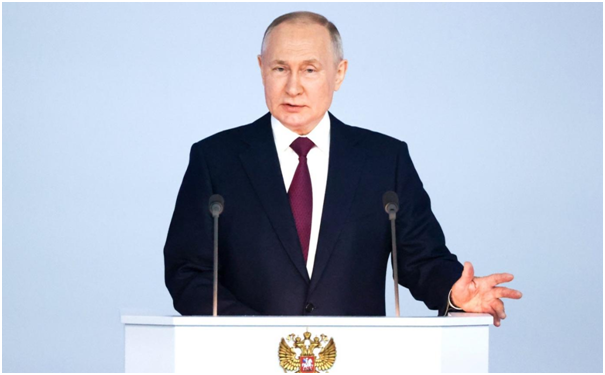
The Russian accusations against the Neo-Nazi elements in Ukraine are indicative of the sentiments of the Great Patriotic War (1941-45), viz the Second World War, but are indeed true. The Azov Regiment continues to be a long-standing blemish upon the Ukrainian Government’s and especially Zelensky’s track record. With the added element of US support, this further complicates the Ukrainian Nationalist Discourse. The tautological Russian Civilizational discourse that holds Kyiv to be Russian adds on to the complications; these impediments that are garnered, complement the crisis, further escalating it.  At this current juncture, two P-5 members of the UN Security Council, who also happen to own the largest nuclear arsenals are in a standoff in the Ukraine crisis. President Putin’s State of the Nation address stands as an open rebuke towards escalation, as one can comprehend from the statements provided:


In fact, the anti-Russia project is part of the revanchist policy towards our country to create flashpoints of instability and conflicts next to our borders. Back then, in the 1930s, and now the design remains the same and it is to direct aggression to the East, to spark a war in Europe, and to eliminate competitors by using a proxy force.


We are not at war with the people of Ukraine. I have made that clear many times. The people of Ukraine have become hostages of the Kiev regime and its Western handlers, who have in fact occupied that country in the political, military and economic sense and have been destroying Ukrainian industry for decades now as they plundered its natural resources…  Responsibility for inciting and escalating the Ukraine conflict as well as the sheer number of casualties lies entirely with the Western elites and, of course, today’s Kiev regime, for which the Ukrainian people are, in fact, not its own people. The current Ukrainian regime is serving not national interests (sic.), but the interests of third countries…


The West is using Ukraine as a battering ram against Russia and as a testing range. I am not going to discuss in detail the West’s attempts to turn the war around, or their plans to ramp up military supplies, since everyone is well aware of that… The Western elite make no secret of their goal, which is, I quote, “Russia’s strategic defeat.” What does this mean to us? This means they plan to finish us once and for all… In (sic.) this regard, I am compelled to announce today that Russia is suspending its membership in the New START Treaty. To reiterate, we are not withdrawing from the Treaty, but rather suspending our participation.


It is from such a speech, President Putin clearly establishes his tsarist stance and does not obfuscate his clear portrayal of Tsar Peter I. However, as Galeotti points out, this could soon turn out to be his last dictum as Tsar Nicholas II. Only time will tell, where the waters shall roll, but as of now, a longue durée understanding of Russian ‘defensive warfare strategy’ has shown that the people have always claimed the head of the politician. Perhaps, that is the irony of a Clausewitzian curse, a real Faustian bargain, one that does not end the way, Goethe ends his protagonist’s saga, but ends in a cold and swift manner.


Raunak Bhattacharjee is an Adjunct Researcher at Asia in Global Affairs, Kolkata, India.He is an Honours Graduate in Political Science from Presidency University, Kolkata, West Bengal, India. His interests lay in International Relations, Area Studies and Maritime Naval Security Studies with particular emphasis upon the Indian Ocean Region, and he is a neo-realist. His favourite realist scholars include John J Mearsheimer and Graham Allison. He is also interested in the Frankfurt School of Thought, Gramscian Studies and Postmodern School of Thought. He is an avid bibliophile and loves quizzes. He has been associated with Asia in Global Affairs from 2019 as an intern, and under the able guidance of the mentors, he has published 10 original papers and participated in more than 10 webinars as a paper presenter, winning due laurels and very often, being the youngest participant.He has also focused precisely upon the application of psycho-analytic theories in International Relations, trying to decode Role Conception, and to comprehend behaviour of the actors in the arena of global politics. He has written extensively on American political behaviour in the contemporary times, and is currently contemplating a possible solution to the Thucydides’ Trap using the balancing variables of India and the European Union. He is focusing his research upon Multipolarities arising across the globe, and concocting a longue durée approach of the same, to understand the comprehend the phenomenological aspect of the same in its brevity.


***** The originality of the content and the opinions expressed within the content are solely the author’s and do not reflect the opinions and beliefs of the website.
/ DEEPENING THE GORDIAN KNOT: RUSSIAN SUSPENSION OF ‘NEW START TREATY’

Escalation, Invasion or Act of War? The Ukraine crisis and its impact on Asia.

Posted on : November 16, 2022
Author : Suchandra Bhaduri

On February 24, 2022, Russia began an aggressive attack and invasion by land, sea and air of Ukraine as the world watched cities crumble into dust. Ukraine, though not part of the North Atlantic Treaty Organization (NATO) began receiving support from its members, backed by the United States as the conflicts began to intensify. The reason for the support can be traced back to the days of the Cold War.

NATO was born at the end of the Second World War in 1949 with 12 states as its member. It made a promise to protect West European states against any aggression of the Soviet Union. Article 5 of the Washington Treaty highlighteda collective defense policy which served as ‘strategic reassurance’(George & Sandler, 2022). What began as a collective security alliance soon became an instrument for the spread of American economy and politics in Europe. With many states such as Greece, Turkey, and West Germany and Spain joining the alliance, it became all the more formidable by the 1980s. The end of the Cold War in the 1990s meant that the East European countries were now free to begin their own nation-building process isolating themselves from the Soviet Union (Choonara, 2022).

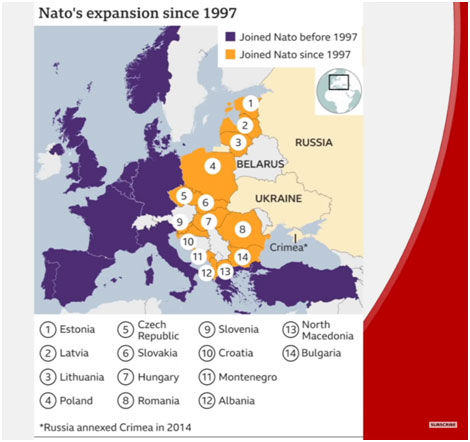
The role of NATO changed with the collapse of the Soviet Union. It now became an alliance to ensure Europe’s resources- geographic, demographic, economic and military to remain secure from adversaries. It also became central to the US strategy of maintaining global primacy, by launching a war against terror around the world(Menon & Ruger, 2020). The expansion of NATO into Eastern Europe also became unhindered, with countries like Czech Republic, Hungary, Poland (1997), Bulgaria, Estonia, Latvia, Lithuania, Romania, Slovakia and Slovenia (2002), Albania and Croatia (2009), all former Warsaw Pact members joining NATO, realizing the importance of the already successful western alliance organization for their growth and protection. NATO soon became a symbol, a protector of global peace, a champion of democracy, while simultaneously spreading American influence all over the world. The alliance began promoting economic reform, bringing militaries under civilian control in the Eastern European countries(Menon & Ruger, 2020).Russia against such expansions, sent several objections, but they made little difference to NATO’s expansionist policy.

Source: BBC News

Numerous critics warned the US that this eastward expansion of NATO would provoke resistance from Russia, that materialized as problems began cropping up in 2008, with a war against Georgia. This war snuffed out Georgia’s NATO ambitions. This was followed by the 2014 crisis that began in Ukraine. A step to join EU by Ukraine, straining economic and trade relations with Russia provoked Russia. Added to this was an alleged coup that ousted a pro-Russian government in Ukraine highlighted the American wish to align Ukraine with the west. This led to the annexation of Crimea, Ukraine’s sole Russian majority province, signaling the beginning of a long- drawn troubled relationship. While internal conflicts and factions in Ukraine plagued the government, a ceasefire agreement in 2015 brought the armed conflict to a halt. But this was not a satisfactory solution, as NATO began deploying battalions,fearing Russian expansion into other states in Eastern Europe. NATO also began giving Comprehensive Assistance Packages (CAP) to strengthen its defense in Ukraine (NATO.inc, 2022). For Ukraine, this trans-Atlantic alliance offers a wide range of economic benefits and a protection against aggression with Russia. For Moscow, NATO’s enlargement is a signal of rupture with its pro-Russian ethnic groups, a threat to its dominance in the Black Sea and Don River.

Early 2021 saw Moscow conducting military exercise in the east of Ukraine, U.S. intelligence picking up signals of an impending invasion of Ukraine also began mobilizing its troop in the Ukrainian borders. All speculation came true when Russia invaded Ukraine in February 2022. Calling it the ‘gravest threat to Euro-Atlantic security’ NATO leaders condemned this invasion. Calling it an ‘act of war’, an unprovoked attack on Ukraine’s sovereignty and territorial integrity’, the world reacted. Ukraine, though not a member of NATO, ineligible to receive troops from member countries, began receiving weapons, military equipment from the trans-Atlantic states. NATO also began imposing economic sanctions on Russia as it began bombing and attacking various cities in Ukraine. Kyiv moved a fast-track motion to join the military alliance, which angered Moscow even more. The fear of a third world war, ‘a nightmare scenario’, lingered in the minds of NATO’s members, as Ukraine’s membership in NATO at this juncture would automatically mean that NATO members become part of this ongoing conflict. What NATO members fear is that, allowing Ukraine’s membership, imposing stricter sanctions, declaring a no-fly zone, sending troops to aid Ukraine would escalate the conflict in Europe.Member states thus, want a resolution of the conflict, restoring Ukraine’s government before letting it in. They also believe that becoming a NATO member should not be a concern for Ukraine anymore, as it is receiving all the help NATO can offer even without a membership.

The Russian invasion coupled with the impact of the two-year pandemic, had several adverse effects around the world.Russia and Ukraine being global suppliers of oil, gas, wheat, sunflower oil impacted supply chains, bringing inflation, destabilizing development trajectories and threatening economic recovery, especially in several South-Asian states. Pakistan, Sri Lanka, Nepal, Maldives, Afghanistan, Bhutan and Bangladesh all have suffered, some better than the other. India, in the midst of the conflict between Ukraine and Russia has maintained neutral while voting in UN resolutions, focusing mainly on dialogue, diplomacy and humanitarian assistance to Ukraine. It enjoys partnership relations with Russia and wishes to continue to do so. Trade linkages now look towards Iran for East-West trading activities. Russia has traded with India through the Suez Canal and sea-routes which have become very vulnerable due to changed political environment (Ahmadi, 2022). What gains prominence here is the International North-South Transport Corridor (INSTC) connecting Russia through the Caucuses, shortening travel time between Russia and India, changing the whole geoeconomic scenario of the world. Sri Lanka continues to cripple under a debt, corruption, pandemic and collapse of trade routes. With increasing decline of tourism from several countries, it struggles to survive without foreign help. The focus of the world shifted from Afghanistan to Ukraine, and led the Taliban to reintroduce several projects it had launched before. Who suffered most in all this struggle are the students who travelled from countries such as Nepal, Bhutan, Pakistan and India to Ukraine(Trigunayat, 2022). What we notice here is a predominance of a stance of neutrality, silence, and an overarching urge to push for dialogue and negotiation rather than condemnation of Russia. Response from the ten ASEAN (Association of Southeast Asian Nations) members were also varied. Singapore like many nations around the world condemned Moscow, announced a number of financial sanctions and export control measures. Indonesia, Brunei and Philippines on the other hand did not call Russia an aggressor, even when they condemned the attacks. Malaysia expressed sadness, Vietnam and Laos did not speak against its biggest defense partner terming the conflict as ‘complex and sensitive’(Shah & Pachaly, 2022). Myanmar’s junta government being recognized by Russia, supported its actions as legitimate. What has emerged to be true is how several economies faced distress due to this conflict. However, what we see is an urge to prioritize national interests instead of condemning Russian aggression. This implies the growth of a strategic shift in the attitude of Asian countries, where they understand how they are played as pawns in several of these crisesonly complicating their trade, tourism, economic growth and energy resources. What this crisis also questioned was the relevance of geoeconomics for ensuring security in the world and western capabilities of reacting against aggression. As China awaits silently, gaining inspiration from the Russian invasion of Ukraine, observing NATO’s reaction to this war, what the western world now fears is an aggressive onslaught on Taiwan.

References

Ahmadi, A., 2022. Russia-Ukraine War: Implications for Asian Geoeconomics. [Online] Available at: https://thediplomat.com/2022/07/russia-ukraine-war-implications-for-asian-geoeconomics/

Choonara, J., 2022. The devastation of Ukraine: NATO, Russia and imperialism.. International Socialism.

George, J. & Sandler, T., 2022. NATO defense demand, free riding, and the Russo-Ukrainian war in 2022. Journal of Industrial and Business Economics.

Menon, R. & Ruger, W., 2020. NATO enlargement and US grand strategy: a net assessment. International Politics.

NATO.inc, 2022. Relations with Ukraine. [Online] Available at: https://www.nato.int/cps/en/natohq/topics_37750.htm

Shah, S. & Pachaly, J., 2022. The Ukraine War: Perspectives and Reactions in Asia. [Online] Available at: https://in.boell.org/en/ukraine-war-reactions-asia

Trigunayat, A., 2022. The War in Ukraine: Impact on South Asia. [Online] Available at: https://indiafoundation.in/articles-and-commentaries/the-war-in-ukraine-impact-on-south-asia/


Suchandra Bhaduri

Intern AGA


/ Escalation, Invasion or Act of War? The Ukraine crisis and its impact on Asia.

The Taiwan Crisis

Posted on : September 19, 2022
Author : Ritwika Dutta Roy

Is independent Taiwan going to fall under  Communist China eventually making US give up its strategic ambiguity and highly risking US position in the Global Capitalist Market?”


Taiwan had been separated from China with its rise as one of the Japanese colonies since the year 1985. However, in the post Second World War era, it was handed over to the Nationalist led Chinese Government who were eventually drove by the Communist forces in 1949 but the Communist China failed to capture China’s hotbed, Taiwan. The United States always took a very ambiguous position in Taiwan. US “Strategy of Ambiguity” was a way to facilitate  stability and maintenance in Taiwan Strait.

In the contemporary  geopolitical scenario, Taiwan once again faces a major dispute from China. US President, Joe Biden’s repeated declaration on Washington’s full support over Taiwan, in case China tried to attack has recently made the strategic ambiguity even more evident. According to the law passed by the Congress, the US is required to provide a strong military supply in order to help Taiwan build a strong military base to defend Beijing’s attack. However, US continues the policy of strategic ambiguity both to ward off the Chinese invasion and also to demoralize Taiwan from formally declaring independence. Nevertheless, this is now a bilateral discussion in Washington that of there should be a shift to the policy of “strategic clarity” given Beijing’s belligerent approach towards cross strait relations. On the other hand, Russia’s declaration of war on Ukraine was one of the driving forces that created a tension that China might rise as one of the invading powers by declaring war against its smaller neighbours.

US policy on Taiwan has always pinned on a diplomatic note. China’s “One China Policy” highlighted US diplomacy when Washington recognises Beijing, but only acknowledges the Chinese position that Taiwan is a part of China. It leaves it to the two sides to work out a solution, while opposing any use of force to change the status quo.

Recently, Taiwan’s President Tsai Ing-wen, was briefed during a visit to a naval station on Penghu, an archipelago of several dozen islands off Taiwan’s western coast. Taiwan’s President apprised the self-ruled military units to wind down, despite the daily instigations with warplane flights and several warship operations from China in order to restrict Beijing from provoking a war. China continued with the military pressure on Taiwan. House Speaker Nancy Pelosi visited Taipei in early August. Beijing initially responded with large military drills in the waters and skies near Taiwan. It fired missiles over the island, some of which landed in Japan’s economic zone, resulting in a serious upsurge, while also sending warships and planes toward the island in large numbers.

However, there is a section of society in Taiwan that  embraces the unification of China-Taiwan. Surveys reveal that up to 12% of the country supports unification with China. At a restaurant in Taipei a few pensioned men at their 70s who are the inheritors of Chinese nationalist grand sires, were spotted protesting for the integration of Taiwan and China considering Taiwan as a part of the same. Although a very limited section of the Taiwan society is saying yes to “One China”, still this stubborn segment suggests a sizeable group of people in Taiwan are not being pushed towards independence like so many of their compatriots. Some analysts also declare that this group could be diehard enough to vote the pro-China candidates. According to Jeremy Huai-Che Chiang, a Taipei-based analyst, lately people’s understanding of unification has changed. He deduced that people view the prospect of amalgamation through the prism of Hong Kong. Taiwanese politics are mostly witnessed as a skirmishing force by China and accused the ruling party for its separatist ideologies leading to a constant tension between the two nations. The nationalist Kuomintang (KMT), the main opposition party, has an ageing base and is struggling to regain popularity while staying true to its roots. The segment of the pro-unification parties including some linked to the Bamboo Union alleged crime syndicate, is often found harassing the pro-Taiwan delegates and eventually giving rise to a number of disproportionate events. Pro-unification people are generally thought to be concentrated among older generations, are probably KMT voters and are typically men. Chiang even commented that there is another minor section with a Chinese Nationalist origin who are mostly coined as the “defeatist”, frequently Taiwan of getting defeated by all- powerful China.

Taiwan’s defence ministry said it detected 23 Chinese aircraft and eight Chinese ships operating around Taiwan on Sunday, as Beijing continues its military activities near the island that included seven Chinese aircraft that crossed the median line of the Taiwan Strait, which normally acts as an unofficial barrier between the two sides, it added.

On the other hand,  vacation vibes were disrupted by a series of explosions. Visitors to Pingtan island, a popular destination with resplendent sea and reefs that attracts thousands of visitors every summer, have been granted a front row seat to China’s latest fury at Taiwan. Reports suggest that tourists were found enjoying the holiday hum on the eastern tip of island unless in the afternoon beach fun was perturbed by the boom of missile fires across the Taiwan Strait by petrifying the tourists. Experts dis not second with the idea of likelihood and timing of a Chinese invasion of Taiwan. The top US military commander in the Indo-Pacific warned that an invasion is impending while others interpret President Xi’s 2017 Party Congress Report as setting a deadline for reunification by 2049. In a report for the Brookings Institute, Senior Fellow Ryan Hass asserts that China’s ultimate objective is “not invasion but instead a process between China and Taiwan authorities to negotiate the formal long-term political relationship across the strait. Michael Shuman views this as a sheer an influence of Vladimir Putin compelling Beijing’s attempt to reclaim Taiwan by force. He concluded saying that autocrats around the world have grown overconfident by assuming to have a global control without facing any serious challenges by the States and its allies. Others disagree with that assessment though. A recent United States Institute of Peace (USIP) publication states that Chinese leaders are convinced that Washington has an immutable relationship with Taiwan based on statements made by successive US presidents and the assumption that American policy makers believe they have a commitment to defend the island from a Chinese attack. Referring to the sanctions placed against Russia, it also asserts that Beijing would be wary of facing an economic backlash from the international community at a time when the Chinese economy is experiencing stagnant growth.  Summing up the situation, a fellow from the Atlantic, Harlan Ullman writes, “China could infiltrate the political parties and Taiwanese government and using influence operations to change public support which might provoke Taiwan to surrender and settle for the unification.


References-


  • The Taiwan Relations Act

Author(s): Shelley Rigger

Source: Asia Policy, OCTOBER 2019, Vol. 14, No. 4 (OCTOBER 2019), pp. 11-17

Published by: National Bureau of Asian Research (NBR)

Stable URL: https://www.jstor.org/stable/10.2307/26867608

Ritwika Dutta Roy

Intern, Asia in Global Affairs.


————–


/ The Taiwan Crisis

East Asia’s Taiwan inquietude

Posted on : September 8, 2022
Author : Subhadeep Bhattacharya

Nancy Pelosi’s  Taiwan visit last month can be described as a plucky approach of the boss of the US Congress who even defied  her President’s advice against undertaking such a visit. The visit was significant at a time when USA and China are apparently taking a daggers drawn approach towards each other.  Such a determination was expected from a public representative like her who, then member of the House she heads today, bravely held high the banner in 1991at the Tienanmen Square in support of the Chinese who were massacred during the ill-fated 1989 anti-regime demonstration. Pelosi is well known for her indefatigable support for the Chinese students living in USA. Thus, there seems to be a political agenda behind Pelosi’s visit. The visit, however, exposed the latent uneasiness that persists in East Asia and the Pacific region over the Taiwan issue.  But the visit no doubt caused distraught to the small and medium powers of the region, especially in ASEAN, who do not want to fly in the face of either of the 21st century geopolitical rivals. But more than that, they do not want the Taiwan issue inflated to a bloody conflict.

On the occasion of Nancy Pelosi’s visit, ASEAN issued a statement clarifying its stand against any provocative action destabilizing the region it is located in. At the same time it did not forget to reiterate its support for ‘one-China’ policy. ‘One-China’ policy is the prime non-negotiable condition that must to adhered to by any country for setting diplomatic relation with China. This is an adroit approach by the Chinese Communist Party to isolate Taiwan. Currently only 14 countries from the Caribbean, Latin America and Africa have diplomatic contact with Taiwan. USA shifted her diplomatic support from Taiwan to People’s Republic of China (PRC) in 1979. The US-PRC Joint Communique , 1978 clearly stated that “The Government of the United States of America acknowledges the Chinese position that there is but one China and Taiwan is part of China.” Yet, the US Congress passed Taiwan Relations Act 1979 committing USA to the defence of US interest in not only Taiwan but the Pacific area as a whole. The Act was sponsored by Clement J. Zablocki, member of the House of Representative known for his strong anti-communist stand. The Act states that  future of Taiwan will be determined by peaceful means and that any effort to determine the future of Taiwan by other than peaceful means, including by boycotts or embargoes is considered a threat to the peace and security of the Western Pacific area and of grave concern to the United States. Noteworthy, it does not commit USA to any direct military involvement in defence of Taiwan (presumably taking lesson from the Vietnam fiasco). Thus USA is said to maintain strategic ambiguity over defence of Taiwan. Once President Joe Biden attempted to clear doubt by asserting that USA would use military force to defend Taiwan against Chinese aggression but the White House immediately denied any such possibility. China, however, made her stand clear decade back when she passed anti-session law in 2005 if the island declares formal independence. Here lies the trick.

China considers her map incomplete without Taiwan. Taiwan is one of the ‘unfinished businesses’ that China has to complete. In his speech commemorating centenary year of the foundation of the Chinese Communist Party in 2021President Xi Jinping, referring to Taiwan,  termed China’s ‘complete reunification’ as ‘a historic mission and an unshakable commitment of the Communist Party of China.’ If one goes by this assertion, China will occupy Taiwan, sooner or later. And China knows the mission will not be easy since occupation of Taiwan will usher in strong resistance. The military modernization mission of China is meant to counter such a situation. Now what will USA do if China resolves to unify Taiwan with the mainland militarily? So far there has been a consistent  approach on Washington’s part to ensure Taiwan does not do anything that would provoke China, nor China wanted to be provoked either. This was more because China was militarily weak but  the CCP was obliged to undertake military action to prove its worthiness to its people. Today, China is militarily strong and is confident to make situation tougher for the challenger(s). That USA still prefers to avoid any unpleasant situation is clear from White House’s clarification following President Biden’s gaffe over Taiwan.

This status quo is welcome affair for East Asia as well. Although Japan is determinant to double down on her defence commitment and its defence ministry put forward largest ever budget demand worth $40.4 billion, the countries of the region, especially among the ASEAN, do not want to choose between China and USA. But in case of a conflict, they might choose USA. Worthy to note here is that none of the US allies in Southeast Asia has given up their five decades old mutual defence treaty. Former Philippine President Rodrigo Duterte, even after his almost regular diatribe against USA, did not revoke the mutual defence treaty. The neighbours are scared of China and needs US’ protection guarantee. Unhindered occupation of Taiwan will enthuse China to  expand to the maritime domain. But, US-China conflict, which might start with Taiwan, will de-stablize the region hitting their economic relation with China hard. USA is not well integrated with the regional economy the way China is, via Regional Comprehensive Economic Partnership (RCEP) which came into effect this January. East Asia prospers on China which is the source of threat as well.

Taiwan is one of the major flash points in Asia-Pacific geopolitics. The countries of the region have adhered to One China policy. Yet they cannot be sure about Chinese intentions. Thus they need US protection. On the other hand their prosperity is tied to Chinese economy and even a US-China melee is too scaring an event for them to hypothesize. Thus they want the geopolitical status quo over Taiwan to continue. However, geopolitics is a constantly changing game and the Russo-Ukraine war has shown invasion is not an obsolete term, even  in the 21st century.


Subhadeep Bhattacharya

Senior Adjunct Researcher

Asia in Global Affairs

/ East Asia’s Taiwan inquietude

Ukraine Crisis: A Russo-Chinese Alliance and implications for Taiwan

Posted on : August 3, 2022
Author : AGA Admin

Source: https://www.businesstoday.in/latest/world/story/ukraine-invasion-will-china-invade-taiwan-next-323882-2022-02-25

Since the Russian invasion of Ukraine began most countries have been looking at the reaction of one major power. This is the People’s Republic of China. There have been talks about the emergence of a new Russia-China international axis and whether the People’s Republic was initially aware of the date and the timing of the invasion. This rumor has been given wings by the fact that the invasion happened soon after the conclusion of the Winter Olympics in Beijing. But how much truth is there to all this speculation. Is an alliance between Russia and China really developing against the Western world? And what implications does Russia’s invasion of Ukraine have for China’s attempt to annex Taiwan? The most important point to consider here is whether the two situations are analogous and can be compared. Also, it can be debated whether the People’s Republic of China needs a country like Russia to achieve its long-term objectives.

Russia has been a power with declining global influence since the end of the Cold War. This is the case both in the economic and the political spheres. Today Russia has political allies in only a few places in the world and its economy is nowhere near the top leagues. This has been mostly the case since the collapse of the Soviet Union. Vladimir Putin has tried to revive pride in Russian nationalism, but even he has failed to revive the glory and prestige that the Soviet Union had in the past. Today Russia has one ally in Europe, Belarus, one ally in West Asia, Syria and one ally in Latin America, Venezuela. All of these countries are themselves facing either severe political or economic crises which have made them look to Russia for help. This is hardly the picture of a country which can count itself among the great powers of the world. So, in this situation Russia and China are highly unlikely allies. Russia needs China more than the other way round.

China also does not have many international allies like Russia, but it has far more influence both economically and politically. A new “Cold War” has developed between the United States and the People’s Republic of China. This new Cold War has both geo-strategic and financial aspects. Both the United States and China are competing for influence in other countries along with their allies. The stakes are extremely high in this new Cold War. In spite of all this China is still not a revisionist power. It is completely in-twined with the international system in all its aspects. Unlike the previous Cold War between the United States and the USSR this is not an ideological competition. Even though China is still ruled by the Communist Party, Marxism-Leninism is no longer the main part of the party’s ideology. It does not seek to export its version of communism to the outside world anymore. But it is seeking to make China a global power at par with the United States through all means possible.

So as can be clearly seen Russia and China are very unusual allies to begin with. The only thing they have in common is their common enmity towards the United States. The People’s Republic of China is a status quo power, in spite of all the rivalry that it has with the West. The Chinese have too much invested in the international system both politically and financially to have any intention to wreck it. They do have some issues with the current global order and are seeking to change it for their own benefit. But these do not in any way change their overall objective of maintaining global stability. Russia on the other hand is a anti-status quo power. It does not have the economic heft or influence of the Chinese to begin with. The only major resource that it has which can influence the global economy is gas. It cannot challenge the United States directly through financial or even military means. So, it uses proxy campaigns like cyber warfare and misinformation propaganda to undermine US influence around the world.

Therefore, it can be said that the two countries are not comparable in any respects other than being autocratic dictatorships. This is more an alliance based on convenience than a relationship based on any common ideological interests. Because Russia has such low stakes in the international system, it has less to lose by undermining it. This poses a dilemma for the Chinese. This is because while they support any Russian action which undermines the West, they are wary of any such Russian action destabilizing the global geo-strategic order.

This is where the invasion of Ukraine by the Russians poses a challenge as well a s learning experience for the Chinese in more ways than once. The war in Ukraine has gone on for six months, yet the initial Russian optimistic predictions that they would win the war in a few days and occupy the whole of Ukraine have not been fulfilled. In the meantime, the Russian economy is facing serious economic setbacks under Western sanctions. The West under the banner of the North Atlantic Treaty Organization (NATO) has stood united in supporting Ukraine, both militarily and economically, against Russian aggression. The Ukrainian people have themselves put up a strong resistance to the Russian invasion.

All this has given the Chinese some pause for thought. They have come to realize that any invasion of Taiwan will not be as easy as they once thought it would be. For Xi Jinping the current leader of China the dream of reunification of the homeland has not been abandoned, it has only been modified. The Chinese have reached the conclusion that they need to carry out a quick, lightning attack on Taiwan so that they can achieve a swift victory before the rest of the world can react. But they have also come to understand that in the meantime they need to build up their economy to such an extent that they do not suffer the severe negative economic repercussions which the Russians are suffering now due to Western sanctions.

So as can be seen the Russo-Ukrainian war does not yet mean that a Chinese invasion of Taiwan is imminent. But it does mean that when it happens one day the Chinese will be fully prepared to meet any economic or political challenges such an invasion might create for them. Taiwan has much greater security guarantees from the United States and the West in general than Ukraine has ever had. Ukraine was once part of the former Soviet Union ruled from Moscow, Taiwan on the other hand was never a part of the People’s Republic of China. There is speculation that the Quad regional grouping in China’s neighbourhood consisting of Australia, India, Japan, and the United States might one day turn into a regional equivalent of NATO in South and Southeast Asia. That remains to be seen. But in the meantime, the Chinese threat to Taiwan and its other neighbours remain and all that will be required to spark of a conflict will be a single major conflagration.

Dr Anirban Sen

Adjunct Researcher, Asia in Global Affairs

/ Ukraine Crisis: A Russo-Chinese Alliance and implications for Taiwan

Sri Lankan Economic Crisis: Analysis and the Perspective of Human Rights Violation

Posted on : May 3, 2022
Author : AGA Admin

Abstract: This piece analyses the Sri Lankan economic crisis from the perspective of human rights abuse by the government and adoption of repressive measures. On one hand, this article adopts a close scrutiny of the ongoing economic crisis in Sri Lanka and tries to investigate the actual causes behind it. On the other hand, it criticizes the repressive attitudes of the governments such as curbs imposed on the demonstration and assembly rights of the citizens and disruption of social media and internet in recent times of crisis.

Sri Lanka is currently entangled in one of the worst economic crisis, the world has even seen in the recent times with its foreign exchange reserves depleting at the alarming rate, inflation reaching its all-time maximum limit and consequent price hike, making it difficult for the common citizens to procure even basic food supplies. While the island nation is dependent on foreign market for import of fuel, food supply and essential medicines, the shortage of foreign exchange creates a major hurdle for it to procure these commodities. The depletion of foreign exchange dates back to the onset of pandemic around August 2020 and the reserves reduced to a drastic level around November 2021. The remaining reserves were insufficient to meet even a month’s import. Around January 2022 the reserves dipped by 24% and considering Sri Lanka’s large list of import goods, such conditions unleashed  economic suffering and hardships for the country. The government has acknowledged that they are undergoing acute economic crisis and facing immense trouble in settling import bills. Although, the government is hopeful that with the help of the latest policies adopted during the pandemic, Sri Lanka would be able to get relief in the near future, scrutinized study of the policies reveals that such a guarantee cannot be ensured.

Trade deficit has been a distinct feature of Sri Lankan economy since its independence. The foreign exchange earned through export have been used to pay for the import bills for years. Further, the debt servicing commitments of the government in recent times have added extra burden on the foreign exchange reserve that ultimately resulted in the ongoing economic crisis in the country.

Many scholars have pointed towards the debt-trap diplomacy of China and asserted that Sri Lanka’s economic relations with the former is the main reason behind its massive economic crisis. The Hambantota port issue is the major reason behind such a discourse. But according to some, these facts require verification. Hambantota port was constructed with Chinese finances and investments and eventually ran in losses. It was then leased out by the government to a Chinese company which in turn boosted Sri Lanka’s forex reserves. Besides, Chinese aid accounts for only 10% of Sri Lanka’s international loans; 30% is constituted by international sovereign bonds; Japan in fact stands at 11% of the share of international loan in Sri Lanka, which is higher than China’s.

Since independence, the export sector of Sri Lankan economy was dominated by agricultural products like rubber, coffee, tea and spices. Gradually, they started exporting garments and other products as well. Thus, foreign exchange reserves were primarily filled with the help of these export bills and even from remittances received from abroad. Sri Lanka used these to procure essential food items from foreign market. Any economic shock or shortage in forex reserves created massive economic crunch and the country often encountered economic crisis. Sri Lanka has taken about 16 loans from the IMF since 1965. Every time, it received a loan, it had to fulfil certain criteria such as reducing their budget deficit, maintaining a tight monetary policy, cutting government subsidies for food for the people of Sri Lanka, and depreciating the currency in order to make exports more profitable.Under conditions of economic strains, it is advisable that the government adopts policies that would inject stimulus in the economy. However, with the IMF clauses in place, it became almost impossible to formulate such policies of making the economy stronger. Thus, as the IMF loans kept coming the Sri Lankan economy weakened.

With the prevailing situation of economic crisis, the government imposed a state emergency and other restrictions which took away the people’s right to protest and express their grievances. Liz Throssell, the spokesperson of UN Human Rights High Commissioner asserted that “her office was concerned that such measures are aimed at preventing or discouraging people from legitimately expressing their grievances through peaceful protests, and that they frustrate the exchange of views on matters of public interest”. The ongoing disruption in power supply, rising fuel and food prices, widespread inflation and devaluating currencies compelled innumerable people to take to the streets and demonstrate peacefully. In response, the government imposed a nationwide emergency on 1st April, declared curfew for more than 36 hours and even disrupted all social media networks. Besides, there were reports of ‘unwarranted’ police brutalities on peaceful protesters. Since the early days of the economic crisis and bankruptcy, the government resorted to intense militarization in the country and institutional system of checks and balances were widely reduced and social, cultural, political and economic rights and safeguards of the citizens were indiscriminately restricted. These were viewed as violation of human rights and extensively criticized by the international community. It goes without saying that women and children who lie at the center of marginalization and undergoes two-way discrimination under conditions of crisis, are present some of the worst affected.

The UN Human Rights Commission clearly specifies that the rights to assemble peacefully, protest and demonstrate peacefully and express their grievances constitute the fundamental rights of the people and therefore can never be taken away from the people. The scope of resolving the issue of confrontation between government forces and citizens should be initiated through peaceful dialogues. As far as the economic crisis of Sri Lanka is concerned, according to experts, Sri Lanka will take another loan from the IMF and if deflationary fiscal policy is followed, that would do little help to deal with the ongoing economic crisis and improve the condition of the people.

Britee Adhikary

Intern, Asia in Global Affairs

/ Sri Lankan Economic Crisis: Analysis and the Perspective of Human Rights Violation

A Distinct Nature of Feminism in Ancient Indian Literature

Posted on : April 18, 2022
Author : Britya Gayen

It is generally assumed that the concept of feminism reached us from the west and we generally hear of feminists like Helen of Anjou, Laura Cereta, Sophia Elisabet Brenner, Blympe de Gouges, Anne Knight, Mary Wollstonecraft, Susan Anthony, Annie Basant, Laura Borden, Simone de Beauvoir, Susan Brownmiller; a long the list of the western feminists. (Notable Women International | Fembio.Org, n.d.) But if we study ancient Indian literature like Vedas, Ramayana and Mahabharata, it will be evident that the concept of feminism is embedded in it and its nature is completely different from the west, in keeping with cultural traditions. Therefore, it is  important to search for the nature of our feminism in ancient Indian literature.

Feminism is presently a highly debatable issue across the globe from the view point of gender-inequality and women empowerment as one of the 17 Sustainable Development Goals. (THE 17 GOALS | Sustainable Development, n.d.) Literature, art etc capture the societal matrices of  contemporary time. Hence, we can’t deny the importance of ancient Indian literature for identification of cultural heritage on any matter. Here, the stories of Ghosha, Lopamudra, Gargi and Maitreyei from Vedas as well as the two heroines Sita and Draupadi of the two epics – Ramayana and Mahabharata respectively need to be taken into account. From the analysis of the main women characters in the selected ancient Indian literature, the cultural tradition of Indian women can easily be derived.

The famous female figures of Vedic India are Ghosha, Lopamudra, Gargi and Maitreyei, who were the epitomes of intellectual and spiritual attainment. They both complimented and supplemented their male partners.(The Famous Female Figures of Vedic India, n.d.)

Ghosha was an Indian female philosopher and seer inthe  Vedic period. She suffered from leprosy which had disfigured her. She fervently prayed to Ashvini Kumars, the divine physician twins who were proficient in rejuvenation. They taught her Madhu Vidhya, a Vedic teaching, a science of secret learning to restore youth and acquire immense knowledge, to get her cured of skin ailment. Ashvini Kumars cured her and restored her youthfulness, health and beauty due to her constant prayer. She was then married. Therefore, it can be said that in spite of her physical disabilities, Ghosha had strong will-force, which enabled her to get normalcy in life. Her story demonstrates that women need to overcome challenges, and this as important as leading a social movement.(A. Joshi, 2014)

Lopamudra was a philosopher according to ancient Vedic Indian literature. She was the wife of the sage Agastya. She was also a Rishiki in her own right. There are three versions of Lopamudra’s legend – the first one is in the Rigveda Hymns; the second one is in the epic Mahabharata (Vanaparva: Tirtha-yatra Parva) where there is an elaborate version which a mentions that Agastya Rishi did penance at Gangadwara (Haridwar) with the help of his wife, Lopamudra. The third version is Giridhara Ramayana, although it has a different story of Lopamudra. Indeed, she contributed a lot of hymns to Rigveda. These reflect her success and progress as a woman intellectual.(D. Joshi, 2005; Mukhopadhyaya, 2014)

Gargi was an ancient Indian woman philosopher. She was the daughter of the sage Vachaknu in the lineage of the sage Garga. From her young age, she had keen interest in Vedic scriptures and she had become very proficient in the fields of philosophy. She had a  knowledge in Vedas and Upanishads as well as intellectual ability to debate with other philosophers at that time. She was honoured as one of the Navaratnas (Nine Gems) in the court of king Janaka of Mithila.(Ahuja, 2011)

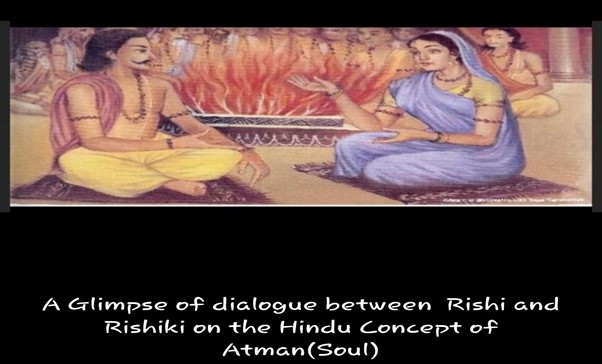
Maitreyei was an Indian woman philosopher during the later Vedic period in ancient India. In ancient Sanskrit literature, she is known as Brahmavadini (expounder of Veda). She explored the Hindu concept of Atman (soul or self) in a dialogue with Yajnavalkya in the Brihadaranyaka Upanishad. From the dialogue between Maitreyei and Yajnavalkya, it has been derived that love is driven by a person’s soul. Therefore, it can be said that Maitreyei is cited as an example of the educational opportunities available to women in Vedic India. Besides, she is still considered as an icon of Indian intellectual women.(MAITREYI AND YAJNAVALKYA (Brihadaranyaka Upanishad), n.d.)

A woman’s educational and intellectual attainment can empower her in the voyage of her life. All the above-mentioned famous women had made themselves famous  through their educational and intellectual attainment These ancient Indian women were  feminists and their ideals move today’s Indian women towards the educational and intellectual attainment.


In the epic – the Ramayana written by Valmiki, the heroine Sita is feminist icon even to today’s women. She was steadfast  in taking decisions during her life from the exile to the trial by fire to prove her innocence, to the taking up the responsibility of twin sons as a single mother and to the returning to her mother-Bhumi as a protest against patriarchy when she was asked again to prove her purity through the trial by fire. While some of these seem to reflect her submissive nature, however if we set our mind to enter into her decisions and activities, they reflect courage, rigidity and dignity and an ability to stand up against injustice in society. Thus, she is feminist icon for women even in the 21st century’s India. Welcome to Valmiki Ramayana | Valmiki Ramayanam, n.d.)

The Mahabharata is an another epic and it is the longest epic in the world. The heroine of this epic is Draupadi, who is also feminist icon for today’s women because of her fearlessness. When Yudhistira placed a bet on her and lost in the game of dice, she raised her voice for her rights. There was only one woman, Draupadi in a court full of the most powerful kings of that time. This pioneer of feminism, Draupadi dared to stand for herself and speak up aloud against male perpetrated injustices. Draupadi raised some questions about their Dharmas towards the most powerful kings of that time in the court. Her questions were a great challenge to the knowledge of right and wrong of the kings. It was beyond imagination of that time. From the view point of feminism, it was of course a strong voice against patriarchy.(Rajagopalachari & Rajagopalachari, 2018; Sacred-Texts: Hinduism, n.d.)

These legendary women in ancient Indian literature raised their voices and arguments against injustice; but they did equally admit that men and women are complementary to each other, having done their duties in spite of a lot of sufferings and hardships in the voyage of their life. This is the distinct nature of feminism that has been flowing in the heart of most Indian women since the time immemorial.

References:  

Ahuja, M. L. (2011). Women in Indian Mythology. Rupa & Company.

Joshi, A. (2014). Awakening India: Swami Vivekananda. Arise Publishers & Distributors.

Joshi, D. (2005). Glimpses of Indian Culture. Star Publications.

MAITREYI AND YAJNAVALKYA (Brihadaranyaka Upanishad). (n.d.). Retrieved March 19, 2022, from https://www.speakingtree.in/blog/maitreyi-and-yajnavalkya-brihadaranyaka-upanishad

Mukhopadhyaya, D. R. (2014). The Rig Veda Reconsidered: The First Four Books of The Rig Veda In the Light of Modern Aesthetics. Anjali Publishers.

Notable women international | fembio.org. (n.d.). Retrieved March 19, 2022, from https://www.fembio.org/english/

Rajagopalachari, C., & Rajagopalachari, C. (2018). Mahabharata.

Sacred-Texts: Hinduism. (n.d.). Retrieved March 19, 2022, from https://www.sacred-texts.com/hin/maha/

THE 17 GOALS | Sustainable Development. (n.d.). Retrieved December 11, 2021, from https://sdgs.un.org/goals

The Famous Female Figures of Vedic India. (n.d.). Learn Religions. Retrieved March 19, 2022, from https://www.learnreligions.com/famous-female-figures-of-vedic-india-1770399

The Valmiki Ramayana eBook by Bibek Debroy—9789387326941 | Rakuten Kobo India. (n.d.). Retrieved March 19, 2022, from https://www.kobo.com/in/en/ebook/the-valmiki-ramayana

Welcome to Valmiki Ramayana | Valmiki Ramayanam. (n.d.). Retrieved March 19, 2022, from https://www.valmiki.iitk.ac.in/

BrityaGayen

Intern, Asia in Global Affairs

The views, thoughts, and opinions expressed in the text belong solely to the author, in his personal capacity. It does not reflect the policies and perspectives of Asia in Global Affairs.

/ A Distinct Nature of Feminism in Ancient Indian Literature

India Continues Tightrope Walk with Myanmar Junta

Posted on : April 11, 2022
Author : Dwaipayan Sinha

Abstract:

The Myanmar military, which ousted elected civilian leader Aung San Suu Kyi and her National League for Democracy (NLD) in early 2021, shows no sign of repentance in the face of Western criticism. The military continues to repress civil liberties in the country as Suu Kyi has been sentenced to imprisonment. India looks to balance its ties with Myanmar as it wants flourishing ties with its eastern neighbour in the face of an aggressive China. Indian Foreign Secretary’s recent visit to the troubled nation comes in this background. This article sheds light on India’s interests in the region and how it is walking a tightrope with the military.

Even after one year has passed since the Myanmar military ousted the civilian government led by Aung San Suu Kyi’s National League for Democracy (NLD), the military is not backing down. The Myanmar military ruthlessly crushed the widespread street protests which took place after the coup. The coup resulted in many members of the NLD going underground and joining hands with ethnic militias to resist the government forces. A “National Unity Government”(NUG) and a “National Defence Force”(NDF) was created to fight the military regime in May 2021. The NUG wants the army to be removed from the political sphere in the country. It has said that it will hold talks with the military regime only after the release of all political prisoners.[i]

Aung San Suu Kyi’s future does not look too bright as a court in Myanmar found her guilty of charges of incitement and neglecting Covid-19 regulations during the 2020 elections in December 2021. Suu Kyi was initially sentenced to four years in prison.[ii] Later the military ruler General Min Aung Hlaing decided to reduce the sentence by a year. The former civilian president Win Myint has also been sentenced to four years in prison. Suu Kyi has also been found guilty of numerous allegations like illegal importing of communications equipment which was used by her official security team. Additionally, she faces many more allegations like violation of the law on state secrets.

Aung San Suu Kyi’s sentencing has been criticised by various governments around the world. The Modi government also took a critical stand. India had earlier been treading a fine line after the military took over. India said that it was “disturbed” with the verdicts which sentenced Suu Kyi to four-year jail term. “We are disturbed at the recent verdicts. As a neighbouring democracy, India has been consistently supportive of the democratic transition in Myanmar,” stated Arindam Bagchi, spokesperson in the Ministry of External Affairs (MEA). India added that it is concerned by any development that undermines democratic processes and promotes differences.[iii]

Harsh Vardhan Shringla, Indian Foreign Secretary, made a visit to Myanmar just a few weeks after the statement was issued. This marked the first time that a prominent Indian diplomat visited Myanmar after the military coup in early 2021.[iv] India seeks to have a good relationship with the Tatmadaw, as the Myanmar military is called, because the two nations share a 1700 Km border. India is concerned about anti-India elements working on the Myanmar side being more active in recent months. In the past, India and Myanmar have worked together to tackle insurgents across the border.[v]

The Indian government is fearful of the Chinese leadership gaining a larger foothold in Myanmar’s polity which would be counter-productive to Indian interests.[vi] The Chinese and the Russians have helped the Tatmadaw regime to escape the wrath of the Western nations at the United Nations and other international organisations. India objected to the imposition of sanctions on Myanmar during the UN Human Rights Council meeting in 2021. The Indian government has decided to go ahead with all of the development projects in Myanmar even though the civilian regime has been toppled. On March 27, 2021 the Indian military attaché attended the Armed Forces Day Parade in Myanmar.[vii] He was joined by the Chinese, Pakistani, Thai and Bangladeshi counterparts as they represented the eight countries which attended the parade. The Deputy Defence Minister of Russia represented his country. The Tatmadaw killed a large number of demonstrators who were protesting against the coup on that day.

Even though the Joe Biden-led United States government has advocated for global boycott of the Tatmadaw, India did not take side with the West. Most nations in the region have rejected the Biden administration’s efforts of complete isolation of the Myanmar military. The Association of Southeast Asian Nations (ASEAN) has adapted with the change in regime in Myanmar. Myanmar is an important member of the regional group. India’s response to the military coup has been similar to that of ASEAN.

The ASEAN agreed on five points to bring the political instability in Myanmar to an end in a meeting which was held in Jakarta in 2021.  These included promotion of constructive dialogue among all the parties, bringing an end to the violence, appointment of a special ASEAN envoy who would act as a mediator and aid production. India had then expressed hope that the ASEAN initiative will break the deadlock.[viii] But the Myanmar military did not grant permission to the ASEAN special envoy to visit Myanmar. The Tatmadaw also denied the UN emissary permission to visit the nation. In response to the rejection, ASEAN did not invite Myanmar to its annual summit which was hosted by Indonesia virtually in October 2021.

India, on its part, has continued to send humanitarian aid to Myanmar. An additional one million doses of Covid-19 vaccine was donated by India during the visit of the Foreign Secretary.[ix] An announcement of granting 10,000 tonnes of wheat and rice was also made. According to the External Affairs Ministry, the Foreign Secretary met senior Tatmadaw officials. However, it was not clarified if he got to meet the top military leadership. Shringla also met with leaders of the National League for Democracy (NLD) and other civilian parties. Names of the opposition leaders were not revealed. Even though the Indian government had made a request, Shringla was not allowed to meet Suu Kyi.[x] None of the foreign diplomats have been permitted to meet her thus far. In October 2020, Shringla and Indian Army chief M.M. Naravane had visited Myanmar and met with Suu Kyi and General Min Aung Hlaing.

Shringla’s discussions with the Myanmar military over matters relating to India’s security comes at an important time. A commanding officer of the Assam Rifles lost his life in an ambush in Manipur near the Myanmar border in November 2021. The officer’s family and four other soldiers were also killed. The ambush was organised by the People’s Liberation Army of Manipur and the Manipur Naga People’s Front, who operate from inside Myanmar.[xi]

The coup can result in a possible security crisis for India in the long run as Myanmar’s people are crossing over to the north-eastern states of India in order to escape the wrath of the Tatmadaw.[xii] The rebel groups and the Tatmadaw are fighting in the areas bordering India, China and Thailand. The Tatmadaw has unleashed large scale atrocities on the residents of the Chin state, which borders Mizoram. Close ethnic ties are shared by the Chins and Mizos.

According to the External Affairs Ministry, the Foreign Secretary made the Myanmar military aware of India’s security concerns in the border areas and asserted that it is essential to maintain peace and tranquillity to effectively deal with insurgents. “Both countries had reiterated their commitment to ensure that their respective territories will not be allowed to be used for any activities inimical to the other”, stated the External Affairs Ministry.[xiii]

Myanmar’s official media took a view different from India on the meeting. It asserted that the discussions with Shringla focussed on the “discharging of state responsibilities by the ‘Tatmadaw’ under the constitution due to voting fraud in the 2020 general elections, terror acts by terrorist groups in the country, efforts on counter-terrorism, response to terror acts against education and health staff and efforts for ensuring peace and stability in the border regions of both the countries.” [xiv]

Dwaipayan Sinha

 Intern

 Asia in Global Affairs

References

[i] Opponents of Myanmar coup announce unity government (https://www.aljazeera.com/news/2021/4/16/myanmar-silent-strike)

[ii] Explained: Why Myanmar’s Aung San Suu Kyi has been sentenced to 4 years in jail

(https://indianexpress.com/article/explained/explained-myanmar-aung-san-suu-kyi-imprisonment-4-years-charges-7658512/)


[iii] India says disturbed over sentencing of Aung San Suu Kyi
(https://economictimes.indiatimes.com/news/india/india-says-disturbed-over-sentencing-of-aung-san-suu-kyi/articleshow/88142708.cms?from=mdr)


[iv] In First Visit to Myanmar After Coup, India’s Foreign Secretary Raises Manipur Ambush

(https://thewire.in/diplomacy/myanmar-first-visit-harsh-shringla-coup-manipur-democracy)


[v] Myanmar military helped curb insurgency in northeast India: M.M. Naravane (https://www.livemint.com/news/india/myanmar-military-helped-curb-insurgency-in-northeast-india-m-m-naravane-11613136488107.html)


[vi] Foreign secretary’s Myanmar trip shows India won’t allow China to use northeast to its advantage (https://www.theweek.in/theweek/cover/2022/01/01/foreign-secretary-myanmar-trip-shows-india-wont-allow-china-to-use-northeast-to-its-advantage.html)


[vii] On Bloodiest Day for Myanmar Civilians, India Attends Military Parade by Coup Leaders (https://thewire.in/diplomacy/india-china-russia-pakistan-attend-myanmar-armed-forces-day-parade)


[viii] India welcomes ASEAN call to end violence in Myanmar (https://www.livemint.com/news/world/india-welcomes-asean-call-to-end-violence-in-myanmar-11619353177395.html)


[ix] India gives 1 million COVID-19 vaccine doses to Myanmar

(https://www.thehindu.com/news/national/india-gives-1-million-covid-19-vaccine-doses-to-myanmar/article38015840.ece)


[x] Foreign Secretary request to meet Suu Kyi turned down

(https://timesofindia.indiatimes.com/india/foreign-secretary-request-to-meet-suu-kyi-turned-down/articleshow/88462516.cms)


[xi] PLA & MNPF — Militant groups behind ‘well-planned’ ambush that killed CO, family in Manipur

(https://theprint.in/india/pla-mnpf-militant-groups-behind-well-planned-ambush-that-killed-co-family-in-manipur/765981/)


[xii] As Myanmar Military Escalates Crackdown, Mizoram Sees Influx of Refugees (https://thewire.in/government/myanmar-military-mizoram-refugees-influx-crackdown)


[xiii] Myanmar senior general, Indian foreign secretary decide to strengthen counter-terrorties

(https://economictimes.indiatimes.com/news/defence/myanmar-senior-general-indian-foreign-secretary-decide-to-strengthen-counter-terror-ties/articleshow/88501515.cms?from=mdr)


[xiv] Myanmar statement on Shringla visit differs from Indian line on restoring democracy (https://www.thehindu.com/news/national/myanmar-statement-on-shringla-visit-differs-from-indian-line-on-restoring-democracy/article38030897.ece?homepage=true)


/ India Continues Tightrope Walk with Myanmar Junta

Deconstructing the PM-CARES Fund

Posted on : February 25, 2022
Author : Pratyusha Raychaudhuri

Deconstructing the PM-CARES Fund

Introduction to the fund

Collaborations of the civil society and the government are not an uncommon phenomenon in the face of an emergency or natural disaster and the COVID19 pandemic has proved to be no exception to this. It is considered to be an important aspect of relief effort especially for developing countries and even more so in a population like that of India’s, where government agencies may not be able to reach all rungs of the society alone. The ‘Prime Minister’s Citizen Assistance and Relief in Emergency Situations Fund’ (PM CARES) Fund was launched on March 27th, 2020 by Prime minister Narendra Modi, as a ‘dedicated’ national fund towards dealing with the distress situations and other difficulties posed by the pandemic. It recognizes itself as a public charitable trust, chaired by the Prime Minister of India (ex-officio), with the Minister of Defence, Minister of Home Affairs and Minister of Finance as its trustees (ex-officio). As Chairperson, the Prime Minister shall reserve the right to nominate 3 trustees from eminent arenas of research who shall take up the role in pro bono capacity. Additionally, the PM-CARES is exempt from the legal restrictions under the Foreign Contribution (Regulation) Act 2010 (FCRA).  This relaxation is granted without meeting the prerequisites of being a body established/owned by the government whose accounts are to be audited by the Comptroller and Auditor General of India (CAG). This measure was taken to encourage contributions from individuals and organizations alike from foreign countries and the Fund has a separate account for such donations.

PM-CARES vs PMNRF 

With the introduction of this fund in 2020, opposition roared in protest on various grounds, the foremost being the existence of the Prime Minister’s National Relief Fund (PMNRF).  The PMNRF was established in 1948 with ex-Prime Minister Nehru’s initiative, used to assist displaced citizens during the partition. The resources of the PMNRF have since then been utilized to provide relief to families of those killed in natural disasters as well as accidents and riots. This fund was also put to use to partially fund medical expenses. Criticism from the likes of Historian Ramchandra Guha and MP Shashi Tharoor has pointed at the unnecessary creation of a separate “self aggrandising” fund with “catchy acronyms”, one that takes away from the gravity of the situation and can be seen as misleading the public. There have also been demands for transferring the funds from the much-debated PM-CARES to the PMNRF filed in the Supreme Court for its transparency of fund allocation and the question of legality which were dismissed.


While the PMNRF and PM-CARES both enjoy 100% tax exemption under section 80(G) of the Income Tax, there is much that sets these two funds apart. Donations to the PMNRF must be made from voluntary institutions and individuals, and cannot come out of Public Sector Undertakings which sets it apart from the PM-CARES fund, throwing its arena for possible contribution wide open. This aids fast collection in the face of the pandemic from citizens irrespective of age, gender, profession etc. These tax exempted donations can be counted as contribution under the Corporate Social Responsibility (CSR) which is not something the PMNRF caters to. The PM-CARES has also taken a stride at being more democratic in its disbursement of funds as three ministers namely Home Minister Amit Shah, Defence Minister Rajnath Singh, and Finance Minister Nirmala Sitharaman have been delegated similar powers apart from the Prime minister, unlike the PMNRF. This eases tensions stemming from consolidated power in one hand acting as Judge Jury and Executioner of a fund of such stature.


Does the PM-CARES care?

The official website of PM-CARES trust accounts for 3 broad allocations that amount to Rs. 3100 crores. The total amount received by the trust has not been disclosed despite several RTIs being filed. The last known figure accounts to Rs. 9677.9 crores as of May 20, 2020 from the press releases on the Press Information Bureau Website summed by the Indiaspend.com website, while the real figures may be higher. Due to its lack of response to the RTIs, only 32% of the total collection has been put to use, which in itself is an unlikely number. Transparency and proper utilization of the PM-CARES fund thus remains a matter of concern especially owing to the endless difficulties that the pandemic has posed upon citizens such as loss of jobs, dangers to the lives of migrant workers, digital divide to name a few. Developing countries like India have the need for government-citizen collaboration at all times as response to situations like the COVID19 pandemic and with the enormous financial power of the PM-CARES it is imperative for swift and proper action on their part, specifically with the Prime Minister and 3 members of the parliament at its helm.

The 3100 crores allotted from the fund have been distributed among the following:

  • 2000 Crore is to be utilised for the supply of 50,000 ‘Made-in India’ ventilators to Government Hospitals
  • 1000 Crore has been allotted to State governments and Union Territories for the plight of migrant labourers
  • 100 Crore is to be disbursed for development of vaccines, announced on 13th May 2020, under the supervision of Principal Scientific Advisor

As the PM-CARES fund is to hit the 2 years landmark, there lacks clarity over the allocation of the abovementioned deposits since the announcement. To throw light on this Indian Navy veteran Commodore Lokesh Batra had filed RTIs with the Ministry of Health and Family Welfare.

The Ministry of health has reported the release of Rs. 1532 crores of the 2000 as of July 2021 as per the Hindu report. The estimated costs of the 50000 ventilators have also been marked at Rs. 2147 crores which exceeds the provision of the PM-CARES, the details of which have been sent to the Prime Minister’s Office (PMO) and the disbursement of payment awaiting clearance. Besides this, many problems have been reported with the batch of ventilators dispersed under this initiative. Chandigarh government hospitals have submitted a quality assessment of faulty ventilators submitted to the Central Government for action. Srinagar’s Shri Maharaja Hari Singh (SMHS) Hospital has also complained of the 165 ventilators it received to be defective.

An RTI was filed to locate the benefactor of the Rs. 100 crore for vaccine development on 16th July 2021 but was faced with several dead ends. Astoundingly, the Indian Council of Medical Research (ICMR) and the Health Ministry’s COVID-19 Vaccine Administration Cell (CVAC) have stated that they haven’t received the allocated funds. Meanwhile, the PMO has refused to answer the RTI owing to its legality question and a conclusive answer is yet to be reached.

Issues of Legality surrounding the Fund

The official website of the PM CARES Fund declares it as a Public Charitable Trust. The trust deed of PM-CARES Fund was registered under the Registration Act 1908 on 27th March, 2020. The Delhi High Court has been told that the PM-CARES Fund is not a Government of India fund and the amount collected by it does not go to the Consolidated Fund of India.

Controversy arises due to the conflicting responses of the Central government, which are open to interpretation, to the various RTI pleas made at Court. In a reply to an RTI application on 24th December, the office of the Commissioner of Income Tax (Exemption) stated that PM-CARES fund was “owned by, controlled by and established by the Government of India” and is yet not subjected to the RTI as it receives private as well as foreign financing. This however is in direct contradiction with Section 2(h) subsection D part I of the RTI, which would make the PM-CARES fall under the gambit of “public authority.” This statement is also contradictory to the trust deed of the PM-CARES which states that the PM-CARES trust was not owned or controlled by the government. The PM-CARES fund also received a heads up for qualifying as a Corporate Social Responsibility (CSR) on 28th March 2020 from the Ministry of Corporate Affairs that necessitates it being a government entity. This caused further confusion and was rectified on May 26th 2020 when the Fund was added to the Companies Act.

The usage of the National Flag and Emblem as well as the association of the Prime Minister’s name with the fund has been brought to the forefront of debate. A Public Interest Litigation (PIL) was filed by Congress leader Vikrant Chavan seeking the removal of such entities from the official website in compliance with the Emblems and Names (Prevention of Improper Use) Act, 1950 and the Flag Code of India, 2002. The Prime Minister’s Office in its affidavit to the Bombay High Court challenging the charges stated that “PM-CARES fund and Prime Minister’s National Relief Fund (PMNRF) are both chaired by the Prime Minister. As the name, photograph of the Prime Minister and National Emblem are being used for the PMNRF, they are also being used for the PM-CARES Fund. Flag Code of India, 2002, which brings together all laws, conventions, practices and instructions regarding display of National Flag provided that there cannot restriction on display of National Flag by members of general public, private organizations, educational institutions etc, except to extend provided in the Emblems and Names Act, 1950” on 18th January 2022.

It’s unforeseen repercussions

To promote the inflow of donations, the Department of Revenue under the Ministry of Finance issued a circular dated April 17, 2020. It read “It has been decided to appeal all officers and staff to contribute their 1 day’s salary every month till March 2021 to the Prime Minister’s Citizen’s Assistance and Relief in Emergency Situations (PM-CARES) to aid the government’s efforts to fight the corona virus pandemic.” While the sudden onset of the pandemic struck hard on a global scale, appeals of such kind are not to be perceived as out of the ordinary. And yet, this move was not seen as welcome especially by those belonging to lower income categories and those unwilling, owing to the identification of one’s employee code in case one didn’t wish to comply. Officials did not wish to be identified specifically on the basis of their lack of contribution, making the voluntary act seem nuanced if not obligatory. Similar appeals were made by various public and private institutions following this. Considering the 100% tax exemption and meeting CSR obligations, many corporates went above and beyond in their donations to the fund. The cure.fit start-up can be taken as an example, wherein the company announced shut down of operations and massive job cuts on one hand and donated Rs. 5 crores to the PM CARES fund on the other.

NGOs under normal circumstances are expected to facilitate the success of various government social undertakings and schemes such as the Swachh Bharat Abhiyan. However, the funds they have for disposal does not match the amount needed for carrying out the work. Not only is finances a massive obstacle for proper functioning, the laws governing the sources from where it may receive donations and the relief from the government itself may prove to be insufficient.  Given the present pandemic situation and the subsequent flow of most contributions to the PM-CARES fund which receives the government support that regular NGO’s do not enjoy, most donors and regulars have turned to the PM-CARES Fund. NGOS have fallen at a disadvantage at the cost of the popularized public trust with 50% tax exemption, not as much publicity, and no aid from the Fund itself. Many have suggested that those working for Covid relief be allotted a portion from the public trust, but measures are yet to be seen.

Pratyusha Raychaudhuri
Intern, Asia in Global Affairs


The opinions expressed within the content are solely the author’s and do not reflect the opinions and beliefs of Asia in Global Affairs.


/ Deconstructing the PM-CARES Fund

India seeks to gain as Russia and China clash in Central Asia

Posted on : February 7, 2022
Author : Dwaipayan Sinha

December 2021 witnessed the third meeting of the India-Central Asia dialogue in New Delhi where former USSR members namely Kazakhstan, Kyrgyzstan, Tajikistan, Turkmenistan and Uzbekistan held a virtual ministerial-level meeting with India. India invited the heads of state of these nations to the Republic Day celebrations after the conclusion of the dialogue.


Of the Central Asian republics, Tajikistan, Uzbekistan and Turkmenistan shares border with Afghanistan, which recently saw the Taliban coming back to power. Although these states have broken away from the USSR, Russia continues to heavily influence their foreign policy matters. India used its presence at the Farkhor air base in Tajikistan to conduct the withdrawal of Indian staff from the Afghan capital.


At the same time, Pakistan also organised an OIC conference on Afghanistan. Interestingly, the foreign ministers of these countries decided to attend the India-hosted dialogue and sent their deputies to the Pakistan organised conference, which shows that India has made considerable inroads in these states. 


Elsewhere, Russia-China bonhomie has increased due to the deteriorating US-China relations and sanctions imposed on Russia by The West after it annexed Crimea. Russia and China have their own ambitions- Russia in Ukraine and China in Taiwan. Both Russia and China would ensure that they look the other way in case either of them acts aggressively in their own neighbourhood. Even though Russia and China are on the same side when tackling US hegemony, Russia is wary of China gaining influence in this region with its Belt and Road Initiative. Russian president Vladimir Putin is unwilling to play second fiddle to an emerging and belligerent China.


The US policymakers are divided on how they should interpret the growing Russia-China proximity. Political analysts believe that Putin attending Beijing Winter Games opening ceremony is a show of resistance to the US and its allies. Chinese president Xi Jinping has invited Putin, but Putin’s presence won’t necessarily be a Russian endorsement of China’s internal and foreign affairs.


India and Russia have always shared cordial ties even though trade relations are not as beneficial as either would like it to be. Although India is a part of the US-led Quad grouping to counter China, it has remained largely independent in its foreign affairs. India signed a host of defence deals with Russia recently even though the threat of sanctions was looming large. India has refrained from out rightly criticising Russian decisions. In return, Russia has backed India’s concerns and has volunteered as a mediator to solve the Indo-China crises. Even while dealing with India’s hostile neighbour Pakistan, Russia has kept Indian interests in mind including in the sale of weaponry.


India was inducted to the Shanghai Cooperation Organization (SCO) by Russia as a balancing act against China. The Indo-Russia summit, the Indo-Central Asian dialogue and the telephone conversation between Indian prime minister Narendra Modi and Russian president Putin all took place in December 2021. This signifies the growing importance of India in the minds of Russian thinkers. Indian involvement in Central Asia would be preferred to China’s involvement by Russia.  Russia believes that India, unlike China, will not seek to replace Russian dominance in Central Asia as India does not neighbour any of these nations. Russia perceives China’s growing as a long-term threat to Russian interests as China borders Kazakhstan, Tajikistan and Kyrgyzstan. China’s debt trap diplomacy is reportedly financially bleeding the Central Asian nations with Tajikistan and Kyrgyzstan owing over 40 percent of their foreign debt to Beijing.


China is now interested to grab gold mining concessions and additional land in lieu of payments after they have settled the border disputes with these countries in their favour. Beijing is still pursuing the Pamir Knot region from Tajikistan. The region borders Afghanistan and control over it would enable China to neutralise threats in Xinjiang province. China hopes to root out Uighur nationalism, which has seen an upsurge. The Central Asian countries have witnessed plenty of anti-China and pro-Uighur protests recently. 3 million Central Asian residents live in the Xinjiang province and China hopes to repatriate them. Additionally, China seeks to exploit mineral resources including oil and gas. China would also be able to gain land access to Europe through this region.


Russia continues to control the military and security dynamics of these countries through the Collective Security Treaty Organization (CSTO) as was seen with the Russian troops coming in support of the Kazakhstan government during the recent crisis. Russian and Chinese interests are at odds here as China, which already controls these countries economically, wants to supersede Russia in the security arena. The Chinese want to increase trade and military ties with nations in this region. China provides cheap weapons to these nations, most of them ironically being substandard replicas of Russian weapons.


Russia realises the threat China poses in this region to its own interests. China, on its part, would not like to see India increase its influence in this bloc. Russia’s proximity to India has not gone down well with China according to reports. Russia hopes that it would be able to significantly reduce China’s influence by aligning with India and jointly manufacturing and maintaining weapons in Central Asia. The Indo- Russia summit touched on the issue of joint defence projects in this region. According to a report on the Russian news agency TASS, Modi and Putin reached an agreement to expand the joint production in India of spare parts for maintenance of Russian origin arms and defence equipment. “Both sides agreed to take forward ongoing engagements to encourage joint manufacturing in India of spare parts, components, aggregates and other products for maintenance of Russian origin Arms and defense equipment under Make-in-India program through transfer of technology and setting up of joint ventures for meeting the needs of the Indian Armed Forces as well as subsequent export to mutually friendly third countries,” read a joint statement released on the Kremlin website.


Increased Indian investments and aid for Central Asia was mentioned in the joint statement at the end of the India-Central Asia dialogue. Discussion on security cooperation took place and holding of regular NSA meetings were agreed upon. Various development projects received approval. Sanctioning of a USD 1 billion line of credit also took place. Detailed discussion took place on the volatile situation in Afghanistan as the Taliban regime is of grave concern for India, Russia and Central Asian countries. To tackle the threat from terrorism, India, Russia and Central Asian countries planned to take part in joint counter-terrorism endeavours in 2022.


Russia and China actively dominate Central Asia as the other major actors are missing. India’s involvement is wanted by Russia and resisted by China. But both are against NATO or US presence. India must seek to utilise the opportunities it is presented with as it can counter China and also use mineral resources Central Asia provides for its own use.


Dwaipayan Sinha

 Intern, Asia in Global Affairs

References

 Russia led CSTO despatches troops to Kazakhstan to control terrorists

(https://economictimes.indiatimes.com/news/international/world-news/russia-led-csto-despatches-troops-to-kazakhstan-to-control-terrorists/articleshow/88739527.cms)

 Indian production of spare parts for Russian defense equipment to expand(https://tass.com/defense/1371617)

Joint Statement of the 3rd meeting of the India-Central Asia Dialogue(https://www.mea.gov.in/bilateral-documents.htm?dtl/34705/Joint_Statement_of_the_3rd_meeting_of_the_IndiaCentral_Asia_Dialogue)

Taliban are back: what next for Afghanistan? (https://www.bbc.com/news/world-asia-49192495 https://www.bbc.com/news/world-asia-49192495)

  What Putin Really Wants in Ukraine?( https://www.foreignaffairs.com/articles/russia-fsu/2021-12-28/what-putin-really-wants-ukraine)

 What’s behind the China-Taiwan divide?(https://www.bbc.com/news/world-asia-34729538)

India and Russia Expand Defense Ties, Despite Prospect of U.S. Sanctions(https://www.nytimes.com/2021/12/06/world/asia/india-russia-missile-defense-deal.html)

 China’s Debt Trap Diplomacy in Kyrgyzstan( https://www.internationalaffairs.org.au/australianoutlook/chinas-debt-trap-diplomacy-in-kyrgyzstan/)

Tajikistan: Another Victim of Chinese Belligerence in Central Asia (https://www.vifindia.org/article/2020/august/12/tajikistan-another-victim-of-chinese-belligerence-in-central-asia)

Rise of Anti-China Public Sentiments in Central Asia( https://icsin.org/blogs/2020/06/01/rise-of-anti-china-public-sentiments-in-central-asia/)

/ India seeks to gain as Russia and China clash in Central Asia

India’s Soft Power Politics in the 21st Century

Posted on : February 2, 2022
Author : Olivia Bannerjee

The recent news of the interactive celebration of the festival ‘Pongal’, between India and Sri-Lanka has galvanized the media towards focusing on scopes to revitalize bilateral relations encumbered by Chinese influence in Sri Lanka. The rough patches of the diplomatic ties, with Sri Lanka first accepting Chinese financial support and subsequently leasing the Hambantota port for facilitation of Chinese maritime trade, is now being seen as moving towards a resolving trend, with India and Sri Lanka’s external ministries playing the card of ‘cultural diplomacy’.

Eminent international relations scholar, Joseph Nye in his book, ‘Bound to Lead: The Changing Nature of American power,’ categorizes ‘cultural diplomacy’ as the advocation of soft power politics to co-opt other nations, without cohesion, but rather in materialising bilateral nations through the use of a country’s culture and values. India’s millennial analysis of soft power diplomacy as represented by Yudhisthir Raj Isat, on the other hand underlines ‘the country’s cultural engagements with others have been more profoundly shaped by a particular sense of national selfhood and being in the world that has gestated since the mid-nineteenth century and continues to have strong purchase.'(Cultural diplomacy: India does it differently, 2017). The soft power politics associated with the reproduction of its own native heritage is made sense by the much-cited statement of Mahatma Gandhi, ‘I do not want my house to be walled in on all sides and my windows to be glued. I want the cultures of all lands to be blown about my house as freely as possible. But I refuse to be blown on my feet by any. I refuse to live in other people’s houses as an interloper, a beggar or a slave.’ (Young India, 1921)

The trajectory of India’s long history can be traced through multiple shifts from non-alignment to low-profile and the pragmatic interaction, making India’s art, culture and spiritualism attractive to people across the globe. Delhi’s soft power politics has its roots in Nehru’s political strategist mind replicated today through an intense outreach to the diaspora to serve the interests of India’s domestic economic development, popularising democratic political Indian ideals in the geopolitical calculus, anchoring economic development to the general push to make India a ‘vishwaguru’ (a global leader). The domestic lexicon is now focused on the use of and penetration of the native language. But a question arises, can India truly be the reservoir of moral influence. Recent news, of Bangladesh, Nepal and Pakistan tilting to China, pushes us to think whether the tall claims of foreign policy is able to yield fruitful results for us and our neighbouring countries. There are contradictory opinions on this.

In a Wire article of 2020, Vaishali Basu Sharma wrote, ‘the arrogant big brother attitude that disparages and belittles the nations at its borders will leave India isolated in any face-off with a big power.’ With India competing to be the ‘vishwaguru’, the attitude of considering her neighbors inferior, though coming from a sense of responsibility, creates the very base for destroying any scope of friendship. The ties have become fragile over time, with a hidden nostalgia of remembering historical cultural associations. She argues, years of insensitivity and taking pride in one’s own heritage to the extent of negating the cultural uniqueness of others has hampered and made the South Asian neighbours turn to China.

India’s pursuit of outstanding boundary issues, as reflected by the statements of Nepalese foreign minister Pradeep Kumar Gyawali, has been viewed negatively. Border disputes and not resolving the acceptance of Bhutanese currencies for Bhutan traders operating in both Indian and Bhutan is tempting Bhutan to move to China. These minor irritants are now infringing upon bilateral relations. India’s role in BIMSTEC (the Bay of Bengal Initiative for Multi-Sectoral Technical and Economic Cooperation) is marked by infrequent summits conduction and low representation in Dhaka. The forum born in place of SAARC lacks proper funding, finance, leadership and is now increasingly turning from issues of development to anti-terrorism rhetoric.

This has also accelerated disputes with Pakistan and China. While cultural diplomats look for a solution through the use of cricket, film and music politics, bilateral relations are discoloured by hyphenated identity politics. Unless Pakistan and India arrive at a settlement on issues of territory it is unlikely that there will be a solution. Sino-Indian relations also affect equations of South Asia. While India can never match the deep pockets of China, development assistance would be helpful in fields like technology and education. Soft power politics based on the civilisational ethos of India and Indian culture had worked wonders when accompanied with the image of developmental scope in the present threshold. India concentrated on faith and trust building internationally, by not just branding it as a tourism attraction but also by portraying its uniqueness in fields of Bollywood Indian music and cuisine. Making its global presence felt with the provision of an alternative Eastern imagination, pushing its diaspora to serve its interests and showing respect to the cultural capabilities of its neighbours, will provide possibilities of better and more fruitful results. A concerted focus on these would lead to India’s public diplomacy in its South Asian neighbourhood.

References

Nye, Joseph S. Soft Power: the Means to Success in World Politics. New York: Public Affairs, 2004.

Young India Patrika (1921). Navjivan Publishing House, Ahmedabad.

Raja Mohan, C (2015), Modi’s World: Expanding India’s Sphere of Influence, New Delhi: HarperCollins India

Basu, Sharma, Vaishali (2020) India’s Lack of Respect for its South Asian Neighbours is Now Mutual, The Wire.in

Debidatta Aurobinda Mahapatra, 2016. “From a latent to a ‘strong’ soft power? The evolution of India’s cultural diplomacy,” Palgrave Communications, Palgrave Macmillan, vol. 2(1), pages 1-11, December.

Mazumdar, Arijit. (2020). India’s Public Diplomacy in the Twenty-First Century: Components, Objectives and Challenges. India Quarterly: A Journal of International Affairs. 76. 097492841990118. 10.1177/0974928419901188.

Olivia Bannerjee
Intern, Asia in Global Affairs

The opinions expressed within the content are solely the author’s and do not reflect the opinions and beliefs of Asia in Global Affairs.

/ India's Soft Power Politics in the 21st Century

Ban on Single-use of Plastic Items in India: A Wise Step Towards Clean Environment

Posted on : January 12, 2022
Author : AGA Admin

“One step for a better environment today is one step toward a better future tomorrow”.

We always seem to be looking for the next great solution for all of our global problems. With bewilderment, we stare at the monumental challenges ahead, trying to comprehend how it is even possible to find a solution for global warming, plastic pollution, mass extinction and all the other great issues of our time. Discoveries and inventions in the field of science have provided many things to man and industries. Plastic is one among those. Growth of plastic has been so rapid that it has engulfed so many natural things which is danger to the environment. Now the plastic made goods are in use in every nook and corner of the society from our smartphones to computers to medical devices. The development of plastics started with the use of natural materials that had intrinsic plastic properties, such as shellac and chewing gum. The next step in the evolution of plastics involved the chemical modification of natural materials such as rubber, nitrocellulose, cellulose, collagen. Finally, the wide range of completely synthetic materials that is recognized now as modern plastics started to be developed around 100 years ago.

Single use plastic is very harmful for human beings, animals, marine creatures and hydrophytes. In the water bodies, aquatic animals mistakenly consume plastic particles along with their food. Many marine animals including fishes, sea birds, turtles are found to have plastics in their stomach. These plastics, pierce the organ of animals and block the digestive systems resulting in serious health problems and causing death.

The Union government in a bid to free India of single-use plastics by 2022, has laid out a multi-ministerial plan to discourage the use of single-use plastics across the country, keeping in view the adverse impacts of littered plastic on both terrestrial and aquatic ecosystems. The Ministry Of Environment Forest And Climate Change has notified the Plastic Waste Management Amendment Rules, 2021, that prohibit specific single-use plastic items which have “low utility and high littering potential” by July 2022. “Pollution due to single-use plastic items has become an important environmental challenge confronting all countries,” the ministry said. In the 4th ‘United Nations Environment Assembly’ held in 2019, India had piloted a resolution on addressing single-use plastic products pollution, recognizing the urgent need for the global community to focus on this very important issue. The adoption of this resolution at UNEA-4 was a significant step. The government has also asked the states and Union Territories to develop a comprehensive action plan to eliminate single-use plastic items.

The manufacture, import, stocking, distribution, sale and use of following single-use plastic, including polystyrene and expanded polystyrene, commodities shall be prohibited with effect from July 1, 2022: Ear buds with plastic sticks, plastic sticks for balloons, plastic flags, candy sticks, ice-cream sticks, polystyrene (Thermocol) for decoration; plates, cups, glasses, cutlery such as forks, spoons, knives, straw, trays; wrapping or packing films around sweet boxes, invitation cards, and cigarette packets, plastic or PVC banners less than 100 micron, stirrers. In order to stop littering due to lightweight plastic carry bags, with effect from 30th September, 2021, the thickness of plastic carry bags will be increased from 50 microns to 75 microns from September 30, 2021, and to 120 microns from December 31, 2021. This will also allow reuse of plastic carry bags due to increase in thickness.

The plastic packaging waste, which is not covered under the phase-out of identified single-use plastic items, shall be collected and managed in an environmentally sustainable way through the Extended Producer Responsibility of the Producer, Importer and Brand Owner (PIBO), as per Plastic Waste Management Rules, 2016. For effective implementation of Extended Producer Responsibility, the Guidelines for Extended Producer Responsibility being brought out have been given legal force through Plastic Waste Management Amendment Rules, 2021. The waste management infrastructure in the States/UTs is being strengthened through the Swachh Bharat Mission. The “India Plastic Challenge-Hackathon 2021” is a unique competition calling upon start-ups/entrepreneurs and students of Higher Education Institutions (HEIs) to develop innovative solutions to mitigate plastic pollution and develop alternatives to single-use plastics.

The Covid-19 pandemic has made the battle against plastic tougher which given the rise in PPE kits and disposable masks. But the war against single-use of plastic has been going on for decades. Like every other segment of Indian society, the rules exist, but there is no implementation. The polluters continue to pollute, and the dump yards grow higher by the minute. Unless there is strong data to support which product needs to be banned and how to go about it, besides putting existing rules into effect, India’s plastic crisis will be far from over. It’s too late for recycling alone to resolve the global plastic crisis. The recycling mark may be among the most recognisable symbols in use today, but we must be mindful that plastics recycling has its limitations. With the rate of plastic production only rising, there’s an urgent need for businesses and governments alike to champion other answers to the crisis that include a shift away from plastic towards alternatives, including compostable packaging, will make a significant difference.


-Rwittika Ghorui,

Intern, Asia in Global Affairs

References

1.   “Manufacture, sale & use of single-use plastic banned in India from July next year”, PTI, The Print. 13th August, 2021.

https://theprint.in/environment/manufacture-sale-use-of-single-use-plastic-banned-in-india-from-july-next-year/714665/

  1. Nidhi Adlakha, “India’s toxic love affair with plastic: on the 2022 ban against single-use products”, The Hindu. 17th September, 2021.

https://www.google.com/amp/s/www.thehindu.com/sci-tech/energy-and-environment/single-use-plastics-2022-ban-environment-crisis/article36510666.ece/amp/

  1. Jayashree Nandi, “Centre notifies ban on single-use plastic”, Hindustan Times, New Delhi. 14th August, 2021.

https://www.google.com/amp/s/www.hindustantimes.com/environment/centre-notifies-ban-on-single-use-plastic-101628897146417-amp.html

  1. “These Single-Use Plastic Items will be Banned from July 1 Next Year”. NDTV. 14th August, 2021.

https://youtu.be/sthBQBEvFFs

5.      “Indian moves to phase out single-use plastic items by 2022”, Firstpost. 20th August, 2021.

https://www.google.com/amp/s/www.firstpost.com/india/indian-moves-to-phase-out-single-use-plastic-items-by-2022-here-are-all-the-plastic-items-that-will-be-banned-9900701.html/amp


/ Ban on Single-use of Plastic Items in India: A Wise Step Towards Clean Environment