Digital Platforms and the New Geography of Power
Posted on : March 29, 2026Author : Sukriti Hazra
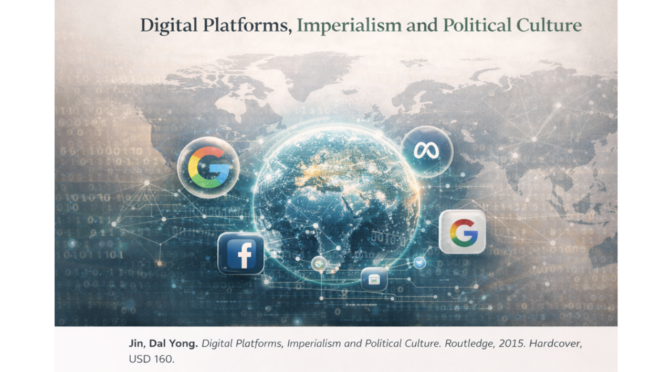
Book Review of Jin, Dal Yong. Digital Platforms, Imperialism and Political Culture. Routledge, 2015.
Price: $160 (Hardcover).
Have power relations taken a new form in the digital landscape? Dal Yong Jin’s Digital Platforms, Imperialism and Political Culture explores the contemporary dynamics of globalization and connectivity in the twenty-first century digital era. Jin offers a new framework to understand the cultural and economic imbalances of power among countries. He argues that platforms that appear to be mere facilitators of data flows, such as Netflix, Google, and others are in reality active participants in the creation of asymmetrical power hierarchies. The significance of the book lies in its theoretical intervention which challenges dominant approaches used to understand globalization. In essence, Jin demonstrates that digitalization, while accelerating globalization, simultaneously reproduces and reinforces existing power hierarchies.
By tracing the historical evolution of technological innovation, Jin demonstrates that digital technologies have not democratized the process of globalization. Instead, they have reproduced hegemonic structures and continued patterns of exploitation in a new form. In the contemporary world, information, algorithms, and data flows have become central to economic and political power. Therefore, Jin argues that a new conceptual framework is necessary to understand this emerging form of dominance in the digital age.
Jin’s central contribution is his theory of Platform Imperialism, which suggests that digital platforms such as Google, Netflix, Facebook, and similar companies have become key actors in the global political economy. Drawing on data analysis, case studies, and comparative research, Jin argues that platforms owned primarily by Western countries generate enormous commercial wealth by circulating the cultural content of various nations through their own digital infrastructures. In doing so, they accumulate economic benefits while simultaneously reinforcing existing North-South inequalities, thereby producing a new form of imperialism. What distinguishes Jin’s analysis is his attention to the mechanisms through which this new imperialism operates. Algorithmic biases, intellectual property regimes, data flows, and information and communication technologies function as subtle yet powerful instruments of hegemony. Data and code, he contends, have emerged as new sites of contestation, exercising a form of power that is particularly potent because of its opacity.
However, Jin’s framework avoids the technological determinism that often characterizes critical analyses of digital power. He acknowledges that economic strength does not automatically translate into technological dominance and that users themselves remain influential actors within the digital ecosystem. The book’s discussion of patent data is particularly illuminating in this regard. While the United States and other industrialized nations held nearly 97 percent of global patents in 1999, by 2011 the distribution had shifted considerably. Countries such as Japan (238,823 patents), the United States (224,505), China (172,113), and South Korea (94,720) had emerged as significant technological competitors. This empirical evidence allows Jin to argue that countries with strong cultural industries and advanced technological infrastructures- particularly Korea, Japan, and China- possess the capacity to compete with Western technological dominance. Consequently, the landscape of digital power is more complex than a simple narrative of unilateral Western control.
The book also makes an important theoretical contribution by reconsidering the relationship between state sovereignty and corporate power in the digital age. Jin argues that the apparent decline of nation-state sovereignty alongside the rise of transnational corporations should not be understood as a simple redistribution of power. Rather, these developments are themselves shaped by existing hegemonic structures. Decisions embedded within algorithmic systems and intellectual property regimes are not merely technological but deeply political. In this sense, the infrastructures that structure everyday digital life reflect particular economic interests and ideological orientations.
One of the book’s most compelling contributions is its analysis of labour exploitation through what Jin terms “user commodification.” Jin argues that individuals in the digital landscape are not merely passive consumers of foreign cultural content but active participants in its creation. Every search, like, share, and upload generates valuable data that platforms commodify for profit. This produces a form of invisible digital labour in which users create economic value without recognition or compensation. Crucially, because the platforms that facilitate and monetize this user-generated content are predominantly Western-owned—such as Google and Meta—the value generated by global users disproportionately strengthens the digital economies of Western nations. Jin therefore demonstrates how user participation, often celebrated as a form of democratization, simultaneously reinforces the global economic asymmetries that digital technologies were expected to overcome.
The subject matter of this book makes an important scholarly contribution to understanding the contemporary functioning of media, software power, and digital governance. It demonstrates that alongside pop culture, economic influence, and military strength, control over data and digital infrastructures has become a crucial component of global hegemony. Those who control digital platforms possess the ability not only to circulate information but also to shape cultural trends, influence public opinion, and structure economic flows across borders.
However, the book relies heavily on the dominance of United States–based platforms and focuses primarily on explaining digital imperialism through an American-centred framework. It pays comparatively less attention to the emerging technological capabilities of countries such as China, Japan, South Korea, and other Afro-Asian nations, which are increasingly developing their own digital infrastructures rather than relying solely on U.S.-based platforms. The book also gives limited attention to how developments such as data sovereignty laws, grassroots digital movements, or the creation of alternative platforms by non-Western countries might reshape these asymmetrical power relations. If countries such as China with platforms like TikTok and WeChat are simultaneously challenging and reproducing Western platform models, does the concept of platform imperialism require further theoretical refinement? Can the framework adequately explain a multipolar digital order, or does it remain largely tied to a U.S.-centric understanding of digital power? These questions open important avenues for further research that builds upon Jin’s foundational contribution.
Overall, Jin’s work provides a significant corrective to technological utopianism and equips scholars with a powerful conceptual vocabulary for analysing digital power asymmetries. While the book’s relatively narrow geographical focus may limit its scope, this limitation does not diminish its importance. Instead, it highlights the need for further scholarship that examines the evolving and increasingly complex landscape of digital power in the contemporary global order.
Sukriti Hazra
Intern, Asia in Global Affairs
The opinions expressed in this review are solely those of the author and do not necessarily represent the views or positions of Asia in Global Affairs (AGA) or any affiliated institutions.




Leave a Reply