Under the Dome: Environmental Activism, State Power, and the Politics of Visibility in Contemporary China
Posted on : March 18, 2026Author : Koushiki Sarkar
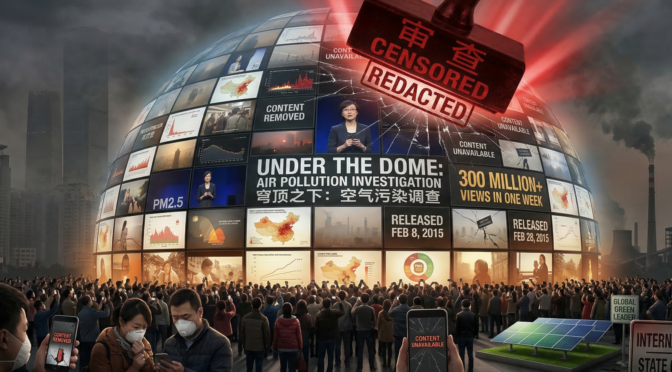
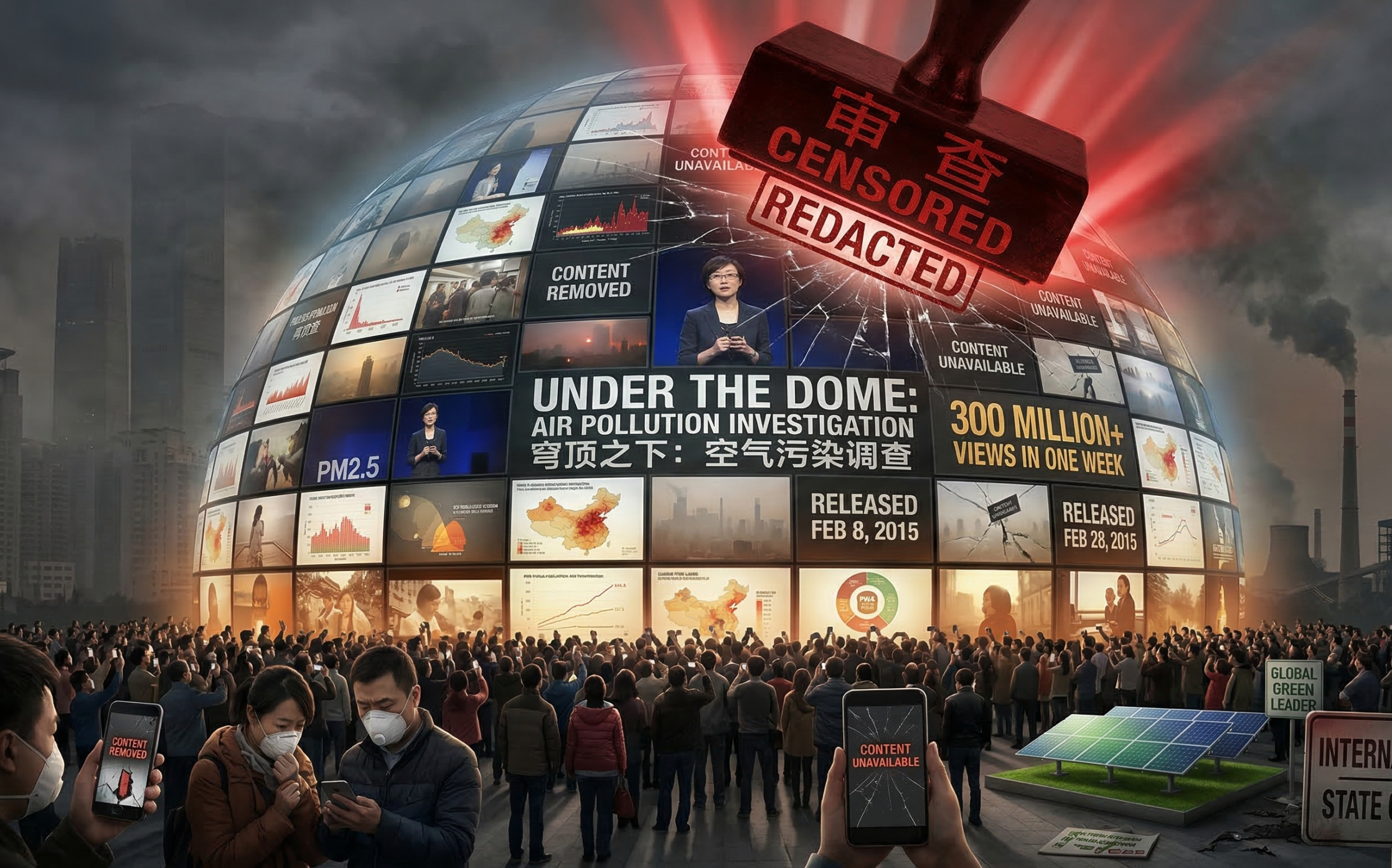
Documentary Title: Under the Dome: Investigating China’s Smog (穹顶之下)
Director/Narrator: Chai Jing
Country: China
Year: 2015
Runtime: 104 minutes
Chai Jing’s Under the Dome is a self-financed documentary that achieved unprecedented virality in China, garnering over 300 million views within a week of its release on February 28, 2015. The film represents a singular moment in contemporary Chinese civil society where environmental activism, personal narrative, and investigative journalism converged to create a national conversation about air pollution. However, its subsequent censorship within days of release reveals the complex interplay between environmental governance, state control, and grassroots mobilization in the People’s Republic of China. As China continues to position itself as a global leader in green technology and climate action while simultaneously managing internal environmental crises, this documentary provides crucial insights into the contradictions inherent in the Chinese model of development.
A Personal Investigation into Environmental Injustice
The documentary opens with Chai Jing’s deeply personal revelation that her daughter was born with a tumor, which Chai attributes to China’s severe air pollution. This narrative choice immediately grounds the film in the framework of intergenerational environmental justice, transforming abstract particulate matter data into a visceral maternal concern. Throughout the 104-minute film, Chai employs a TED-talk style presentation, standing before a live audience while utilizing multimedia elements including data visualizations, investigative footage from factory visits, and interviews with government officials, environmental experts, and ordinary citizens.
The film’s structure skillfully weaves together multiple documentary modes. It functions simultaneously as investigative journalism, personal memoir, public lecture, and call to action. Chai traces the sources of PM2.5 particulate pollution across China’s industrial landscape, visiting steel mills in Hebei province, examining coal-fired power plants, and confronting oil refineries about substandard fuel production. Her investigation reveals a systemic failure where China’s environmental laws exist on paper but lack enforcement mechanisms capable of challenging powerful state-owned enterprises.
Energy, Environment, and Development: The Chinese Dilemma
Under the Dome directly engages with one of Asia in Global Affairs’ key research areas: Energy, Environment and Development. The documentary exposes the paradox at the heart of China’s development model, where rapid economic growth has been achieved through environmental degradation that now threatens public health on a massive scale. Chai reports that 500,000 premature deaths annually are linked to air pollution, a figure that transforms environmental policy from an abstract concern into a public health emergency.
The film’s most damning revelations concern the entrenched interests protecting polluting industries. State-owned petroleum giants like China National Petroleum Corporation, PetroChina, and Sinopec set their own production standards, effectively regulating themselves. The Ministry of Environmental Protection, despite possessing legal authority, proves largely powerless against these economic behemoths. When Chai accompanies environmental inspectors to factories, the inspectors themselves admit that imposing meaningful penalties risks unemployment and economic disruption, revealing how environmental protection is subordinated to economic imperatives.
This dynamic reflects broader tensions across Asia between development and sustainability. Similar patterns emerge in India’s coal-dependent energy sector, Southeast Asia’s palm oil industries, and the region’s rapid but environmentally taxing urbanization. The documentary thus offers a case study with implications extending far beyond China’s borders.
Security, Democracy, and Governance: Censorship and Civil Society
The documentary’s reception history illuminates critical questions about governance and public participation in environmental policymaking. Initially, the film received remarkable official support. It was hosted on People’s Daily Online, the Chinese Communist Party’s flagship website, and newly appointed Environment Minister Chen Jining publicly praised it, comparing its potential impact to Rachel Carson’s Silent Spring. This suggests internal Party debates about environmental policy and recognition that public engagement might bolster reformist factions.
However, within one week, the Party’s propaganda department ordered the film’s complete removal from Chinese internet platforms. The rapid reversal from official endorsement to censorship reveals the state’s ambivalence toward grassroots environmental activism. While environmental awareness serves government objectives in transitioning toward cleaner energy, the documentary’s call for bottom-up citizen action—exemplified by Chai’s urging viewers to report polluters via hotline—represented a challenge to hierarchical governance structures.
The film’s final segment particularly troubled authorities. Chai advocates for individual responsibility, demonstrating how she convinced a restaurant to adopt cleaner equipment and encouraging viewers to report environmental violations. Her concluding statement captures this ethos of grassroots mobilization: “This is how history is made. With thousands of ordinary people one day saying, ‘No, I’m not satisfied, I don’t want to wait. I want to stand up and do a little something.'” This vision of citizen-driven change, however modest, conflicts with the Party’s insistence on maintaining exclusive authority over collective action.
Linkages and Legacies: Transnational Environmental Justice
Under the Dome demonstrates awareness of transnational environmental governance by comparing China’s situation to historical precedents in London and Los Angeles. Chai interviews officials from both cities about their successful air quality improvements, drawing parallels between 1950s London smog and contemporary Chinese pollution. These comparisons suggest that China’s environmental crisis is not unprecedented and that proven solutions exist, provided political will can overcome entrenched economic interests.
Yet the documentary also reveals the limitations of transplanting Western environmental governance models to the Chinese context. London’s Clean Air Act of 1956 and Los Angeles’ strict vehicle emission standards operated within democratic systems where public pressure could force regulatory action. China’s authoritarian structure theoretically enables rapid policy implementation but in practice creates powerful vested interests insulated from accountability.
The film’s global resonance extends beyond its Chinese context. Environmental documentary scholar Shuqin Cui argues that Under the Dome presents an unprecedented model of multimedia documentary activism in the digital age. Its virality demonstrated how digital networks can temporarily circumvent state media controls, creating space for public dialogue on issues the Party considers sensitive. This has implications for environmental movements throughout Asia, where many governments similarly balance development imperatives against growing public environmental consciousness.
Critical Reflections: Representation and Reform
Despite its strengths, Under the Dome exhibits certain limitations. The documentary’s heavy emphasis on personal narrative and middle-class concerns about children’s health risks obscuring the disproportionate environmental burdens borne by working-class communities and rural populations. Factory workers suffering occupational exposure to pollutants receive minimal screen time compared to Chai’s personal story, potentially reinforcing class hierarchies in environmental discourse.
Additionally, while the film criticizes state-owned enterprises and regulatory failures, it ultimately frames solutions in terms of consumer responsibility and individual action rather than structural transformation. This aligns with neoliberal environmental governance that emphasizes personal choice over systemic change, potentially depoliticizing what is fundamentally a question of political economy and power.
The documentary’s censorship also raises ethical questions about the politics of visibility. The film’s brief moment of virality created awareness but no sustained institutional change. President Xi Jinping subsequently pledged carbon neutrality by 2060, yet China has continued building coal-fired power stations. This gap between rhetorical commitment and policy reality suggests that viral media moments, however powerful, cannot substitute for sustained political organizing and institutional reform.
Conclusion: The Dome and Beyond
Under the Dome remains a landmark in Asian environmental documentary, demonstrating both the potential and limitations of media activism under authoritarianism. For scholars and practitioners engaged with Asia in Global Affairs’ research framework, the film offers vital insights into the tensions between economic development, environmental sustainability, and political participation that define contemporary Asia. As climate change intensifies and environmental crises proliferate across the region, understanding these dynamics becomes increasingly urgent.
The documentary’s legacy endures in China’s subsequent environmental policies and growing middle-class environmental consciousness, even as the film itself remains censored. Its story reminds us that environmental governance cannot be separated from questions of democracy, transparency, and social justice. For Asia to achieve sustainable development, it must address not only technical questions of pollution control but fundamental issues of power, accountability, and who has the right to breathe clean air.
REFERENCES
Chai, J. (Director). (2015). Under the dome: Investigating China’s smog [Documentary film]. Self-financed.
Cui, S. (2018). Documentary film in China. Edinburgh University Press.
Carson, R. (1962). Silent spring. Houghton Mifflin.
Koushiki Sarkar
Intern, Asia in Global Affairs
The views and opinions expressed in this review are those of the author and do not necessarily reflect the official policy or position of Asia in Global Affairs. The review is intended for academic and informational purposes only. It is not an endorsement of any particular viewpoint, nor is it intended to malign any individual, group, organization, company, or government

Leave a Reply