Is India’s Foreign Policy 2,000 Years Old? A Critical Review of Pande’s From Chanakya to Modi
Posted on : March 26, 2026Author : Abhradeep Shill
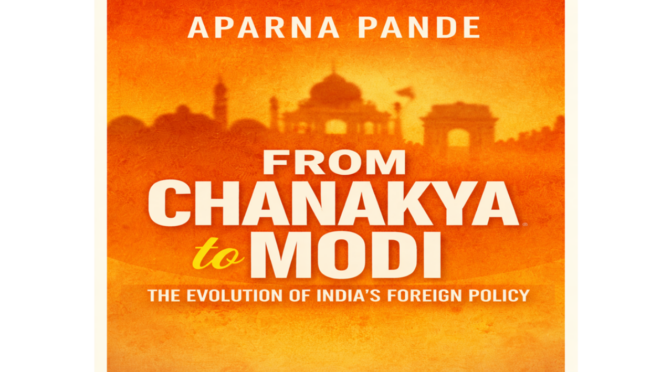
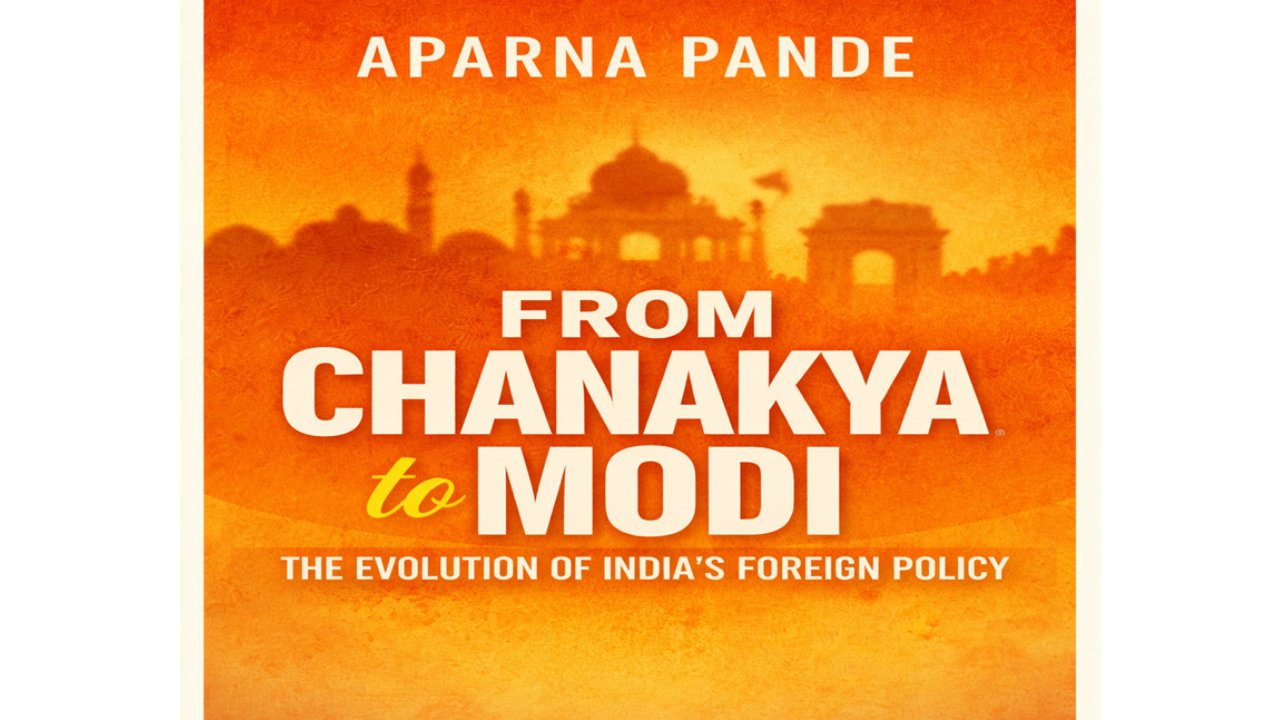
Aparna Pande. From Chanakya to Modi: The Evolution of India’s Foreign Policy.
New Delhi: HarperCollins India, 2017.
Is India’s contemporary foreign policy, from its balancing act between great powers to its nuclear posture, a direct inheritance of strategic concepts drafted two millennia ago? Or are these merely convenient rhetorical cloaks for decisions driven by modern material realities? This is the central question provoked by Aparna Pande’s ‘From Chanakya to Modi: The Evolution of India’s Foreign Policy’ (HarperCollins, 2017). Written as the Modi government’s energetic personal diplomacy suggested possible departures from established norms, the book makes a bold intervention. It argues that India’s global engagement is best understood not through post-colonial adaptation or Cold War exigencies, but as the expression of a civilizational strategic culture with roots in the ancient text, the Arthashastra. This review argues that Pande’s framework valuably corrects accounts overemphasizing Western influence, but that her thesis of civilizational continuity ultimately overstates ideational
persistence while neglecting the political economy, institutional constraints, and material interests that critically mediate between ancient ideas and modern policy.
Pande’s organizing argument rests on two key concepts. The first is strategic autonomy: the consistent impulse to resist binding alliances and maintain independent decision-making, manifest from Chanakya’s circle-of-states theory through Nehru’s non-alignment to Modi’s multi-alignment. The second is the identification of four competing traditions shaping India’s worldview: messianic idealism, realism (derived from Chanakya’s principles of saam, daam, dand, bhed), isolationism, and the legacy of British imperial statecraft. Drawing explicitly on the Arthashastra’s six methods of diplomacy, Pande provides a pre-colonial vocabulary for analysing Indian behaviour, reading Modi’s outreach to multiple powers as the ancient tactic of dual policy (dvaidhibhava) or strategic restraint in the face of Chinese provocation as inaction (asana). Her key methodological claim is that foreign policy does not exist in a “cultural vacuum,” and India requires its own analytical lens rather than wholesale application of Western IR theory.
The framework is most illuminating when applied to the longue-durée of Indian strategic thinking. Pande’s account of how colonialism shaped the assumptions of India’s founding generation is nuanced, showing that Nehru’s idealism was not merely derivative of Western liberalism but was refracted through a civilizational pride that positioned India as a unique moral actor. This reading explains the paradox of Nehru’s non-alignment and his active global mediation as flowing from a conception of India as a civilizational state. The book also provides a compelling account of how the four traditions have oscillated across prime ministerships—from Nehru’s idealism to Indira Gandhi’s realism, the Gujral Doctrine’s pragmatism, and Vajpayee’s nuclear assertiveness. Most valuable is her treatment of strategic autonomy as a master concept, explaining India’s resistance to binding commitments not as indecision but a consistent preference for maximum strategic flexibility, from Cold War non-alignment to simultaneous engagement with the Quad and the Shanghai Cooperation Organisation.
For all its analytical ambition, the book exhibits significant gaps. The most serious is its treatment of political economy. Pande’s framework operates almost entirely at the level of elite ideas, with minimal attention to the material interests shaping policy. The business community, trade flows, and energy security concerns are largely absent. This omission is particularly glaring when she addresses the Modi period. She presents his foreign policy as a civilizational expression without adequately examining how domestic economic change is reshaping its content. Why has a government so invested in civilizational rhetoric also pursued aggressive economic liberalisation and courting of foreign investment? The answer likely lies in the 1991 balance-of-payments crisis and the subsequent reforms, which fundamentally altered the incentive structure for Indian policymakers, creating powerful domestic constituencies with a stake in global integration—a material shift her ideational framework cannot fully capture.
A second absence is the role of institutions. Pande notes a “preference for individuals over institutions” but does not develop this insight. The Ministry of External Affairs, the Prime Minister’s Office, and intelligence agencies have their own cultures and bureaucratic interests that shape how strategic ideas translate into policy. Furthermore, the book’s treatment of history is selective, jumping from ancient India to the colonial encounter with barely a nod to the millennium of Islamic sultanates and Mughal rule. This omission allows a more seamless continuity narrative than the historical record warrants. Finally, Pande assumes contemporary policymakers are shaped by the Arthashastra without establishing the mechanisms of transmission. Are Modi or his predecessors consciously drawing on Chanakyan categories, or are we seeing a diffuse strategic culture? The distinction matters for understanding continuity and change.
Pande’s thesis can be further tested against specific policy domains. Consider India’s response to China’s rise. Pande reads this through Chanakyan categories: China as the proximate enemy, the US as a natural ally. But this reading, while not wrong, is flattened. It cannot fully explain why India’s approach has oscillated between competition and cooperation in ways that track domestic political cycles. The sharp deterioration of relations with China after the 2020 Galwan clashes, and the subsequent deepening of the Quad, was not simply a timeless expression of “dual policy.” It was a specific response to the material reality of Chinese military aggression, the structural logic of the US-China rivalry, and the domestic political benefits for the Modi government of projecting strength. The civilizational framework, emphasising persistent themes, is ill-equipped to explain such a sharp, context-driven inflection point.
‘From Chanakya to Modi’ succeeds as an intervention, challenging analysts to take civilizational dimensions seriously. Its framework of strategic autonomy provides a useful vocabulary for identifying patterns. Yet its limitations point toward questions for future research. First, how do changes in India’s political economy—the rise of corporate power, integration into global supply chains—reshape the interests that foreign policy serves? Second, what is the role of institutions like the MEA in mediating between ideas and outcomes? Third, how does the structure of the international system—bipolar, unipolar, or multipolar—interact with India’s strategic culture? Strategic autonomy in the Cold War meant something different from today’s multipolar order.
Pande’s book, for all its ambition, opens rather than closes a research agenda. Its civilizational framework illuminates important ideational continuities but cannot substitute for analysing the material interests, institutional dynamics, and systemic pressures that shape how those continuities are expressed. The evolution of India’s foreign policy from Chanakya to Modi is a story that requires multiple registers of analysis—ideational, material, institutional, and systemic—working in combination. Pande has made a valuable contribution to one of these registers; the others await their chroniclers.
Abhradeep Shill
Intern
Asia in Global Affairs
Disclaimer:
The views expressed in this review are those of the author and do not necessarily reflect the position of Asia in Global Affairs.

Leave a Reply