Performing Globality in an Age of Geopolitical Fragmentation Dubai, Diaspora, and the Politics of Connectivity
Posted on : May 28, 2026Author : Priya Singh
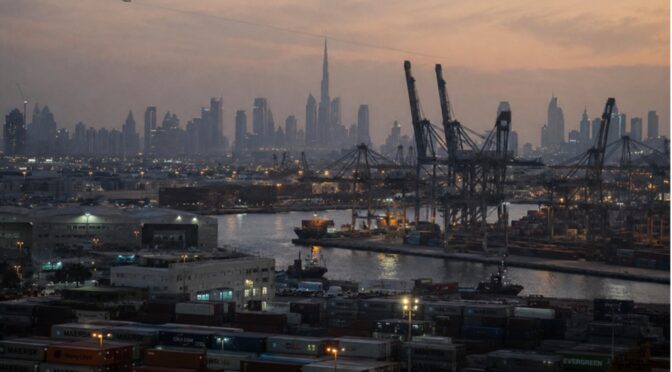
The renewed instability across the Gulf, marked by the U.S.–Israeli confrontation with Iran, anxieties surrounding the Strait of Hormuz, disruptions to maritime movement, and turbulence in global energy and financial markets, has once again exposed the intimate relationship between geopolitics and the global city. Far from being insulated economic spaces, global cities remain deeply entangled within regional infrastructures of power, mobility, and strategic interdependence. Yet the significance of this moment extends beyond questions of regional instability alone. It compels a reconsideration of the global city itself, not merely as an economic formation, but as a geopolitical, infrastructural, and geocultural project through which contemporary power is organized, performed, and circulated.
Dubai occupies a particularly distinctive position within this transformation. Much of the literature on global cities, particularly following the work of Saskia Sassen, examined cities as command centres of advanced capitalism: sites where finance, producer services, and transnational coordination became concentrated under conditions of globalization. Yet Dubai complicates this framework in important ways. Unlike older Atlantic global cities shaped through industrial capitalism or imperial finance, Dubai emerged through logistics, mediation, and strategic connectivity. Its rise was not built upon manufacturing depth or democratic institutional consolidation, but upon circulation itself.
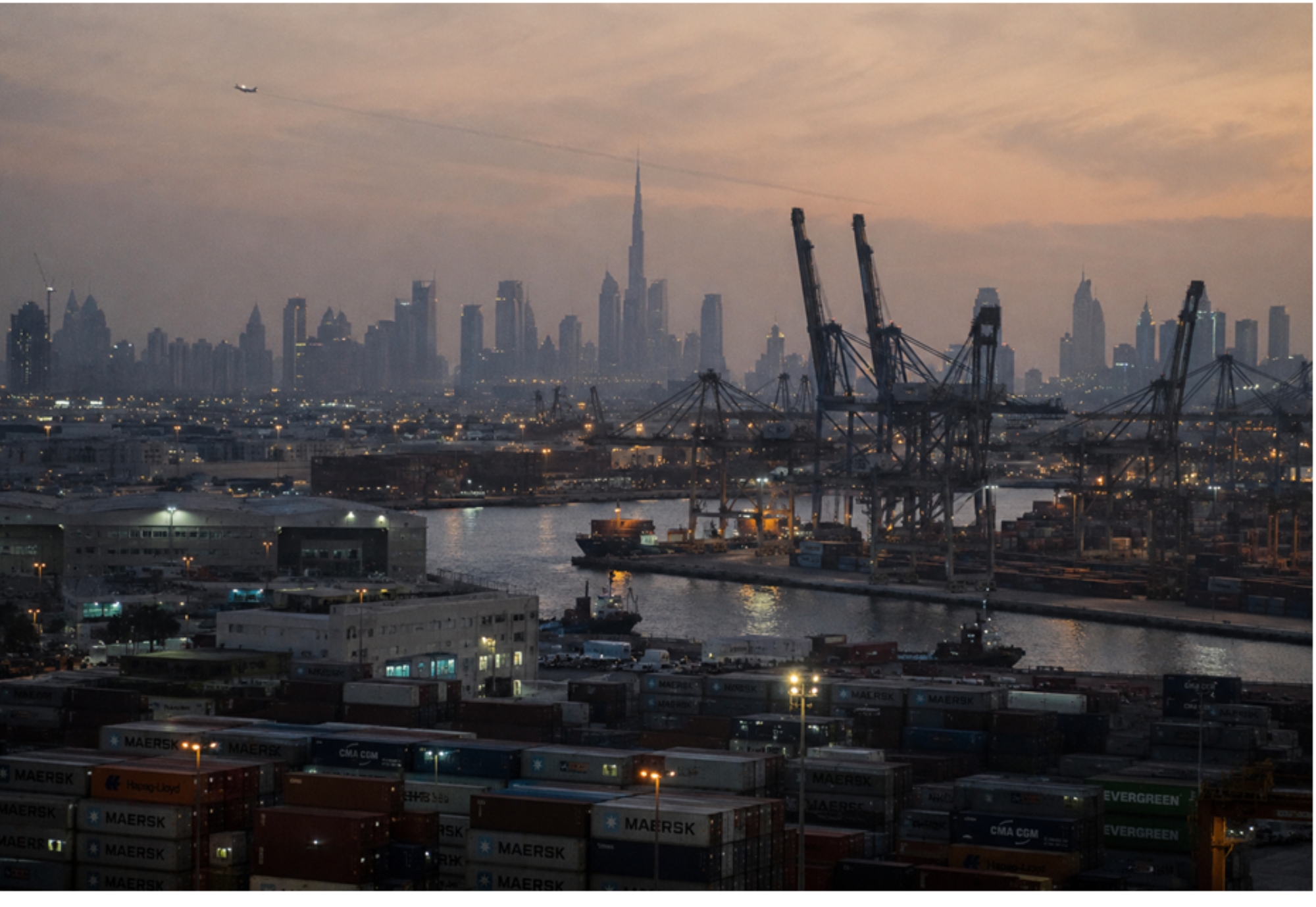
The city’s power lies in its ability to organize movement across multiple scales. Jebel Ali Port, Emirates Airlines, the Dubai International Financial Centre, free economic zones, digital infrastructures, luxury real estate, and tourism economies collectively transformed Dubai into an intermediary urban formation linking Asia, Africa, Europe, and the Gulf. It is less a conventional metropolis than an infrastructural hinge within global capitalism.
At one level, Dubai represents the triumph of hyper-connectivity. Yet the present Gulf crisis exposes the fragility embedded within that very condition. Global cities depend upon uninterrupted circulation: shipping routes, aviation corridors, financial transfers, digital systems, energy flows, and migrant labour mobility. When maritime insecurity emerges around Hormuz or regional airspaces become vulnerable to military escalation, the consequences are felt immediately across these urban mobility infrastructures. Conflict today does not merely threaten territory; it threatens connectivity itself.
Cowen (2014) argues that contemporary logistics systems increasingly function as strategic infrastructures through which global circulation, security, and geopolitical power are organized. During periods of heightened tension in the Gulf, commercial airlines operating through Emirati airspace have rerouted flights, while maritime insurance premiums and shipping costs have fluctuated sharply, revealing the dependence of global urban economies upon vulnerable geopolitical corridors (Reuters, 2025).
This is why the present moment requires a closer integration of global city theory with contemporary geopolitical analysis. Classical geopolitics emphasized territorial control, military reach, and strategic geography. Contemporary geopolitical power increasingly operates through infrastructures of movement. Ports, logistics corridors, free zones, insurance systems, undersea cables, aviation routes, and financial jurisdictions have become central instruments through which states and urban regimes secure strategic relevance.
The present moment also signals a wider spatial reorganization of geopolitical power. Earlier geopolitical frameworks privileged the nation-state, territorial sovereignty, and regional blocs as the principal scales through which power was imagined and exercised. Contemporary globalization has not eliminated these formations, but it has increasingly displaced strategic significance toward cities, infrastructures, logistical corridors, and financial networks that operate across and beyond territorial borders. As Neil Brenner (2004) argues in his discussion of the rescaling of statehood, contemporary capitalism has reorganized political and economic power across new spatial configurations in which urban regions and infrastructural networks increasingly emerge as strategic sites of governance and accumulation. The global city emerges within this transition as a critical spatial form of late capitalism. Dubai is exemplary precisely because it reveals how contemporary geopolitics is increasingly mediated through urban infrastructures of connectivity rather than territory alone.
Dubai exemplifies this shift with unusual intensity. Its geopolitical importance lies not in territorial scale or military capacity, but in its ability to stabilize connectivity within an unstable region. The city functions as a mediator between regional volatility and global mobility. It absorbs uncertainty while simultaneously converting uncertainty into strategic opportunity. In other words, Dubai suggests that contemporary global urbanism may no longer be adequately understood through earlier frameworks centred primarily upon finance and producer services. Instead, strategic connectivity, infrastructural mediation, and geopolitical circulation increasingly constitute the foundations of global urban power.
Yet Dubai is not only an infrastructural space. It is also a profoundly performative one. The city continuously stages itself as global. Its skylines, malls, waterfront developments, museums, luxury districts, platform-mediated visibility, branded futurism, and spectacular architecture produce an urban imaginary of frictionless cosmopolitanism. Dubai does not simply participate in globalization; it performs globality. These performances circulate globally through digital media, branding infrastructures, and platform visibility. In contemporary global urbanism, geocultural projection increasingly becomes inseparable from geopolitical strategy.
This performativity is central to its geopolitical function. The city projects order amidst regional fragmentation, mobility amidst border anxieties, and visions of the future amidst geopolitical crisis. In this sense, Dubai operates not only economically but symbolically. It produces an image of seamless global integration even as the wider region remains marked by conflict, sanctions, displacement, and infrastructural vulnerability.
The geocultural dimension of the global city therefore becomes critical. Contemporary global cities are not merely command centres of finance; they are spaces where power is aestheticized and narrated. Drawing on Harvey’s discussion of postmodern urbanism and the cultural logic of late capitalism, spectacle, image, and symbolic consumption may be understood as central to the production of contemporary global urban power.Dubai’s urbanism depends upon carefully curated visibility. The spectacle of verticality, luxury, efficiency, and cosmopolitan openness positions the city as indispensable within global networks of capital and mobility.
At the same time, this urban order remains deeply uneven. The global city’s openness is highly selective. Capital circulates with relative ease, while labour remains stratified through differentiated regimes of mobility and belonging. Dubai’s infrastructure of globality continues to depend fundamentally upon migrant labour and diasporic populations from South Asia, Southeast Asia, Africa, and elsewhere, many of whom sustain the city’s logistical, construction, and service economies while remaining politically peripheral to formal structures of citizenship and representation. Scholars of Gulf migration have noted that such forms of urban cosmopolitanism frequently operate through differentiated systems of mobility in which expatriate and migrant populations sustain economic circulation while remaining structurally excluded from long-term political incorporation and substantive citizenship (Vora, 2013; Lori, 2019).
The diasporic question is therefore central rather than incidental to Dubai’s globality. The city is not simply inhabited by diasporas; it is constituted through them. South Asian merchant communities, migrant workers, financial professionals, service-sector labour, and transnational expatriate populations collectively produce the social architecture of the city. Dubai’s cosmopolitanism emerges less from liberal multiculturalism than from managed transience. It is a city organized through movement rather than settlement.
This distinction is crucial. The global city often presents itself as post-national, yet Dubai reveals how global urbanism can coexist with tightly regulated forms of political belonging. Mobility is encouraged, but permanence remains constrained. As Wachsmuth (2014) argues, contemporary urbanization increasingly exceeds the traditional bounded form of the city, even as the ideological and conceptual power of the city itself remains remarkably persistent.Cosmopolitanism is embraced economically while citizenship remains carefully delimited. The city’s apparent openness therefore conceals a highly managed urban order structured through hierarchy, temporariness, and differentiated access to belonging.
The work of Neil Brenner becomes particularly useful here. In his work on planetary urbanization (Brenner, 2014), Brenner challenges the assumption that urbanization is confined to bounded metropolitan space. Instead, urbanization increasingly unfolds through extended infrastructural systems linking logistics, extraction, finance, circulation, and governance across transnational geographies. Dubai is exemplary of this broader infrastructural condition. It is not merely a city in the Gulf; it is part of an expansive infrastructural geography connecting ports, shipping routes, energy systems, investment networks, labour corridors, and speculative real estate circuits across continents.
Equally significant is Keller Easterling’s (2014) conception of infrastructure space. Dubai’s authority does not derive solely from state sovereignty or monumental architecture. It emerges through protocols, zones, logistical systems, financial regulations, and urban arrangements that shape movement before politics appears in its formal diplomatic form. Infrastructure itself becomes political.
The present Gulf escalation therefore reveals more than regional instability. It exposes the contradictions embedded within globalization itself. For decades, globalization was imagined as a force that would gradually diminish geopolitical antagonism through economic integration and interdependence. Instead, contemporary global cities increasingly function as terrains through which geopolitical competition is reorganized. Infrastructure, logistics, and connectivity have themselves become geopolitical objects.
Dubai illustrates this transformation with remarkable clarity. The city embodies a world in which extraordinary integration coexists with profound insecurity; where mobility depends upon militarized corridors; where cosmopolitan spectacle coexists with precarious labour; and where the performance of stability becomes inseparable from the management of permanent uncertainty.
The global city, in this sense, can no longer be understood simply as a command centre of capitalism. It has become a geopolitical form. Dubai reveals a world in which the management of circulation has become as geopolitically consequential as the control of territory itself.
Priya Singh
Associate Director
Asia in Global Affairs
References
Brenner, N. (Ed.). (2014). Implosions/explosions: Towards a study of planetary urbanization. Jovis.
Brenner, N. (2004). New state spaces: Urban governance and the rescaling of statehood. Oxford University Press.
Cowen, D. (2014). The deadly life of logistics: Mapping violence in global trade. University of Minnesota Press.
Easterling, K. (2014). Extrastatecraft: The power of infrastructure space. Verso.
Harvey, D. (1989). The condition of postmodernity: An enquiry into the origins of cultural change. Blackwell.
Lori, N. (2019). Offshore citizens: Permanent temporary status in the Gulf. Cambridge University Press.
Reuters. (2025, June 26). Gulf shipping costs drop as Israel-Iran ceasefire holds. Reuters. https://www.reuters.com/business/energy/gulf-shipping-costs-drop-israel-iran-ceasefire-holds-2025-06-26/
Sassen, S. (2001). The global city: New York, London, Tokyo (2nd ed.). Princeton University Press.
Vora, N. (2013). Impossible citizens: Dubai’s Indian diaspora. Duke University Press.
Wachsmuth, D. (2014). City as ideology: Reconciling the explosion of the city form with the tenacity of the city concept. Environment and Planning D: Society and Space, 32(1), 75–90. https://doi.org/10.1068/d21911
Disclaimer
The arguments and opinions expressed here are solely those of the author and do not necessarily represent the views of Asia in Global Affairs. The image used is digitally created for illustrative purposes to avoid copyright restrictions.


Leave a Reply