Women as Climate Crusaders: Unravelling the Gendered Impacts of Climate Change on Women’s Lives in Sundarbans
Posted on : April 21, 2025Author : Lahari Bandyopadhyay
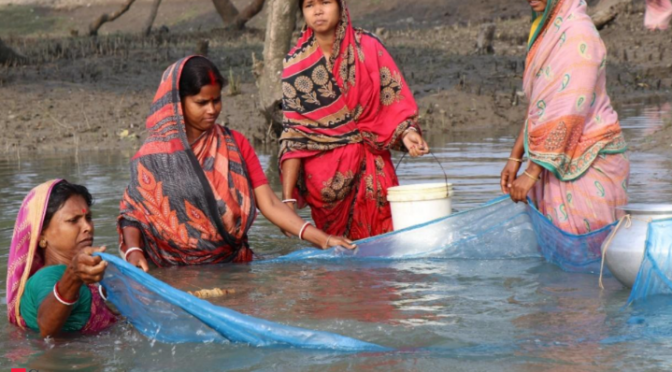
The Sundarbans, the world’s largest delta with its vast mangrove forest and unique ecosystem that spans over India and Bangladesh, has been enlisted as the UNESCO World Heritage Site in 1987. The extensive mangroves, besides being the home to rich flora and fauna, play a crucial role in protecting the coastal ecosystem from cyclones and erosions. This vital region, however, has seen casualties due to the effects of global warming and climate change. Increasing cyclones, raising sea levels, salinization of the land and ecological degradation has put immense pressure and has caused existential threat to the communities that depend upon it to sustain their livelihood. The entire region supports around 4.3 million people. Amidst all the problems faced by the people in general, women endured some major issues and have also demonstrated extreme resilience in securing the lives of their communities.
Economy and Livelihood
Women in Sundarbans are engaged in miscellaneous activities to sustain livelihood. They engage in activities like fishing, agriculture, honey collection, etc. Another activity in which they are actively involved is the mangrove restoration in which they run mangrove nurseries and cooperatives to produce and markets mangrove products like honey, beeswax, shrimp, golpata, keora fruit etc. Traditional crafts including intricately woven mats, baskets, fishing nets etc. are also mostly done by women. In addition to it, they also get involved in patrolling protected areas, training harvesting methods etc. The burden and responsibilities accelerate with climate change and they reach a peak during and after natural disasters. The entire delta has been very vulnerable to cyclones that destroys livelihoods, farmlands and basic needs of life. Salinization of the soil due to severe cyclonic storms and tidal wave actions, which carries water from the Bay of Bengal back to the delta, has posed threat to agricultural lands making them infertile and this in turn has threatened the economy of the place.
According to the West Bengal State Action Plan on Climate Change, the sea level in the Sundarbans area has been increasing by about 1.4 mm per year for the last several decades, which is responsible for its rising salinity. More or less, everyone is harmed due to this. However, taking into account the fact that women are primary caregivers as well as contributors to income of the family somewhat equal to men in the region, these challenges distinctly affect women both in short and long term. Now it is also important to understand what led these women get involved in the economic activities in the region and why is the socio-economic pattern working in case of women in Sundarbans different from that of women in other regions. Increased male migration pushed women into workspace, and that is the point to question whether the work is taken up voluntarily by them, like women in other parts of the country, or are they compelled to do so. The migration of the male counterparts, within the country or overseas, gets amplified as the region face cyclone strikes, tidal surge, embankment breaching etc. The women, who belong mostly to marginalised communities, bear the burden of climate change. By working at home and negotiating with the outside world, they gain the confidence to becoming the bread-winner for the family in the absence of their husbands. Therefore, our intention is to determine whether their involvement has actually empowered them, or they have encountered more challenges, or if the social fabric has changed only superficially.
Climate Change and its Impacts on Women’s Health
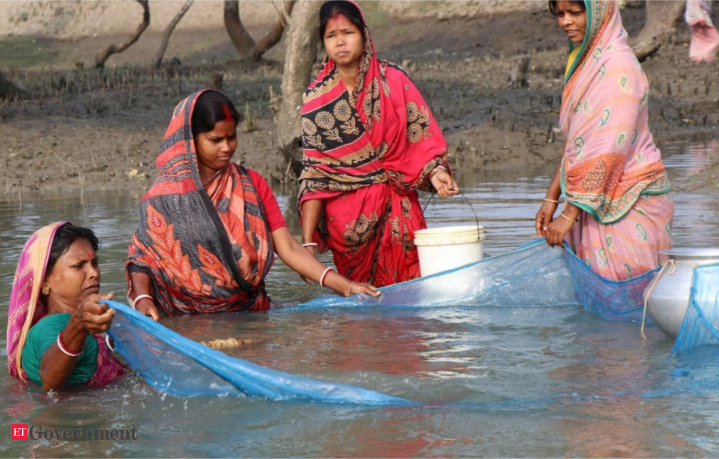
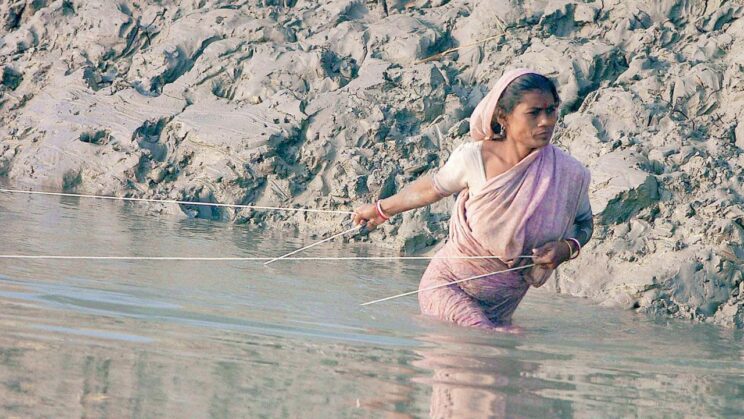
In the entire Sundarbans, getting access to fresh water is a struggle. Groundwater is the only source of fresh water, that too faces stress due to irrigation demands. Hence, public health crisis is triggered as a result of this coupled by limited healthcare access and food insecurity. Data from the rural hospitals highlights that most people, majority of whom are women, visit the hospital due to stomach ailments, dermatological issues such as eczema and infected sores, UTIs and reproductive health issues due to usage of unclean water with high salinity. Increased salinity, however, has also led to brackish water shrimp farming on a commercial scale. Prawn seed collection is a low-paying job that requires women to stand in seawater for up to six hours, and has a very negative impact on their health including skin and bones. One of the lesser-known impacts of climate change is on the menstrual health of women and it is due to following traditions of using pond water for bathing which is getting highly saline and contaminated with time. According to an action-research conducted by SaciWATERs, 77% of the 400 women interviewed reported suffering from menstrual and reproductive health issues such as increasing cases of leukorrhea, irregular bleeding, pelvic inflammation, miscarriages, cysts and endometriosis. A lot of women who come for delivery are often affected by genital infections that increases the risk of infection for the unborn baby. Two villages each from Gosaba and Pathar Pratima block in South 24 Parganas were selected for this research which included finding solutions to menstrual and reproductive health risks induced by climate change. But for those affected by these, lack of hygienic practices and advanced diagnostic facilities makes treatment challenging. According to a survey conducted by Women for Development, 70% of the women in the Sundarbans region use very traditional and unhygienic means during menstruation because poverty is so high that it is not possible for them to afford sanitary products. Moreover, majority of the women do not report these health issues due to the taboos and misconceptions associated with it.
Sustainable Practices for Subsistence
Multiple climate- resilient techniques have been adopted to support sustainable agriculture in the regions of fresh water shortage. This would not only make subsistence activities a lot easier, but also would be more economical.
- Residents of some parts of Sundarbans, especially women, form self-help groups and are using the technique of rainwater harvesting to combat groundwater salinity and improve agricultural productivity. This is a climate resilient technique would also help convert single land crop to multi crop land by storing rainwater in dig up ponds and improve water retention, enhance soil moisturizer and support sustainable agriculture.
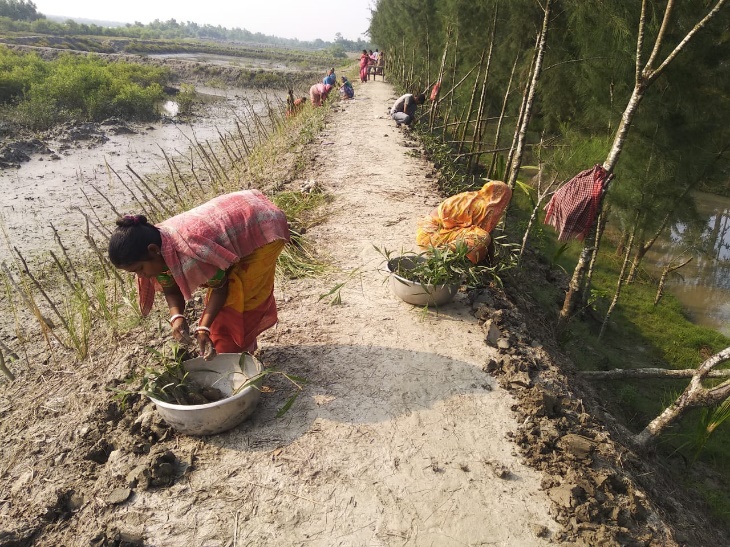
- Cyclones push river water into the agricultural land and fisheries. Hence, river bank protection plays a major role in supporting local livelihoods. To protect the banks, the women plant Khus grass (Vetiver) as it effectively prevents soil erosion. They have learned innovative techniques of vetiver plantations using bamboo struts and coir mats.
3) Another important climate change adaptation in the area is the Salinity-resistant paddy farming with paddy varieties like ‘Hamilton’ and practising vegetable farming on raised beds. It is becoming increasingly popular since past few decades.
The West Bengal government has also launched some schemes in order to ease the burden on women. A project called Jal Swapno has been started to improve water infrastructure so that increasing salinity and problems associated with it can be dealt with. NGOs like Health Bridge Foundation conducts health education workshops and distributes sanitary items specially for women.
The climate crisis is a multifaceted problem for the women. Hence, as Malala Yusufzai quoted, “We cannot all succeed when half of us are held back”; by prioritising the needs and voices of women in Sundarbans, inclusive solutions to the climate crisis can be created more effectively.
REFERENCES
- Self help group women implementing rainwater harvesting in Sundarbans area to counter salinity. (2025). The Economic Times. https://economictimes.indiatimes.com/news/india/self-help-group-women-implementing-rainwater-harvesting-in-sundarbans-area-to-counter-salinity/articleshow/118579372.cms
- Srinivasan, P. (2024). The Sundarbans dilemma: Islands swallowed by water, and nowhere else to go. Aljazeera. https://www.aljazeera.com/features/2024/1/27/the-sundarbans-dilemma-islands-swallowed-by-water-and-nowhere-else-to-go
- Rahman, Y. (2024). Women led climate change adaptation in the Sundarbans. Village Square. https://www.linkedin.com/pulse/women-lead-climate-change-adaptation-sundarbans-villagesquare-thqtf/
- Roy Chowdhury, B. (2025). Women as climate warriors: Livelihood and resilience in the rural Sundarban delta. SAIARD Chronicles. https://www.linkedin.com/pulse/women-climate-warriors-livelihood-resilience-rural-sundarban-rsigst-dxucc/
- (2024). How climate change-induced salinity effects the menstrual health of sundarban women. Youth ki Awaaz. https://www.youthkiawaaz.com/2024/09/climate-change-induced-salinity-leads-40-of-menstruation-issues/
- Chourey, J. (2024). Sundarbans: Climate change, water and women’s health in a globally critical ecosystem. ET Government. https://government.economictimes.indiatimes.com/blog/sundarbans-climate-change-water-and-womens-health-in-a-globally-critical-ecosystem/110549054
Lahari Bandyopadhyay
Intern, Asia in Global Affairs
The views and opinions expressed in this book review are those of the author and do not necessarily reflect the official policy or position of Asia in Global Affairs. The review is intended for academic and informational purposes only. It is not an endorsement of any particular viewpoint, nor is it intended to malign any individual, group, organization, company, or government


Leave a Reply